English


What Should a Top Wind Jack Manufacturer Confirm Before You Order?
Choose a top wind jack manufacturer that can connect your application requirements to a specific product drawing, an agreed inspection plan, and a clearly identified production configuration. Start with the load at the jack location, then confirm installation dimensions and operating space before discussing finishes or packaging. For an OEM buyer, the objective is not simply to purchase a jack that looks suitable; it is to approve a specification that engineering, purchasing, and receiving inspection can use consistently. ZTL’s trailer jack product range includes both top-wind and side-wind options, providing a starting point for a model-specific review rather than a substitute for one.
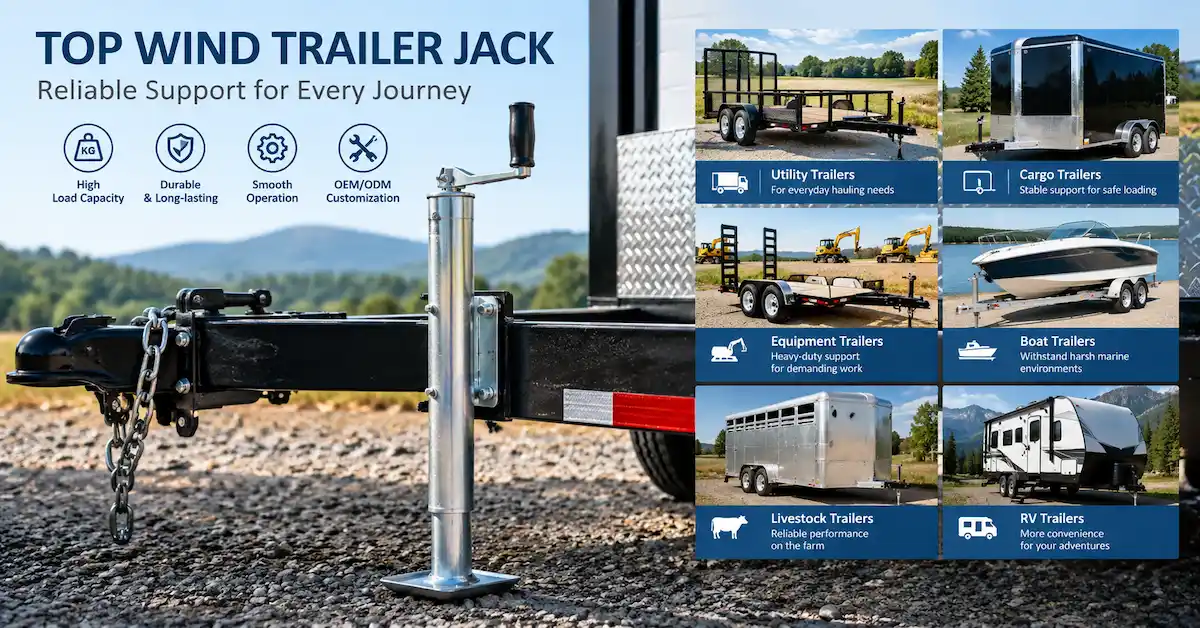
Match the Top-Wind Layout to the Trailer and the Buyer
A top-wind trailer jack is operated through a crank at the top of the unit. Consider this layout where the operator has unobstructed access above the jack; a side-wind configuration deserves consideration when that upper space is restricted. Utility-trailer builders should review the drawbar and nearby accessories, while equipment-trailer OEMs should also define the supported load and operating frequency. Distributors need clear replacement dimensions, and private-label buyers need consistent product identification across cartons, instructions, and purchase orders. These are different approval priorities, even when buyers begin with the same catalogue model. The top-wind versus side-wind selection guide provides further layout context. Do not approve a top-wind configuration where the complete crank movement or safe operator access remains obstructed.
Clarify Capacity Before Comparing Models
Ask your top wind jack manufacturer what the quoted capacity means and under which conditions it applies. The relevant application input is the maximum supported load at the jack point, not the trailer’s gross weight alone. Record lifting capacity and static support capacity separately wherever the manufacturer specifies both; neither should be inferred from the other. Also identify the mounting arrangement, operating extension, loading conditions, and intended frequency of use for engineering review. A request stating only “7,000 lb jack” leaves important questions unanswered. Treat the catalogue designation as a starting point, then obtain the selected model’s rating definition and instructions. Final suitability must account for the trailer structure and intended operation, not just the number printed beside the product name. A jack rating also does not authorize work beneath an inadequately supported trailer; follow the product instructions and the applicable safe-support procedures.
Prepare a Model-Specific Specification Sheet
Before requesting comparable quotations, give each top wind jack manufacturer the same requirement sheet. The following worksheet separates the information you provide from the details the supplier must confirm. It is a procurement template, not a universal specification for all ZTL products; numerical values should come from your application assessment and the selected model’s approved drawing.
| Specification item | Information to confirm | Approval purpose |
|---|---|---|
| Application and load | Trailer type, maximum load at the jack point, intended operation | Establish the design requirement |
| Capacity definition | Published rating, lifting/static distinction, applicable conditions | Avoid comparing unlike ratings |
| Mounting interface | Mounting method, hole positions, bracket dimensions, reference surfaces | Confirm installation compatibility |
| Height and travel | Retracted and extended dimensions, screw travel, drop-leg adjustment if fitted | Match coupling and storage positions |
| Crank operating space | Handle dimensions, full turning path, operator hand clearance | Check access and interference |
| Materials and components | Model-specific materials, tube dimensions, drive and retention components | Define the supplied construction |
| Surface protection | Finish by component, appearance limits, required verification | Match the specified exposure |
| Inspection and documentation | Drawing revision, acceptance criteria, sampling, required records | Make sample and batch approval consistent |
| Marking and packaging | Product code, capacity label, instructions, carton and loose-parts arrangement | Preserve identification through delivery |
Compare ZTL’s 2,000 lb and 7,000 lb Top-Wind Options
ZTL lists two top-wind capacity designations in its current trailer jack catalogue: 2,000 lb and 7,000 lb. Both listings identify customization as available. Use the comparison below to organize an initial enquiry, then request the exact drawing and configuration for your project. The larger catalogue number does not establish that the product is an interchangeable replacement for the smaller one.
| Listed product | Published capacity designation | Initial selection role | Details still required for approval |
|---|---|---|---|
| 2,000 lb top-wind trailer jack | 2,000 lb | Lower-capacity candidate when the assessed load and installation requirements permit | Rating definition, mounting dimensions, travel, crank clearance, finish, and quotation |
| 7,000 lb top-wind trailer jack | 7,000 lb | Higher-capacity candidate when the application assessment calls for it | Rating definition, mounting dimensions, travel, crank clearance, finish, and quotation |
Check Crank Clearance Across Your Actual Trailer Variants
For OEM selection, propose a clearance review that covers every trailer variant intended to use the jack, not only the base model. Consider a hypothetical product family with the same drawbar but two different storage-box layouts: approval on one configuration should not automatically release the other. Give the supplier a drawing that identifies fixed obstructions, opening lids, and the intended operator position. Ask engineering to review the handle’s full movement at the relevant working positions and record any unresolved interference. Keep that review with the part approval so a later accessory change triggers another check. This turns “it should fit” into a documented decision and gives both teams a clear reason to revisit the layout when the trailer changes.
Review Materials and Workmanship at the Model Level
Ningbo Zhongteli Rigging Co., Ltd. states that it was established in 2008 and describes material inspection, process inspection, finished-product inspection, and surface-treatment capabilities in its company and manufacturing overview. For your top-wind project, translate those general capabilities into questions about the quoted assembly. Request the specified materials and dimensions for the tube set, mounting components, lifting mechanism, handle, and retainers, together with the relevant fabrication and assembly controls. Ask which features are checked before finishing and which are checked after assembly. Do not assume that a company-level reference to forging or heat treatment means every component in a trailer jack receives the same process. The useful evidence is the manufacturing route and inspection requirement for your model.
Specify Surface Protection for the Intended Environment
Describe the operating environment before asking for a particular finish. An agricultural trailer exposed to mud and cleaning, a rental trailer stored outdoors, and a coastal application should not enter the enquiry as the same undefined “outdoor use.” Ask which treatment applies to each component and what appearance, adhesion, or corrosion checks are proposed. Where salt-spray testing is requested, define the specimen, method, duration, and acceptance criteria rather than accepting a bare statement that testing passed. Do not convert a laboratory exposure time into a guaranteed number of service years. ZTL’s trailer jack coating and corrosion guide explains the specification questions behind these choices. Confirm severe-exposure requirements separately instead of assuming every standard finish is suitable.
Approve the Sample Together with Its Inspection Evidence
Ask the top wind jack manufacturer to provide a production-representative sample and an approval record identifying the product, drawing revision, measurements, functional checks, and agreed test results. Review the basis of any load test rather than treating an isolated pass statement as complete evidence. Confirm which checks apply to every unit, which use sampling, and how the production lot is identified. Certification claims also need supporting documents with a clear holder, scope, and validity; do not treat a general factory credential as the test report for your particular jack. Use the trailer jack factory audit checklist for a broader qualification review. Sample approval should leave an identifiable reference for subsequent deliveries, not just a photograph in an email.
Structure OEM Development Around Clear Approval Decisions
ZTL’s published custom-service process covers requirements analysis, solution design, production manufacturing, and quality assurance. For an OEM top-wind jack project, a practical purchasing approach is to agree on the information required at each stage: application inputs before design review, a confirmed drawing before sampling, and closed approval questions before production release. Separate requests for branding or packaging from changes to mounting geometry, travel, or load-bearing construction. Ask the top wind jack manufacturer to identify which requests need new development or validation and price them separately. For private-label supply, propose a single approved package containing the product code, artwork, rating information, instructions, packaging layout, and revision. Confirm feasibility and responsibilities rather than assuming every requested change is a standard option.
Compare Complete Quotations, Not Only Unit Prices
A useful quotation comparison begins with identical requirements. Give each bidder space to mark every item as included, excluded, or requiring clarification, then compare the resulting scope. Keep sample charges, development or tooling costs, inspection requirements, labels, export packaging, and delivery terms visible rather than burying them inside a single unit price. For your own purchasing decision, also consider the work needed after arrival: incoming checks, sorting, repacking, or resolving incomplete product identification. These are cost questions to assess, not automatic savings claims. ZTL’s trailer jack wholesale purchasing guide offers additional sourcing context. The objective is to understand why quotations differ before asking a supplier to match the lowest figure.
Confirm MOQ, Lead Time, and Repeat-Order Conditions
Request an order-specific minimum quantity and schedule from the top wind jack manufacturer instead of assuming that one MOQ or delivery period applies across all configurations. Ask the quotation to distinguish sample preparation, any development work, bulk production, inspection, and readiness for shipment. Define the event that starts each stage: acceptance of the drawing, sample approval, payment, or another agreed milestone. For recurring supply, provide expected quantities and ordering frequency, then agree how forecasts become firm orders. Include a written change-notification rule covering the approved product and packaging, with a named buyer-side approver. Record how a specification change affects the agreed production date so engineering revisions do not become unexplained delivery delays.
Send ZTL an RFQ Built Around Your Application
To discuss a top-wind trailer jack order, send ZTL your project specifications, including the trailer type, maximum supported load, preferred capacity class, mounting drawing, required travel, height limits, crank-clearance information, operating environment, order quantity, and destination. Add your sample-approval requirements, inspection documents, branding, and packaging needs. Where a requirement is still undecided, identify it explicitly so the enquiry can distinguish confirmed dimensions from open engineering questions. A top wind jack manufacturer can then review a defined requirement set instead of trying to reconstruct the application from a photograph or product nickname.
Frequently Asked Questions
What should I send before requesting a top-wind jack quotation?
Send an application description, supported-load requirement, installation drawing, travel and height limits, operating-space information, finish expectations, and quantity. Add the destination and required documents. Mark missing inputs as open questions rather than allowing a preliminary assumption to become the production specification.
Does ZTL list both 2,000 lb and 7,000 lb top-wind trailer jacks?
Yes. Both appear in ZTL’s trailer jack catalogue. Request the selected product’s current drawing, rating definition, and available configuration before ordering; the catalogue names alone do not establish the complete installation specification.
Can I select a jack using only the trailer’s gross weight?
No. Establish the load at the intended jack location and review the operating conditions. Keep the manufacturer’s rating definition and instructions with the selection record. The trailer jack capacity guide explains this distinction in more detail.
Is top wind always preferable to side wind?
No. Compare the space required by each crank arrangement and the operator’s access on the actual trailer. A top-wind layout is not a good choice where its turning path is blocked. Keep the layout decision separate from the capacity decision.
Should a replacement jack be approved from a photograph?
Use photographs to identify the application, then request dimensions and installation details. Make the approval conditional on confirming the mounting interface, required positions, operating space, rating, and instructions. Do not treat visual resemblance as your replacement specification.
Can I request private-label packaging or a different mounting arrangement?
ZTL lists customization availability, but the scope must be confirmed for the selected model. Present packaging and branding requests separately from structural changes, and ask for the development, sample, testing, quantity, and pricing implications of each request.
What should I ask about a coating for coastal use?
Describe the expected water and salt exposure, cleaning, and storage conditions. Ask for a proposed component-level finish and relevant verification requirements. Use the coating specification guide to frame the enquiry, not as proof that every model is marine-rated.
What MOQ and production lead time should I plan around?
Use the written quotation for your confirmed model, quantity, finish, packaging, and documentation requirements. Ask when the schedule starts and which approvals affect it. Do not apply terms from another product family to a top-wind jack order.
How should I handle a change after sample approval?
Ask the supplier to describe the proposed change, affected product, supporting evaluation, and first affected batch before you approve it. Keep the decision with the original sample record and update the relevant drawing, specification, or packaging revision.
What should the after-sales agreement cover?
Agree on the information needed to investigate a concern, including product identification, batch details, photographs, and operating conditions. Confirm the contact route, response expectations, warranty terms, and replacement or corrective-action process in writing rather than assuming standard terms.
Conclusion
Selecting a top wind jack manufacturer is a specification and approval decision, not simply a choice between capacity labels. Define the supported load, confirm mounting and crank clearance, review the proposed construction and finish, and connect sample approval to the documents used for production. ZTL’s top-wind catalogue gives buyers 2,000 lb and 7,000 lb options to evaluate, with the final configuration subject to project confirmation. To move from an initial shortlist to a comparable quotation, contact ZTL with your trailer drawing and purchasing requirements and identify the technical questions that need to be closed before the order is released.