English


What Should You Verify Before Choosing a 12000 lb Trailer Jack Supplier?
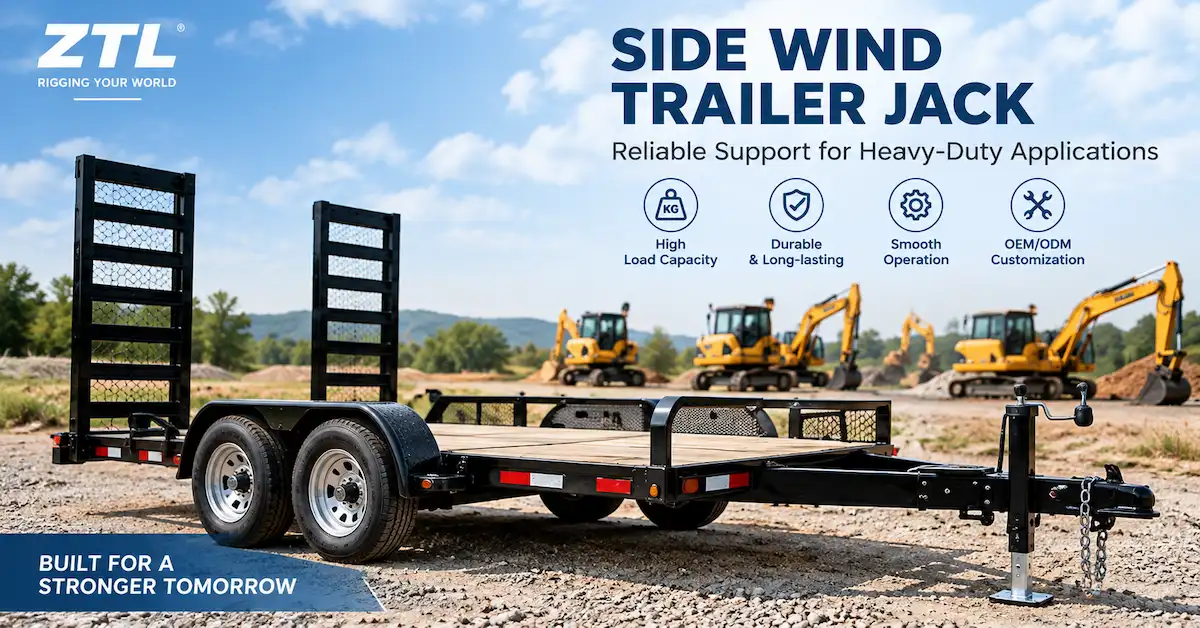
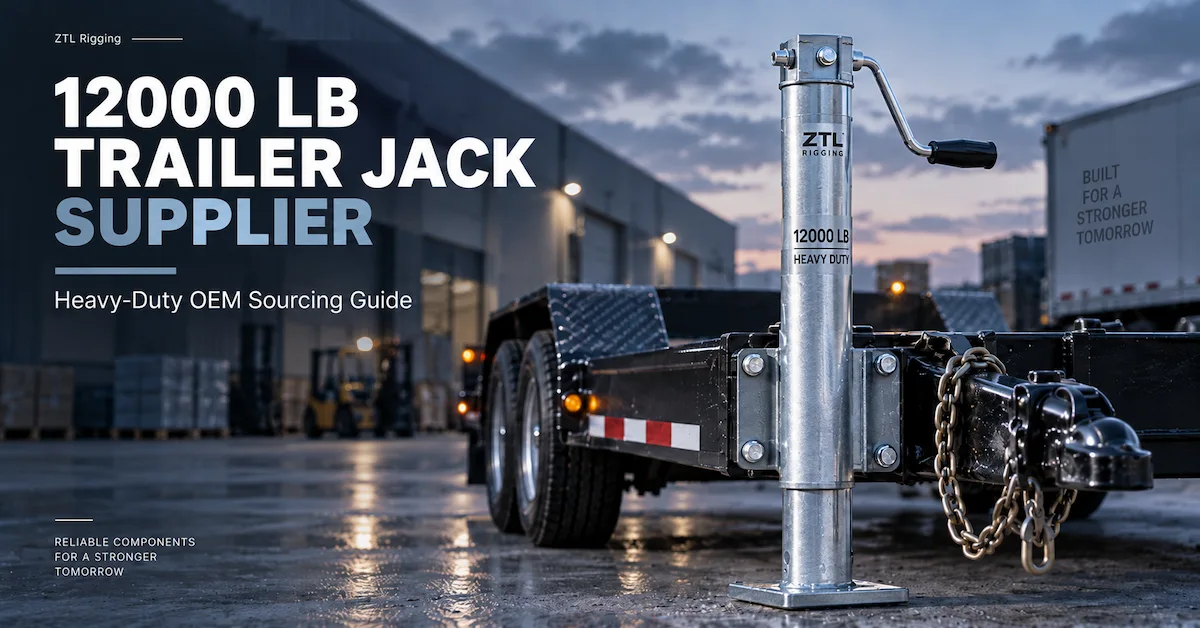
A 12000 lb trailer jack supplier should be evaluated on the complete application, not on capacity and price alone. For an OEM buyer, the important questions are whether the jack's published rating matches the load at the actual jack position, whether its weld-on interface fits the trailer frame, whether the side-wind crank has enough operating clearance, whether the travel and drop leg provide the required height range, and whether the approved specification can be repeated in production. ZTL currently lists a 12,000 lb Side Wind Trailer Jack with a 12,000 lb published load capacity, 12.5-inch travel, 13.5-inch drop leg, alloy-steel construction, weld-on installation, side handle, 28.6 kg listed weight, and black powder coating combined with zinc-plated components. Those fields give buyers a useful starting point, but the current drawing, rating definition, tolerances, inspection criteria, and project configuration still need to be confirmed before an OEM order is released.
Which Buyers Typically Need a 12,000 lb Trailer Jack?
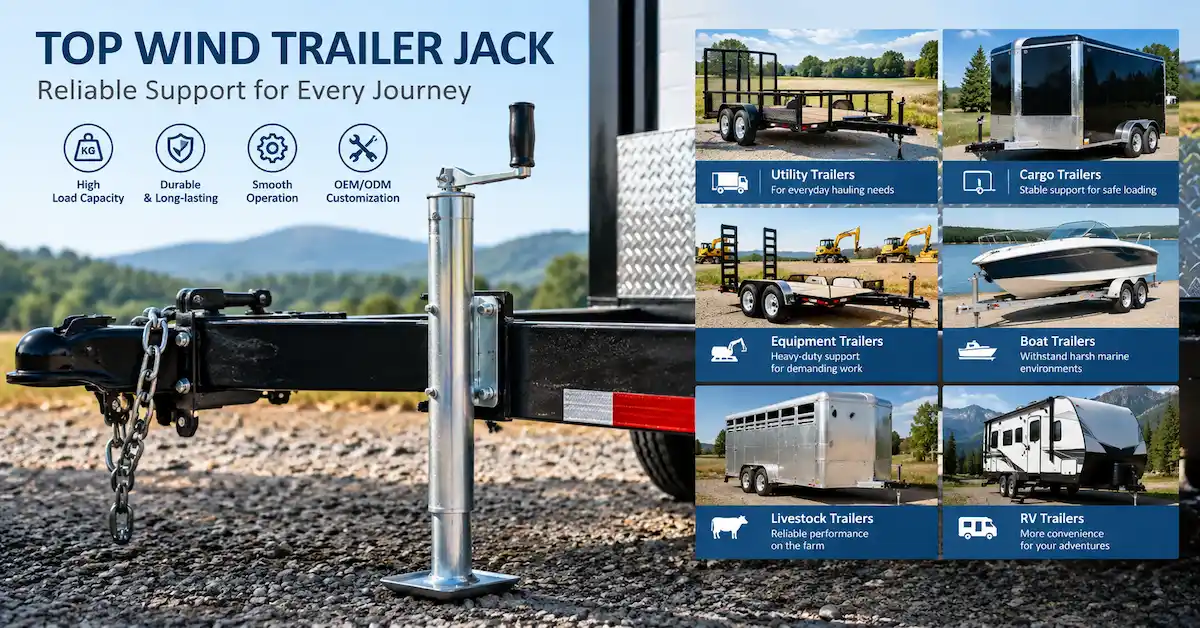
A 12,000 lb capacity class is relevant to buyers evaluating heavier trailer applications, including equipment trailers, industrial transport trailers, agricultural equipment, commercial cargo platforms, machinery-hauling systems, and other trailers where the jack-point load and operating conditions justify a higher-capacity product. The buyer is often a trailer manufacturer, equipment OEM, replacement-parts distributor, fleet procurement team, or private-label trailer-hardware brand rather than an individual retail user. However, “heavy trailer” by itself is not enough to select this model. Buyers should calculate or establish the maximum load the jack will actually support at its mounting position and then check the manufacturer’s rating definition, mounting requirements, operating height, and duty conditions. ZTL’s trailer jack OEM buyer’s guide similarly emphasizes selecting around the real load at the jack point rather than treating total trailer weight as the only selection number.
When Is a 12,000 lb Side-Wind Design a Practical Choice?
The current ZTL 12,000 lb model uses a side-wind handle, which means the available operating space beside the jack matters as much as the capacity class. Before approving the design, check the complete crank path against the trailer frame, drawbar braces, coupler, storage boxes, hydraulic or electrical components, safety chains, spare-wheel positions, and any nearby accessories. Side-wind operation can be practical where the operator has clear lateral access, but it is not automatically better than a top-wind layout. If the trailer design places a large toolbox or structural member beside the jack, a different crank arrangement may be easier to operate. ZTL’s current trailer jack range includes top-wind and side-wind products across several nominal capacity classes, so crank layout and capacity should be treated as separate selection decisions.
Start with the Published 12,000 lb Trailer Jack Specifications
For sourcing work, a catalogue should narrow the selection, while the approved technical package should control the order. The following table uses the fields currently published for ZTL’s 12,000 lb side-wind model and separates them from the questions an OEM buyer should still close before purchase.
| Specification Item | ZTL Published Information | OEM Buyer Follow-Up |
|---|---|---|
| Product type | Side Wind Trailer Jack | Confirm exact model and drawing revision |
| Load capacity | 12,000 lb | Confirm rating definition and applicable operating conditions |
| Material | Alloy Steel | Confirm component-level material specification where required |
| Handle | Side wind | Check full crank envelope and operator clearance |
| Travel | 12.5 in. | Confirm reference points, tolerance, and usable travel |
| Drop leg | 13.5 in. | Confirm adjustment positions and retained configuration |
| Listed weight | 28.6 kg | Confirm production and shipping weight if commercially important |
| Construction | Weld-on | Confirm mounting geometry and welding interface |
| Surface finish | Black powder coating + zinc plated | Confirm which components receive each finish |
| Customization | Available | Define requested change and validation requirements |
Do Not Treat the 12,000 lb Rating as the Whole Specification
Capacity is an essential purchasing parameter, but it does not describe the complete product. A procurement team should ask what the 12,000 lb published figure represents, what conditions apply to that rating, and what installation assumptions are built into the product. Do not assume that the jack can support the full gross trailer weight simply because “12,000 lb” appears in the product name. The actual load at the trailer tongue or support point can differ substantially from total vehicle or cargo weight. Likewise, lifting capacity, static support capacity, side loading, impact loading, and long-term parked conditions should not be treated as interchangeable concepts unless the supplier’s technical documentation defines them that way. For an OEM program, record the intended maximum supported load, normal operating height, worst-case operating height, duty cycle, and mounting arrangement as separate RFQ inputs.
Why 12.5-Inch Travel and a 13.5-Inch Drop Leg Matter
The combination of 12.5-inch published travel and a 13.5-inch drop leg affects how quickly the jack reaches the ground, how much powered adjustment remains available, and whether the trailer can reach the required coupling or parked position. A buyer should therefore ask for the fully retracted height, relevant extended dimensions, drop-leg hole positions, foot-plate location, and the reference points used for the published travel. Two jacks with the same capacity can behave very differently if one requires much more screw travel before reaching the ground. For a production trailer, this can influence operator time, ground clearance, coupler height range, and the visual position of the jack after installation. The best way to verify the combination is to place the proposed jack dimensions directly into the trailer drawing rather than choosing from capacity alone.
Review the Weld-On Mounting Interface Before Sample Approval
ZTL currently identifies the 12,000 lb model as a weld-on construction. That makes the jack-to-frame interface an important engineering and manufacturing control point. Buyers should obtain the mounting dimensions, allowable welding area, orientation, clearance around moving components, and any requirements that affect the jack’s supplied finish. The trailer manufacturer should also determine its own welding process and structural design requirements rather than assuming the jack supplier’s capacity label validates the finished trailer frame. Welding after coating may affect nearby surface protection, so the production sequence and any coating-repair procedure should also be discussed. A sample should be evaluated in the real installation position whenever practical because a jack that looks correct on a bench can still conflict with a drawbar brace, toolbox, coupler assembly, or crank path when installed.
Check Side-Wind Crank Clearance on the Actual Trailer
For a side-wind model, clearance problems are often visible only after the handle is rotated through its complete path. An engineer should check the crank at the jack’s relevant operating positions and with nearby trailer accessories in both normal and service positions. A toolbox lid, spare-wheel bracket, hydraulic reservoir, electrical box, or drawbar reinforcement may not interfere when the trailer is parked but may obstruct the operator at another height or configuration. If several trailer models will share the same 12,000 lb jack, repeat the clearance review for every frame and accessory package. Record the accepted crank envelope on the drawing or approval document so future design changes trigger another review. This is more reliable than approving a supplier based solely on a catalogue image.
Evaluate Materials and Components, Not Just the Finished Appearance
The product page identifies alloy steel as the material for the current 12,000 lb jack, but an OEM buyer may need more component-level detail depending on the project. The outer tube, inner tube, mounting structure, screw mechanism, gear components, crank, drop leg, retaining pin, fasteners, foot plate, and other parts perform different functions and may have different manufacturing or surface requirements. When material information is important to your approval process, ask the 12000 lb trailer jack supplier to identify which specification applies to each critical component. This is particularly important when a buyer is qualifying an alternate source or developing a private-label product because “alloy steel” alone may not be detailed enough to demonstrate equivalence between two products.
Translate Factory Capability into Model-Specific Quality Controls
ZTL publicly describes itself as a manufacturer of trailer jacks and related hardware and states annual trailer-jack production of 200,000 sets, with products exported to more than 20 countries and regions. These figures are useful when evaluating overall supplier scale, but production capacity alone does not prove that a particular order will meet a specific drawing or schedule. Buyers should convert factory capability into an inspection plan for the selected jack: incoming-material verification, critical dimensions, weld and assembly checks, travel and drop-leg function, crank operation, surface appearance, markings, packaging, and any project-specific functional or load verification. The objective is to connect each important specification to an inspection method rather than relying on general statements such as “strict QC” or “heavy-duty quality.”
Specify the Surface Finish by Component
The current product page lists black powder coating + zinc plated as the surface finish. A professional RFQ should go one step further and identify which components are powder coated, which are zinc plated, which surfaces remain functional or lubricated, and how weld areas or sliding surfaces are handled. This matters because corrosion problems often begin at interfaces rather than on broad visible surfaces. ZTL’s corrosion-resistant trailer jack specification guide recommends defining the coating map, preparation, test method, specimen, exposure conditions, acceptance limits, and packaging rather than reducing corrosion protection to a single phrase such as “rust resistant.” For agricultural, coastal, winter-road, wash-down, or long-term outdoor storage, tell the supplier the actual environment so the coating requirement can be evaluated against a defined use case.
Do Not Convert Salt-Spray Hours Directly into Service Life
Salt-spray testing can be useful for comparing coating processes or verifying an agreed production requirement, but it should not be presented as a direct prediction of how many years a trailer jack will survive outdoors. The test specimen, method, duration, coating preparation, failure definition, and sample size all affect what the result means. ZTL’s coating guide specifically advises buyers to define these conditions and treat salt-spray data as controlled comparison information rather than a calendar forecast. For B2B buyers, this distinction reduces disputes because the purchase requirement becomes measurable: the agreed product must meet a stated coating and test specification instead of a vague promise of “long service life.”
Approve the Sample Against a Controlled Specification
A strong sample-approval process should identify the jack model, drawing revision, published and agreed dimensions, mounting interface, travel, drop leg, crank configuration, surface finish, markings, packaging, and required test records. The buyer should not approve only a photograph or one successful installation. A physical sample can look correct while the production definition remains incomplete. Record what was checked, what was measured, and which deviations were accepted. If a dimension, coating, crank, foot plate, drop leg, package, or label changes after approval, the supplier and buyer should have a written rule for deciding whether reapproval is required. This matters especially for repeat orders, where the commercial objective is not merely to receive another “12,000 lb jack” but to receive the same controlled version that engineering and quality already approved.
Compare the 12,000 lb Model with Other ZTL Trailer Jack Classes
ZTL’s current public range includes 2,000 lb top-wind, 7,000 lb top-wind, and 2,000 lb, 5,000 lb, and 12,000 lb side-wind configurations. The comparison below is therefore best used as a family-selection guide rather than an interchangeability chart.
| Capacity Class | Current Public Layout | Buyer Selection Focus |
|---|---|---|
| 2,000 lb | Top wind / Side wind | Lighter jack-point loads, mounting, travel, and crank access |
| 5,000 lb | Side wind | Intermediate capacity needs and side-handle clearance |
| 7,000 lb | Top wind | Higher-capacity application with overhead crank access |
| 12,000 lb | Side wind | Higher jack-point load, weld-on installation, drop leg, side clearance, and heavy-duty application review |
A higher nominal capacity is not automatically the better purchasing decision. Larger products may differ in weight, geometry, mounting, operating effort, packaging, and cost. The correct choice is the smallest appropriate configuration that satisfies the actual engineering and operational requirements with the required margin and documentation, according to the buyer’s design process.
Understand the Cost Drivers Behind a 12,000 lb Trailer Jack Quote
A meaningful supplier comparison should use the same technical and commercial scope. Unit price can be affected by product configuration, material requirements, surface finish, customized mounting, labels, private-label packaging, inspection documentation, sample approval, order quantity, and shipping terms. A cheaper quote may exclude requirements that another supplier has already included. The commercial risk also extends beyond the purchase price: incorrect mounting geometry can create rework; insufficient crank clearance can cause an assembly problem; poorly defined coatings can create sorting or refinishing work; and unclear labels can complicate distribution and after-sales identification. ZTL’s trailer jack wholesale purchasing guide recommends evaluating manufacturing capability, product consistency, customization, export support, and long-term supply alongside unit price.
Confirm MOQ and Lead Time for the Exact Project
Do not assume that one minimum order quantity or production period applies to every 12,000 lb trailer jack project. Standard products, customized weld-on interfaces, special coatings, private-label packaging, and new validation requirements can follow different commercial paths. Request an order-specific quotation that distinguishes sample preparation, drawing or specification approval, any tooling or development work, bulk production, inspection, packaging, and shipment readiness. ZTL’s published production scale provides useful factory context, but it does not replace a written schedule for the individual purchase order. For repeat programs, buyers should also share forecast volume and expected order frequency so the supplier can evaluate production planning and commercial terms based on the real purchasing pattern.
Define OEM Customization Before Requesting the Sample
ZTL states that customization is available for its 12,000 lb side-wind trailer jack. Buyers should divide customization into three categories: identification and packaging changes, dimensional or mounting changes, and functional or structural changes. A carton logo or product label is fundamentally different from changing the mounting interface, drop-leg design, travel, component construction, or another load-related feature. Each request should therefore be evaluated for drawing changes, sample requirements, testing, tooling, price, and lead time. The safest OEM workflow is to agree on the technical specification first, approve the physical product second, approve artwork and packaging third, and then release bulk production using a single controlled revision package.
What Should You Send a 12000 lb Trailer Jack Supplier?
A qualified RFQ should give the supplier enough information to evaluate the application rather than forcing the sales team to guess. Send the trailer type, maximum load at the jack position, required capacity class, mounting drawing, required operating heights, desired travel, drop-leg requirement, available side-crank clearance, operating environment, expected duty cycle, finish requirement, first-order quantity, annual demand estimate, destination market, required quality documents, branding, and packaging requirements. If the project is replacing an existing jack, add photographs and dimensional drawings of the current installation, but do not use photographs as a substitute for critical dimensions. Buyers can send these details through the ZTL contact page for a model and project review.
Frequently Asked Questions
1. What are the published specifications of ZTL’s 12,000 lb trailer jack?
ZTL currently publishes a 12,000 lb side-wind trailer jack made from alloy steel with 12.5-inch travel, a 13.5-inch drop leg, 28.6 kg listed weight, weld-on construction, and black powder coating plus zinc-plated components. Customization is also listed as available. Buyers should still confirm the current drawing, rating definition, tolerances, and exact project configuration before purchase.
2. Is a 12,000 lb jack suitable for a 12,000 lb trailer?
Not necessarily. Trailer gross weight and the load applied at the jack position are different values. Selection should be based on the maximum actual load the jack must support under the intended operating conditions, together with the manufacturer’s rating definition and the trailer designer’s requirements.
3. Why does the drop leg matter on a heavy-duty trailer jack?
A drop leg can reduce the amount of screw travel needed before the foot reaches the ground and can extend the usable height range. For ZTL’s current 12,000 lb model, the published drop-leg value is 13.5 inches, while powered travel is listed as 12.5 inches. The buyer should verify adjustment positions and overall height dimensions on the current drawing.
4. Is ZTL’s 12,000 lb model top wind or side wind?
It is currently listed as a side-wind model. This means the buyer should verify sufficient lateral crank clearance around the trailer frame, coupler, storage equipment, and accessories.
5. Is the 12,000 lb ZTL trailer jack weld-on?
Yes. The current product page lists the construction as weld-on. Buyers should obtain the interface drawing and coordinate welding, structural integration, and coating repair with their own trailer manufacturing process.
6. Can the 12,000 lb trailer jack be customized?
ZTL lists customization as available. The actual feasibility, validation requirements, MOQ, cost, and lead time depend on whether the request involves packaging and branding or changes to dimensions, mounting, finish, or functional construction.
7. What corrosion protection is published for the model?
The product page states black powder coating + zinc plated. Buyers should confirm which specific components receive each treatment and define any additional corrosion test requirements according to the application environment.
8. What should I check during sample approval?
Check model identification, drawing revision, critical dimensions, mounting, travel, drop leg, crank clearance, operation, surface finish, markings, required verification records, and packaging. Keep the approved record as the reference for mass production and repeat orders.
9. How do I compare two 12000 lb trailer jack suppliers fairly?
Send both suppliers the same RFQ, drawing, finish requirement, inspection requirement, packaging specification, quantity, and commercial terms. Then compare what is included in the quotation, what remains unconfirmed, and how each supplier controls repeat production rather than comparing unit price alone.
10. How can I request a quotation from ZTL?
Use the ZTL contact page and provide the application, jack-point load, mounting drawing, travel and height requirements, crank-clearance information, environment, quantity, destination, customization needs, and required documents. The more complete the RFQ, the easier it is to evaluate whether the existing 12,000 lb model or a customized configuration fits the project.
Conclusion
Choosing a 12000 lb trailer jack supplier is a technical purchasing decision involving far more than a capacity label. ZTL’s current 12,000 lb Side Wind Trailer Jack provides a published starting specification of 12,000 lb capacity, 12.5-inch travel, 13.5-inch drop leg, alloy-steel construction, weld-on mounting, side-wind operation, and black powder coating plus zinc-plated components. For OEM and bulk buyers, the next step is to verify jack-point load, installation geometry, crank clearance, height range, coating requirements, inspection criteria, customization, and repeat-order controls against the actual trailer. If you are developing a heavy-duty trailer, sourcing an alternate supplier, or building a private-label product line, contact ZTL with your drawing, load requirements, operating environment, quantity, and documentation needs so the correct configuration can be reviewed before sample and mass-production approval.