English


Buying a load binder is easy when the order is small and the consequence of a mismatch is low. Buying thousands of binders for a distribution program, a private-label range, a fleet, or a heavy-haul project is different. A buyer must connect chain grade, chain diameter, working load limit, take-up, hook geometry, handle behavior, markings, proof testing, finish, packaging, and lot traceability. Miss one of those connections and a product that looked acceptable on a quotation can become difficult to sell, difficult to inspect, or unsuitable for the intended securement system.
This guide is built for importers, cargo-control distributors, transport-equipment brands, fleet procurement teams, and quality engineers who need more than a generic load binder size chart. It explains how to read the numbers, how to compare the types of load binders, and how to prepare a request for quotation that a qualified load binder manufacturer can answer without guesswork.
Quick answer: Select a load binder by the marked working load limit and the exact chain size and grade for which the binder is designed. Never select it only by handle length, product weight, color, or a supplier's informal “tonnage” description. The securement system is limited by its lowest-rated component.

Why a load binder size chart is more than a chain-diameter table
A chart is useful only when its column headings are unambiguous. In real RFQs, the same row may contain a minimum–maximum chain size, a working load limit, a proof load, a minimum ultimate load, product weight, handle length, and several dimensional references. Those values answer different questions. Chain size tells you what the end fittings are intended to engage. Working load limit defines the maximum load assigned to the component in service under the stated conditions. Proof load is a manufacturing or verification load, not permission to operate the binder at that level. Minimum ultimate load is a destructive-performance threshold, not a field rating.
Procurement errors usually begin when one of those values is copied without its label. A salesperson sends “9,200 lb,” an internal buyer records it as “capacity,” and a distributor later publishes it without saying whether it is WLL, proof load, or minimum ultimate load. A professional specification keeps each term separate all the way from drawing and test report to carton label and online product page.
For that reason, a good load binder size chart should be treated as the start of technical review, not the end.Ask which chain specification was used, whether the listed range applies to both hooks, how the WLL is marked, how proof testing is performed, and whether the production item matches the approved sample.
Example ratchet load binder size chart from Zhongteli
The table below reproduces the key rating fields currently published for Zhongteli's Ratchet Type Load Binder. Buyers should confirm the latest drawing, marking and test requirements on the formal quotation because custom hooks, finishes or regional specifications can change the approved configuration.
| Minimum–maximum chain size (in.) | Working load limit (lb) | Proof load (lb) | Minimum ultimate load (lb) | Approx. weight each (lb) |
|---|---|---|---|---|
| 1/4–5/16 | 2,200 | 4,400 | 7,800 | 3.52 |
| 5/16–3/8 | 5,400 | 10,800 | 19,000 | 10.50 |
| 3/8–1/2 | 9,200 | 18,400 | 33,000 | 12.20 |
| 1/2–5/8 | 13,000 | 26,000 | 46,000 | 14.38 |
This table shows why a row cannot be reduced to “fits 3/8 chain.” The published 5/16–3/8 row carries a different WLL from the 3/8–1/2 row. Both mention 3/8 inch, yet they are not interchangeable statements. The hook dimensions, take-up range, body geometry and intended chain engagement must be reviewed as a complete assembly.
It also shows a recurring relationship in the published data: proof load is twice the stated WLL. That relationship is useful for checking whether a quotation has been transcribed correctly, but buyers should still require the supplier's controlled specification and actual test method. Do not build a safety program around a pattern inferred from a web table.
Working load limit is the number used for the securement calculation
For North American road transport, the Federal Motor Carrier Safety Administration states that the aggregate working load limit of a securement system must be at least one-half the weight of the article or group of articles being restrained. The agency also explains how different tiedown paths contribute to aggregate WLL. Buyers and fleet operators should review the full FMCSA Cargo Securement Rules and the applicable sections of 49 CFR Part 393 rather than relying on a product article as legal advice.
The practical procurement lesson is simple: the binder's WLL does not operate alone. Chain, hooks, anchor points, tiedown geometry, edge protection, load shape and the number of tiedowns all matter. If a binder has a high marking but the connected chain or another component has a lower rating, the lower rating governs the assembly.A buyer therefore needs ratings that are traceable by component, not a single promotional claim for the “system.”
The same discipline applies outside the United States. Regulations, accepted standards, inspection practices and marking conventions vary by market and application. State the destination market in the RFQ. A responsible load binder manufacturer should not guess which compliance framework the buyer intends to use.
Proof load and minimum ultimate load answer different questions
Proof loading is a controlled check that a product can withstand a defined load without unacceptable permanent deformation or failure under the specified procedure. It helps verify production consistency and detect defects that visual inspection may miss. It does not transform the proof value into a service rating. A 10,800 lb proof load shown beside a 5,400 lb WLL still means the product's working limit is 5,400 lb under the stated specification.
Minimum ultimate load is farther from everyday use. It is normally associated with destructive validation or qualification. A production buyer should ask how ultimate testing is sampled, how the test machine is calibrated, what failure mode is recorded, and how results are linked to the heat or batch. Simply seeing a large minimum ultimate number on a brochure is not enough.
When comparing quotations, keep three separate columns for WLL, proof load and minimum ultimate load. If a supplier uses “breaking load,” “test load,” “capacity,” or “safe load” without a definition, stop the comparison and ask for clarification.A clear vocabulary is one of the fastest indicators of a disciplined quality system.
Chain size compatibility: diameter alone is not a complete match
The phrase load binder chain size compatibility sounds straightforward, but chain diameter is only one variable. Chain grade affects its assigned WLL. Link dimensions affect how a grab hook seats. Coating can alter fit at tight interfaces. Wear, deformation or mixed components can reduce the reliability of the connection. A binder should be matched to the chain sizes and grades identified by the controlled specification, with the full system checked for the destination market.
Ask the supplier for the hook throat, pocket or cradle dimensions that control engagement. Request a drawing that shows the measurement points. If you are developing a private-label line, send representative chain samples or an approved chain drawing before final tooling or mass production. A paper match is useful; a physical fit check is better.
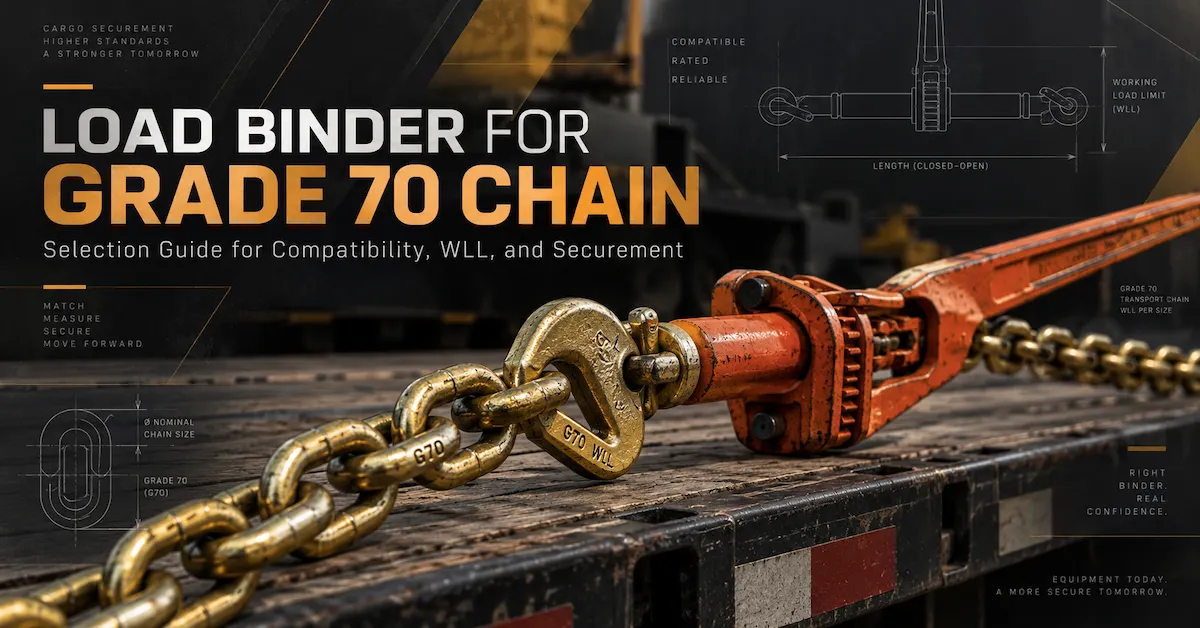
Do not assume that every binder described as a load binder for grade 70 chain has identical compatibility. The claim needs a defined chain size, an assigned WLL, hook geometry and markings. It should also be consistent across the product page, label, carton, manual and test report. Mixed messages create risk for distributors and end users.
How to compare the main types of load binders
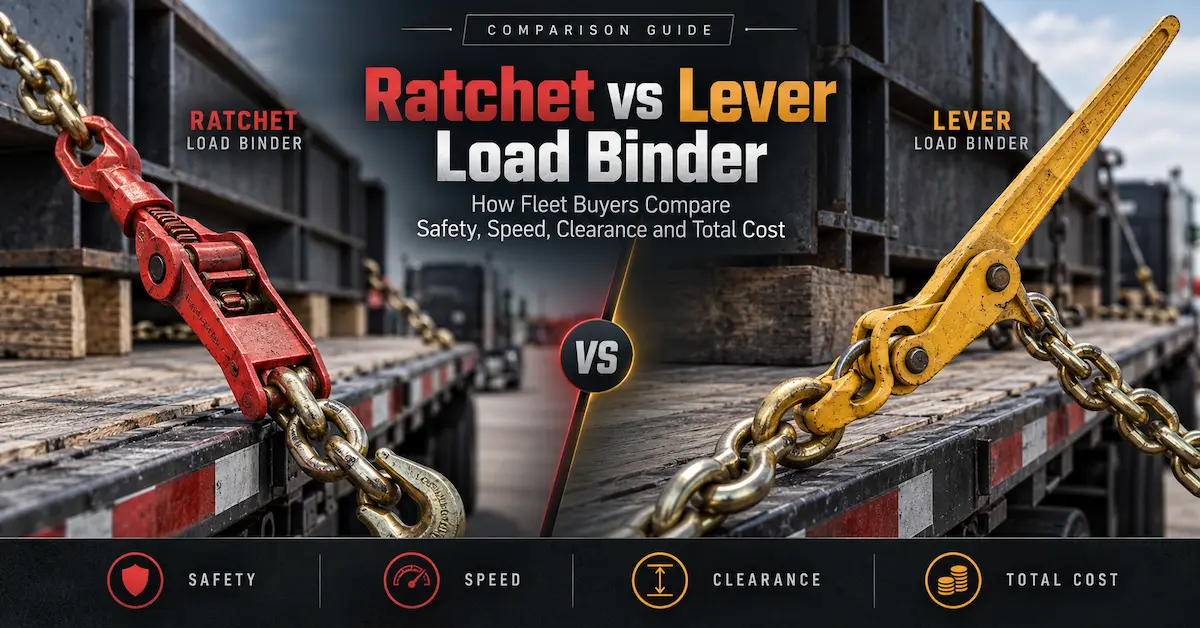
The right design depends on operating method, take-up requirement, clearance, user preference, regional practice and the risk controls around the task. Zhongteli's current load binder range includes ratchet, lever, indirect, EU type, folding-handle and torque-tensioner designs. Each deserves its own controlled specification.
| Binder type | Typical purchasing reason | Questions to put in the RFQ |
|---|---|---|
| Ratchet type | Controlled incremental tensioning and familiar operation | Chain range, WLL, take-up, handle length, thread protection, hook type |
| Lever type | Fast operation and established use in heavy transport | Handle-locking practice, rebound risk controls, hook rotation, WLL and proof test |
| Indirect type | Alternative operating geometry and handling preference | Operating sequence, clearances, hook articulation, release method, markings |
| EU type | Regional design preference and cradle-grab-hook configuration | Destination requirements, chain interface, WLL, proof test, finish, documentation |
| Folding-handle type | Reduced handle projection in truck-loading environments | Folded envelope, hinge durability, pinch points, locking behavior, cycle test |
| Torque tensioner | More controlled tensioning behavior for specified systems | Torque procedure, calibration assumptions, chain compatibility, inspection method |
This is a sourcing comparison, not a declaration that one design is universally better. A distributor may need several types of load binders because customer practices differ.An OEM brand may prefer one platform with two hook options to reduce SKU complexity. A fleet may standardize on a single design to simplify training and inspection. The correct commercial decision combines safety, usability, assortment strategy and total landed cost.
Ratchet type: what buyers should inspect beyond the headline WLL
A ratchet load binder manufacturer should be able to explain the forged components, heat treatment, thread quality, take-up, end-fitting movement and proof-test plan. The ratchet mechanism should operate smoothly through the usable range without binding, rough spots or obvious misalignment. Threads deserve particular attention because contamination, coating buildup or poor geometry can turn a strong forged body into a frustrating product.
Ask for fully closed, mid-travel and fully extended dimensions. Define how much thread engagement must remain at the maximum approved take-up. Specify whether grease, protective caps or packaging are required. If the product will sit outdoors before use, consider how the finish and packaging protect the mechanism from early corrosion.
For a ratchet type load binder wholesale program, packaging matters almost as much as the part. A carton that allows heavy binders to strike each other can damage paint, deform labels and create an unprofessional first impression. Request a packing drawing, carton gross-weight limit, moisture protection and pallet plan before the first large shipment.
Lever type: speed must be balanced with release behavior and training
Lever binders remain familiar in many heavy-duty transport environments. Zhongteli describes its Lever Type Load Binder as drop forged, heat treated, proof tested and fitted with 360-degree swivel hooks. Those are relevant product features, but the buyer's review should also cover operating clearances and the energy stored in the tensioned system.
The RFQ should identify the intended chain range, WLL, handle length, hook configuration, finish and marking. The buyer's operating procedure should address tightening and release methods, damaged components, extensions or “cheater bars,” and employee training. A manufacturer supplies a component; the fleet or employer controls the work practice.
When testing samples, do not limit the review to a clean bench. Use chain representative of the intended program, gloves similar to those used in the field, and realistic clearances. Record observations about grip, handle travel, hook alignment and release. These comments often reveal whether a technically acceptable product will be accepted by users.
Folding-handle binders: a packaging-sized feature with operational value
The Folding Handle Load Binder is positioned for applications such as truck loading where reducing handle projection can be valuable. For a buyer, the hinge adds both a benefit and an inspection point.The folded envelope should be shown on the drawing, while the hinge pin, stops, clearances and locking behavior should be controlled.
Request cycle testing that reflects expected folding and operating frequency. Inspect the hinge after proof loading and after coating. Check whether the design creates pinch points during normal use. Confirm that the folded handle stays where intended during transport and storage.
For a private-label program, a folding handle can differentiate the assortment, but only if the feature is explained consistently. The product page, carton artwork and instructions should show the operating sequence. A photograph of the handle in both positions is more useful than a generic lifestyle image.
Indirect, EU type and torque tensioners require application-specific review
An Indirect Load Binder may appeal to buyers looking for a different operating method, while an EU Type Load Binder may align with a regional range or existing customer preference. A Torque Tensioner can support a more controlled tensioning process when the entire procedure is properly defined.
None of those names is a substitute for a drawing. Two suppliers may use the same product label for designs with different dimensions, hooks or operating methods.The RFQ should therefore describe the intended chain, WLL, take-up, handle envelope, finish, proof test, markings and packaging. If the buyer expects a torque-based procedure, state the tool, range, lubrication condition and acceptance method rather than assuming a universal torque-to-tension relationship.
The strongest product page answers “what is it?” The strongest sourcing document answers “exactly which controlled version will we receive?”

Take-up range is a commercial specification, not a minor dimension
Take-up determines how much slack the binder can remove within its approved operating range. Insufficient take-up forces operators to reposition chain or choose another component. Excessive extension without adequate thread engagement can create misuse risk. Yet many quotations give only an overall length and omit the usable take-up.
Require three dimensional states: closed, nominal and maximum approved extension. Ask the supplier to mark the minimum safe thread engagement in the drawing and, where appropriate, in the product design or instructions. Verify take-up on samples with the intended chain and hook orientation.
Take-up also affects packaging and shelf presentation. A binder shipped fully extended consumes more carton volume and exposes more thread. A binder shipped fully closed may arrive with the handle in an awkward position. Define the packing position, thread protection and corrosion-prevention method. These small decisions influence damage rates, warehouse efficiency and the end customer's first interaction with the product.
Hook geometry, swivel movement and chain seating
Hooks carry the load into the chain, so their geometry deserves more attention than catalog photographs usually provide. A grab hook or cradle-style hook must engage the intended link correctly. The throat, pocket profile, tip, pin area and transition into the body should match the approved design. Free rotation can improve handling, but movement should not hide excessive clearance or poor assembly.
For products described as a load binder with 360 swivel hooks, check rotation before and after proof loading. Look for interference from coating, burrs or deformation. For a load binder with grab hooks, use go/no-go gauges or controlled chain samples to confirm engagement. Record the inspection method in the control plan instead of relying on visual opinion.
If your assortment uses several chain grades or suppliers, maintain a compatibility matrix. State which combinations are approved, which require verification and which are prohibited. That matrix is more useful to sales teams and customers than a vague sentence saying the product “fits common transport chain.”
Forging, heat treatment and machining form one quality chain
A credible drop forged load binder supplier should treat forging, heat treatment and machining as connected processes. Forging establishes the material flow and near-net geometry. Trimming and surface preparation remove flash and scale. Heat treatment develops the required mechanical properties. Machining or thread production creates functional interfaces. Coating protects the surface and changes dimensional clearances.
The buyer does not need to become the factory's process engineer, but the audit trail should answer practical questions. What raw material grade is specified? How is heat or batch identity maintained? Which characteristics are checked after forging? How is the furnace cycle controlled and recorded? Which hardness or mechanical tests are required? How are thread gauges managed? How are nonconforming parts segregated?
When sourcing from a heat treated load binder manufacturer, request the process flow and inspection plan, not confidential furnace recipes. The goal is evidence that the approved process is repeatable and that changes are controlled.
What “individually proof tested” should mean in a purchase order
Zhongteli's published product descriptions state that several load binder designs are individually proof tested. For a procurement team, that statement should be converted into auditable requirements. Define the proof load, loading fixture, hold or cycle method, acceptance criteria, test-machine calibration, recording method and marking or traceability expected after the test.
Ask whether every unit is tested or whether the phrase refers to a product design capability. If every unit is tested, determine how results are associated with the production lot and how failed parts are controlled. If only samples are tested, specify the sampling plan. Avoid leaving the distinction to marketing language.
A good load binder proof test requirements section in a purchase order fits on one page. It names the applicable drawing revision, the load and procedure, the acceptance criteria, the records to retain and the disposition of failures. Clarity protects both buyer and manufacturer.
Marking and traceability: information that must survive paint and use
Product markings help distributors and end users identify the component. At minimum, the approved marking layout should be shown on the drawing or artwork. Define the brand, WLL, chain range, traceability code and any market-specific information required by the buyer's program. Confirm the unit, character height, location, depth or permanence, and orientation.
Coating can fill shallow marks. Forging variation can distort raised characters. Laser marks can become difficult to read on rough or dark surfaces. Inspect markings after the final finish, not only on bare parts. Run a legibility review on realistic samples and photography intended for the product page.
For a batch traceability rigging hardware supplier, the code should connect the finished unit or lot to incoming material, forging, heat treatment, inspection and shipping records.Traceability does not need to expose confidential process details to the end customer, but it should let the manufacturer investigate a complaint efficiently.
Surface finish, corrosion and the hidden cost of storage
Load binders may spend months in warehouses, on open trailers or in humid environments. A finish that looks good at final inspection can still fail during ocean transit or outdoor storage if surface preparation, coating thickness, cure, drainage, packaging or handling is poor. Specify color and appearance, but also define measurable requirements appropriate to the program.
Review recessed areas, threads, hook interfaces and contact points where coverage can vary. Decide which surfaces must remain free of heavy coating to preserve function. Check whether the corrosion-prevention oil or grease is compatible with labeling and packaging. For export shipments, include desiccant, barrier material or other protection only when justified by the route and storage conditions.
The best finish is not automatically the thickest. It is the finish system that protects the part while preserving fit, movement, markings and serviceability.
How to qualify a load binder manufacturer without repeating a full factory audit
If you already have a supplier-audit procedure, use this guide to deepen the product-specific portion. Start with controlled drawings and product specifications. Then follow one representative batch through material receipt, forging, heat treatment, machining, assembly, proof test, marking, coating, packing and release. Compare records with the physical parts on the floor.
Look for consistency between departments. The sales quotation, engineering drawing, inspection instruction and carton label should describe the same product. If the website says “individually proof tested” but the work instruction shows sample testing, resolve the discrepancy before approval. If the drawing specifies one chain range while packaging shows another, treat it as a release blocker.
For a broader checklist, use Zhongteli's Load Binder Factory Audit Checklist as a companion resource. The present article focuses on sizing and system compatibility; the audit guide focuses on process evidence and supplier controls.
OEM and private-label decisions that change the quotation
An OEM load binder can involve more than a logo. Buyers may request a custom hook, handle, color, marking, label, carton, manual, pallet pattern or inspection report. Each option affects tooling, process routing, minimum order quantity, sample approval and lead time. Separate cosmetic requests from engineering changes so everyone understands the validation burden.
For a custom load binder manufacturer, the cleanest development path is a controlled change list. Start from the closest standard platform. Identify every requested difference. Classify each as artwork, packaging, dimensional, material or performance related. Agree which changes require a new drawing, new tooling, sample testing or destructive validation. Freeze the approved configuration before mass production.
Private-label buyers should also control claims.If the carton states a chain grade, WLL or compliance statement, that wording must match the tested product and destination requirements. Marketing artwork should pass the same technical review as the drawing.
Building a distributor assortment without unnecessary SKU duplication
A distributor may be tempted to stock every chain-size range in every binder type. That can create slow-moving inventory and confusing overlap. Use actual customer segments to build the range. Heavy-haul customers, general flatbed fleets, agricultural dealers and industrial supply houses may need different combinations of WLL, handle style and packaging.
Map each proposed SKU to a buyer job. Which chain sizes does the customer already stock? Which WLL ranges create meaningful steps? Does the handle design solve a recognized problem? Can salespeople explain the difference in one sentence? Are replacement and warranty records likely to be manageable?
A smaller range with clear positioning often converts better than a long catalog of nearly identical products. It also improves forecast accuracy and allows a load binder wholesale supplier to consolidate production, packaging and inspection.
Landed cost: why unit price is only the first line
Two quotations cannot be compared by unit price alone. Add tooling, sample testing, third-party inspection, packaging, palletization, inland freight, export documents, ocean or air freight, duty, warehousing, damage allowance, financing and warranty handling. Then consider the cost of slow-moving SKUs and product-data maintenance.
A low price can be erased by overweight cartons, weak packaging, inconsistent markings or rework at destination. Conversely, premium packaging may not be justified for a fleet buyer who consumes binders internally. Define the commercial model before asking for a “best price.”
For load binder price for bulk orders, request price breaks at realistic quantities and identify what changes at each level. Tooling amortization, carton printing, pallet configuration and test documentation may affect the curve. Ask whether the quotation includes samples, inspection records and replacement parts.
A practical RFQ table for load binder procurement
Use the following table as the minimum technical attachment to a load binder RFQ. Add company-specific requirements rather than sending a long email with unstructured questions.
| RFQ field | Buyer input | Supplier response required |
|---|---|---|
| Product type | Ratchet / lever / indirect / EU / folding handle / torque | Exact model and drawing revision |
| Chain | Size range, grade, reference specification | Approved compatibility and hook drawing |
| Rating | Required WLL and market | WLL, proof load, minimum ultimate load |
| Dimensions | Closed length, take-up, handle envelope | Dimensioned drawing with tolerances |
| Material/process | Buyer restrictions, if any | Material grade, forging and heat-treatment route |
| Testing | Unit proof test or sampling, record needs | Test method, equipment and report format |
| Marking | Brand, WLL, chain size, lot code | Marking artwork and process |
| Finish | Color, coating system, appearance criteria | Process and inspection method |
| Packaging | Unit pack, carton limit, pallet, labels | Packing drawing and gross/net weights |
| Commercial | Annual volume, order quantity, destination | MOQ, price breaks, tooling and lead time |
| Quality | Sample plan, change notification, records | Control plan, certificate and retention period |
| Approval | Samples, pilot lot, golden sample | Timeline and responsible owner |
Sample approval: test the commercial configuration,not a laboratory special
The sample should represent the intended production route, material, heat treatment, hook, coating, marking and packaging. A polished sample produced outside the normal line has limited value. Ask the supplier to identify any differences between the sample and planned mass production.
Create an approval checklist before the sample arrives. Measure chain engagement, dimensions, take-up and handle envelope. Confirm markings and color. Operate the binder through the intended range. Review proof-test and material records. Inspect the unit after transport packaging. Photograph the approved sample and record its weight and drawing revision.
If destructive validation is required, separate test samples from golden samples. Keep one controlled reference at the buyer and one at the supplier. That pair can resolve future appearance or assembly disputes more quickly than a long email chain.

Pilot lot controls that prevent a weak first shipment
A pilot lot verifies more than the design. It tests the production instructions, inspection frequency, marking, coating, packaging and document flow.Choose a quantity large enough to expose variation but small enough to contain if a problem appears. Require the same line and route intended for normal orders.
Review first-off, middle and last-off parts. Compare weights and key dimensions. Check hook movement, thread operation, take-up and markings. Open cartons from different pallet positions after simulated handling or an agreed transport test. Reconcile the shipped quantity, packing list and traceability records.
Do not waive discrepancies because the order is “only a pilot.” Early concessions become undocumented standards. If a deviation is acceptable, record it, define the limit and decide whether the drawing or process must change before mass production.
Incoming inspection for distributors and fleets
Incoming inspection should be risk based. Identity, quantity, obvious damage, marking and packaging can be checked on every shipment. Dimensions and functional checks can follow a sampling plan. Test certificates, proof-test records or third-party reports should be reviewed at the frequency agreed in the purchase order.
Train inspectors to distinguish cosmetic variation from functional risk. A small paint blemish may be acceptable under an agreed appearance standard, while coating in a thread or an unreadable WLL may be a critical issue. Use photographs and boundary samples to reduce subjective decisions.
Quarantine mismatched lots immediately. Do not mix approved and suspect product in the same bin. Record the lot code, carton numbers, defect, photographs and sample size. A well-structured complaint gives the manufacturer a realistic chance to find root cause.
Questions to ask before awarding a bulk load binder order
- Which controlled drawing and revision define the quoted product?
- Which chain sizes and grades have been physically verified with the hooks?
- What are the WLL, proof load and minimum ultimate load, and how are they marked?
- Is proof testing performed on every unit or by sampling?
- How are raw material, forging and heat-treatment batches traced?
- What inspection controls thread, take-up and hook engagement?
- How is coating kept out of critical functional areas?
- Which records accompany each shipment?
- How are OEM artwork and packaging revisions controlled?
- What requires buyer approval after a material, process or tooling change?
- What is the pilot-lot plan and acceptance method?
- What are the MOQ, price breaks, tooling charges and production lead time?
Common sourcing mistakes and the corrective action
Mistake: selecting by a familiar chain diameter. Corrective action: confirm size, grade, hook engagement and the component WLL as one controlled combination.
Mistake: treating proof load as working capacity. Corrective action: keep WLL, proof and ultimate values in separate fields throughout procurement and marketing.
Mistake: approving appearance before function. Corrective action: inspect take-up, threads, hook seating and operation before signing the cosmetic standard.
Mistake: asking for every customization in the first message. Corrective action: start from the nearest standard model, identify the business reason for each change, and validate engineering changes separately from artwork.
Mistake: sending a price-only inquiry. Corrective action: attach the RFQ table, annual volume, target market and approval process. Better information usually produces a faster and more reliable quotation.
FAQ: load binder size, WLL and supplier selection
Can I choose a load binder only from the chain diameter?
No. Confirm the intended chain size and grade, hook geometry, marked WLL, take-up, destination requirements and the rating of every connected component. Diameter is necessary information, but it is not a complete system specification.
Is proof load the same as working load limit?
No. WLL is the assigned maximum working load under the product specification. Proof load is a verification load used under a defined test procedure. Minimum ultimate load relates to destructive performance. Never substitute one for another.
Which types of load binders should a distributor stock?
Build the range around customer segments and chain sizes. Ratchet and lever designs cover many established needs; folding-handle, indirect, EU type or torque designs can address specific operating or regional preferences. Avoid duplicate SKUs that salespeople cannot distinguish clearly.
What documents should come with a bulk order?
The answer depends on the contract, but common items include the approved drawing, packing list, certificate of conformance, material or heat-treatment records where required, proof-test or inspection report, and traceability information. State document expectations before the order.
How should a buyer compare two load binder quotations?
Normalize product type, chain range, WLL, proof load, dimensions, take-up, hook, finish, marking, testing, packaging, MOQ, tooling, lead time and destination. A lower unit price is not comparable if the technical scope or quality records differ.
Does Zhongteli offer OEM customization?
Zhongteli states that customization is available across its load binder range. Buyers should submit the intended market, chain, rating, volume, artwork and packaging needs so feasibility, tooling, validation and lead time can be evaluated.
From keyword to qualified inquiry: what buyers should send
Search phrases such as load binder manufacturer, load binder supplier, chain load binder manufacturer, heavy duty load binder supplier, load binder OEM manufacturer, custom load binder manufacturer, load binder wholesale supplier, bulk load binder supplier, ratchet load binder manufacturer, lever load binder manufacturer, indirect load binder manufacturer, EU type load binder manufacturer, folding handle load binder manufacturer, torque tensioner manufacturer, load binder supplier for distributors, load binder working load limit, load binder for heavy haul transport, and cargo securement equipment supplier all describe legitimate buyer needs. They do not describe the same product.
Turn the keyword into a technical brief. State the binder type, chain size and grade, WLL, market, annual volume, desired order quantity, finish, markings, packaging, test records and delivery destination. Add photographs or drawings when the interface is unusual. This information lets the factory assess the project instead of returning a generic price.
Zhongteli manufactures load binders and trailer jacks and describes in-house capabilities covering forging, heat treatment, surface treatment, inspection and custom service. Buyers who need a broader view of the rigging hardware manufacturing process can review the company profile before issuing the RFQ.
Final procurement checklist
- Define product type and intended application.
- Confirm chain size, grade and physical hook engagement.
- Record WLL, proof load and minimum ultimate load separately.
- Approve closed, nominal and maximum dimensions, including take-up.
- Control material, forging, heat treatment, machining and coating requirements.
- Define unit or sample proof testing and record retention.
- Approve markings after final finish.
- Link every lot to traceable production and inspection records.
- Test the actual commercial packaging.
- Approve production-representative samples and a pilot lot.
- Compare total landed cost, not unit price alone.
- Put change-notification requirements in the purchase order.
The best load binder quote is not the one with the most impressive single number. It is the one where chain compatibility, WLL, dimensions, testing, markings and commercial terms describe the same controlled product. That alignment gives distributors confidence to sell, gives fleets confidence to standardize, and gives the manufacturer a clear target to produce.
Need a Load Binder Size Recommendation or Bulk Quote?
Send your chain size and grade, target WLL, market, annual volume, finish, packaging and required test documents. Zhongteli will review the specification before quoting.
Request a Load Binder Quote →