English


Short answer: begin with a binder taken from ordinary stock and ask the factory to tell its story. Which drawing was used? Where did the steel come from? Which heat-treatment lot includes the hooks? What test record belongs to this production lot? Who approved the marking and carton? If those answers connect, the machinery on the tour has meaning. If they do not, a polished sample and an attractive unit price cannot fill the gap.
This 25-point guide is for importers, distributors, fleet-equipment brands, private-label programs, and procurement teams comparing a load binder manufacturer. It can be used on site, during a video audit, or as the agenda for a technical review before tooling and samples are released. Keep the purpose narrow: verify whether the proposed factory can repeat the exact product being purchased and show what happened to each important lot.
The guide does not replace engineering or legal review. Cargo-control rules, chain compatibility, markings, warnings, and test requirements depend on the market and application. Put those requirements in the purchase specification. “Same as catalog” is not enough, especially when two visually similar binders can follow different material, heat-treatment, or testing routes.
A capable load binder manufacturer should be able to mark every unanswered point as a deviation, a proposed option, or a requirement that still needs the buyer’s approval. That is more useful than quietly filling blanks with the nearest catalog model.
What a strong audit should produce
One marked-up process map, the released drawing, material and heat-treatment links, an inspection and test plan, readable lot identity, an accepted packing layout, and a short action list with names and dates. Photographs support those items; they do not replace them.

Why Load Binder Sourcing Needs a Process-Based Audit
A load binder is compact enough to look uncomplicated in a meeting room. The process behind it is not. Steel grade, heating practice, die wear, heat-treatment cycle, thread form, hook alignment, ratchet engagement, pin retention, and testing can all change while the outside silhouette stays familiar. That is why a showroom sample deserves inspection but not blind trust.
On the audit sheet, draw five boxes: intended use, released product definition, real process route, verification record, shipped lot identity. Connect them with arrows. Now choose one production binder and try to travel through every box without changing part numbers or revisions. A missing arrow tells the team exactly what to investigate. This simple sketch is often more useful than a thick certificate folder because it keeps the discussion on the SKU being purchased.
Product family matters too.Ratchet, lever, and specialized tensioning designs do not behave alike. The overview of types of load binders helps a commercial team choose a direction, but the factory still needs an SKU-level drawing that fixes compatible chain, WLL, take-up, handle geometry, markings, and finish. If the brief only says “standard binder,” ask who gets to decide what standard means. Do not leave that decision to the packing line.
Before the Audit: Build a One-Page Sourcing Brief
Write the brief before booking the tour. Use one page if possible. State the destination market, annual and order volume, chain size and grade, required WLL, binder design, take-up, finish, marking, language, documents, inspection, carton, and pallet limits. Add private-label or fleet details that would change production. Beside the product fields, ask the supplier to mark each process “in-house” or “external.”
Here is the reason for the discipline. The buyer may be picturing a private-label ratchet binder for North American transport distribution while the salesperson has priced the nearest general-purpose model in the catalog. Both sides can spend an hour discussing “the binder” and never notice that the steel route, chain interface, label, or proof-test expectation is different. Put the proposed model code and drawing revision at the top of the page. If there is no drawing yet, label the document “quotation basis” so nobody mistakes it for approval.
| Brief field | What the buyer should state | Why it matters |
|---|---|---|
| Use and market | Transport, fleet, agricultural, industrial, export region | Determines regulatory and documentation review |
| System interface | Chain size, grade, end fittings, anchor arrangement | Prevents an apparently suitable binder from being mismatched |
| Rated values | Required WLL, take-up, handle length, proof-test rule | Creates objective approval criteria |
| Identity | Logo, model, WLL, chain range,date or lot code | Supports correct selection and traceability |
| Commercial pack | Quantity, carton, pallet, barcode, manual, corrosion protection | Reduces damage, relabeling, and receiving disputes |
The 25-Point Load Binder Factory Audit Checklist
1. Confirm the application, destination market, and responsible product owner
Begin with a cross-functional opening meeting. Ask sales, engineering, quality, production, and export-document staff to describe the proposed product and market. Their answers should agree.Record the person who owns drawing approval, the person who can stop production, and the person who releases finished lots. If every technical question is redirected to one salesperson, the buyer has not yet reached the people controlling the product.
A neat sample doesn't answer this point. Discuss foreseeable use, not only the catalogue name. Will the binder be sold into transport cargo control, fleet maintenance, agriculture, or industrial distribution? Which chain grades and sizes will users connect? What languages and permanent markings are required? Which complaints would be considered safety critical? This context drives every later check. That is the evidence to keep with the order.
2. Verify the legal manufacturer and map the real process route
Compare the quoted company, business documents, invoice entity, factory signage, and production address. Then draw the process route on one page: steel receiving, cutting, heating, forging, trimming, machining, heat treatment, shot blasting, threading, coating, assembly, testing, marking, packing, and shipment. Mark each step as in-house or outsourced.
Outsourcing isn't automatically a weakness. Hidden or uncontrolled outsourcing is. For each external step, ask who approves the supplier, what specification is issued, how lots remain identified, what certificates return with the goods, and how incoming verification is performed. Heat treatment and coating deserve special attention because a visually acceptable component can conceal a poorly controlled cycle.
3. Freeze an approved drawing and revision
There is a practical reason for checking this early.Request the controlled drawing for the exact SKU. It should define critical dimensions, tolerances, material requirements, component geometry, threads, take-up, finish, markings, and assembly details. The drawing number and revision should appear on the purchase order or an attached specification. Verify that the drawing available at the workstation matches the current approved revision.
A buyer should not approve only a sample. A sample without a controlled definition can become an attractive object that the factory can't reproduce consistently. Seal the approved sample and link it to the drawing revision, color standard, label artwork, and packaging specification. If an improvement is later agreed, update the revision instead of relying on chat messages. A photograph can support the record, but it cannot replace it.
4. Check chain compatibility and the rated system definition
The binder must be specified in relation to its intended chain. Ask the engineer to show how the model’s chain-size range, hook profile, working load limit, and take-up are established. Review the company’s load binder size chart, then reconcile it against the approved drawing and market documents. A sales chart is useful for selection; it is not a substitute for engineering control.
Watch what the operator does before reading the form. Where a tie-down assembly contains components with different ratings, buyers should assess the system under the rules applicable to the destination market.don't assume that a stronger-looking handle increases the rating of the chain, anchor point, hook, or assembly. The approved label and instructions should make selection clear enough that a distributor’s customer is less likely to create an incompatible system.
Why does that matter? Because the approved sample is only useful when production can repeat it.
5. Establish positive material identity and lot control
At receiving, inspect how steel is identified. Material tags should remain connected to the purchase order, heat or batch information, grade, section, supplier, and receiving inspection. Ask to trace one component backward from finished goods to its raw-material record. Then choose a raw-material lot and trace it forward to work in progress or finished stock.
Review material certificates for plausibility and linkage, not merely presence. Confirm that certificate numbers match receiving records and that mixed or unidentified stock is quarantined. If the specification requires chemical verification or third-party testing, examine the method and frequency. The factory should be able to explain what happens when a tag is lost. The result should be repeatable on a normal shift.
6. Review forging temperature and die control
The fastest check starts with a random part, not a prepared sample. Observe the heating and forging of representative components when possible. Ask how the acceptable heating window is defined, monitored, and recorded. Look for controls that limit overheating, underheating, excessive scale, incomplete fill, laps, folds, and off-center forming.Confirm that operators know the rejection examples and that inspectors have clear visual standards.
Review die identity, maintenance history, expected life, and dimensional checks after a die change. A worn die can gradually shift section thickness or hook geometry while parts still appear acceptable at a glance. Ask who authorizes continued use when dimensions approach a tolerance limit and how first-off pieces are approved after setup.
In other words: check the ordinary process, not the demonstration.
7. Inspect trimming, machining, and stress-raising features
Follow forged components through trimming and any machining. Sharp flash, gouges, abrupt transitions, or poorly located holes can create assembly problems and local stress concentrations. Verify that deburring does not remove required section or alter the hook throat. Inspect the control plan for critical radii and load-bearing sections.
This point often decides whether an audit finding is minor or serious. Compare the shop’s gauges with drawing dimensions. For attributes that can't be reliably judged with a ruler, look for dedicated fixtures, templates, thread gauges, or coordinate measurement. Ask how the factory validates a new fixture and how it prevents damaged gauges from remaining in use. Small variations become expensive when they repeat across a container.
8. Audit heat-treatment recipes, furnace records, and lot separation
Heat treatment can be decisive for strength and toughness.Ask the supplier to identify which components are treated, the intended property, the controlled recipe, and the acceptance evidence. Review furnace identification, recipe authorization, time-temperature records, sensor calibration, load arrangement, quench controls where applicable, and batch identity before and after treatment.
don't accept a generic “heat treated” statement. The buyer needs evidence that the defined cycle is applied to the defined material and component. Examine how reprocessing is approved and recorded. Confirm that rejected or unverified batches can't re-enter production because they look the same as accepted parts.
9. Verify hardness and mechanical-property checks
Think about the next five thousand pieces, not the one on the desk. Ask how the factory verifies the result of heat treatment. Hardness may be used as a process indicator, but it should be connected to an approved requirement and a defined sampling plan. Review equipment calibration, surface preparation, test location, operator training, acceptance range, and records.
Where tensile, impact, metallographic, or third-party testing is required by the buyer’s specification, trace the test sample to the production lot. Ask how the company responds when hardness passes but another mechanical property fails. A mature system avoids treating one convenient measurement as proof of every product characteristic. It is a modest check, but it exposes a surprising number of problems.
10. Audit thread forming, engagement, and take-up
Threads translate handle movement into controlled tension.Review whether threads are rolled, cut, or otherwise formed and how tooling wear is monitored. Inspect go/no-go gauge use, effective engagement, straightness, burrs, lubrication, and contamination. Verify that left- and right-hand components cannot be mixed during assembly.
Why does that matter? Because the approved sample is only useful when production can repeat it.
A good record should survive one blunt follow-up question. Measure take-up across assembled samples and cycle the mechanism through its intended range. Look for tight spots, excessive looseness, cross-threading, or exposed thread conditions that conflict with the drawing. Ask whether coating thickness is accounted for in the thread fit and how seized assemblies are handled.
11. Test ratchet pawl, gear engagement, and directional control
For ratchet binders, check tooth form, pawl engagement, spring function, directional selector operation, and retention. Cycle samples repeatedly while feeling for incomplete engagement or irregular motion. Verify that the mechanism does not rely on uncontrolled grinding or manual fitting to function.
Review the factory’s functional test and defect catalogue. A pass/fail statement such as “ratchet works” is too vague. The control plan should define the required operating range, engagement, free movement, retention, and visual condition. If lubricant is used, its type and application amount should be controlled to avoid dry operation or contaminated packaging. That is the evidence to keep with the order.
12. Check lever geometry and stored-energy risk communication
Lay the drawing beside a lever binder and move the handle slowly through its path. Check the pivots, hook alignment, retention, take-up, and the space a user’s hand needs. Then read the package and instruction text as if the buyer had never seen the product. The operating method and foreseeable stored-energy hazard should not depend on a salesperson’s explanation. Qualified safety and legal reviewers need to approve market-specific warnings.
Handle length and price are easy to compare in a spreadsheet. They are not the whole choice. Clearance on the vehicle, user position, compatible chain, take-up, training, and the complete securement system all matter.When several designs share one catalogue page, selection guidance should explain the operating difference plainly enough to discourage improvised methods.
13. Inspect hooks, swivels, pins, and retention details
Pick up the hook and look into the throat, around the tip, and beside the pin rather than viewing only the profile. Measure the drawing features with the gauge used in production. Swivel it. Feel the side play. Check for laps, cracks, sharp edges, a bent tip, or coating that restricts movement. A small retaining pin can decide whether the assembly stays together, so verify its material, dimensions, and method of retention.
If hooks or pins arrive from another factory, follow one incoming lot back to that source and forward into assembled binders. Ask how replacement parts are identified after rework. The inspector should be able to show a normal gauge or fixture without searching for a special audit sample. Keep one accepted and one rejected visual example near the station when appearance defects are hard to describe.
14. Control welding only where the approved design permits it
First ask whether the approved design permits a weld at all. A quick weld must never become the shop’s answer to poor fit. Where welding is specified, match the joint, procedure, operator qualification, consumable, fixture, inspection, and repair limit to the requirement. Where the design is weld-free, the route on the floor should be weld-free as well.
Use good light and turn the part over. Compare starts, stops, profile, length, and access with the accepted reference.If nondestructive examination is required, trace its report to the lot in hand. Ask what happens after rejection: how many repairs are allowed, who approves them, and which check follows. “Weld and grind until it looks right” is not an acceptable route for load-bearing hardware.
15. Use a dimensional control plan tied to product risk
Take a highlighter to the drawing. Mark the features that control chain fit, thread engagement, hook geometry, take-up, alignment, retention, and marking. For each highlighted item, the control plan should say where it is checked, with which tool, how often, against what limit, and what the team does after a miss. Leave low-risk reference dimensions out of the critical list; a crowded plan can hide the checks that matter.
Open records from an ordinary recent lot. Natural measurements usually move a little. A column of identical values deserves a friendly recheck. Choose a finished sample and let the factory inspector repeat several readings while the buyer follows the drawing datum. When part, drawing, method, and record agree, the evidence is useful. A generic inspection sheet with no model or revision is only paper.
16. Define proof testing before discussing a pass result
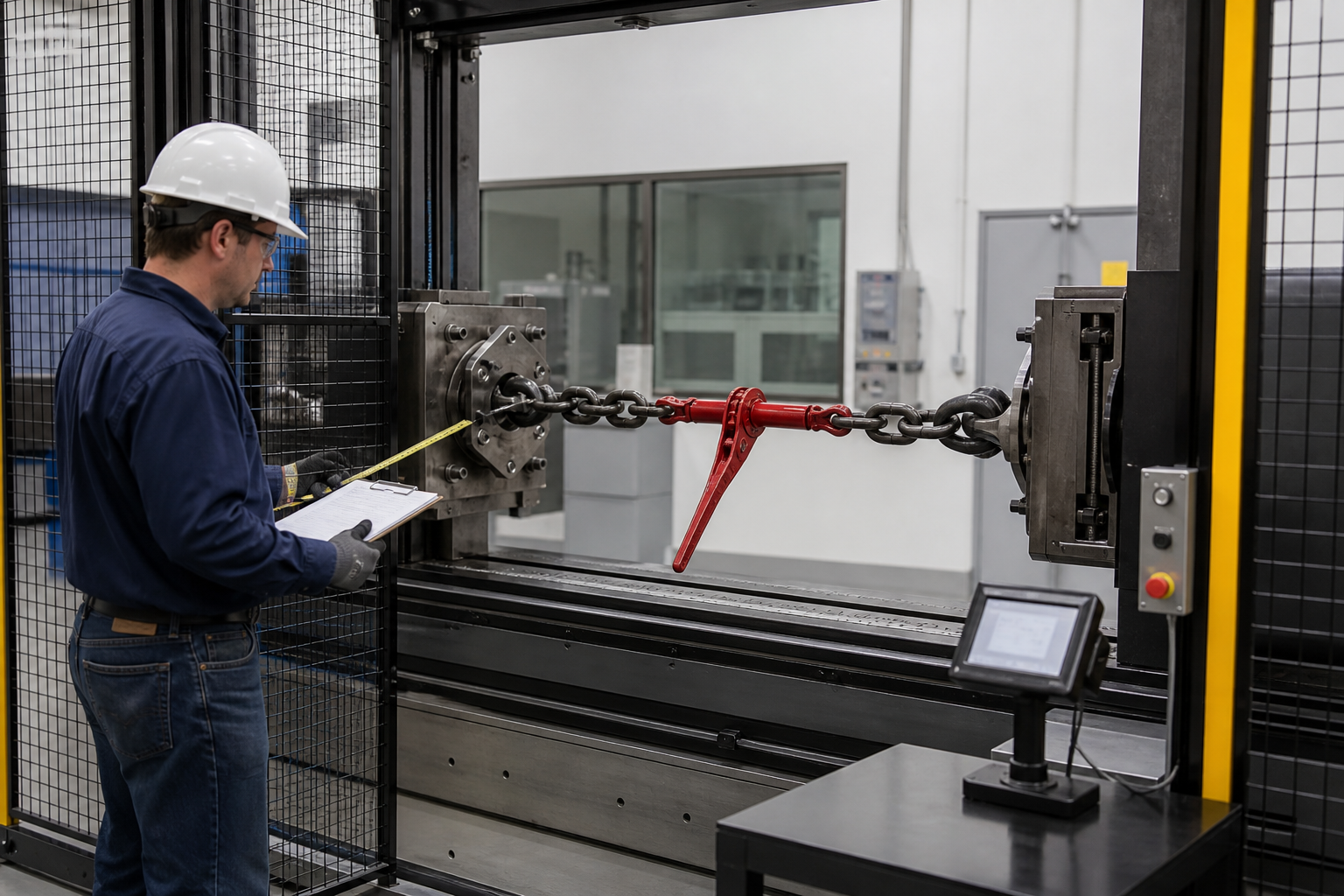
When a quotation says “proof tested,” write a question mark beside it.The phrase needs a load, fixture, direction, loading sequence, hold time, sample or lot rule, acceptance criterion, and referenced requirement. Put those details in the specification. The fixture should load the supplied assembly honestly, not brace a feature that the real tie-down system leaves exposed.
Watch one test when it is safe and practical. The operator should identify the piece, select the correct recipe, confirm units, use guarding, record the result, and place the tested item in its approved next location. Decide in advance whether tested pieces may ship. If they may, define the conditions; if they may not, make sure the segregation route is visible on the floor.
17. Verify calibration, capacity, and fixture condition
Read the machine nameplate, then the calibration record, then the active screen. Capacity alone is not enough; the range and accuracy must suit the required measurement. Check maintenance and the daily or pre-use verification. Copy the equipment ID into the audit notes and find the same ID on a recent product report.
Fixtures bend and holes wear. Sight along the load path and look for off-center pull, damaged pins, or contact that supports the wrong feature. Ask who can change the software recipe and how revisions are locked. Finally compare units on screen and on paper. Confusing kilogram-force, kilonewtons, and pounds-force can create a neat, plausible report with the wrong result.
18. Match sampling frequency to the buyer’s risk plan
Circle the testing frequency on the quote.Is the plan every unit, a fixed sample from each lot, first-off testing, or periodic qualification? The answer must agree with the product specification and the destination-market review. Define the lot in plain language; “one batch” could otherwise mean a shift, furnace charge, assembly order, or container.
Then ask the uncomfortable follow-up: what happens after one failure? Repeating the test until a passing piece appears is not containment. The team should hold related stock, investigate, decide disposition, and apply a written retest or escalation rule. Testing frequency affects machine time, lead time, and cost, so settle it before the order rather than after the production calendar is full.
19. Confirm permanent WLL, identity, and traceability markings
Read the actual marking under normal light. Is the brand or manufacturer identity, model, WLL, compatible chain information, and lot or date code legible and correct for this market? Exact content belongs in approved artwork or the drawing, with qualified compliance review where needed. Check depth and durability on a finished surface, not only on a clean uncoated sample.
Use the code immediately. Can it reach the production and test lot? A code that names only the packing month may be too broad when several component or heat-treatment lots were mixed. Ask how identity survives coating and rework, and what prevents two lots from merging at assembly or packing. If the answer is colored bins, walk over and see whether the colors are understood on the current shift.
20.Audit surface preparation, coating, and corrosion-control evidence
Follow one hanger or basket through cleaning, blasting or preparation, coating, cure, and inspection. Check material identity and the controls that matter for the chosen system. Then turn a finished binder over. Threads, pin joints, swivels, stamped markings, and contact faces are the places where excessive coating can stop movement or thin coverage can expose steel. Bright color by itself proves neither fit nor corrosion performance.
If the requirement includes salt spray or another corrosion check, spell out the specimen, preparation, method, duration, inspection points, and acceptance rule. ASTM B117 describes operation of salt-spray equipment; it does not assign one lifetime or pass value to every binder. The purchase file should explain what is being measured and why that result is relevant to the selected finish.
21. Perform final assembly and functional inspection
At final inspection, let the inspector choose several binders by the approved sampling rule and then let the buyer add one random piece. Run the thread and mechanism through the working range. Check hook movement, pin retention, alignment, marking, finish, sharp edges, cleanliness, and lubricant. The accepted condition should live in a model-specific standard, not in the memory of the most experienced inspector.
Open cartons from the top, middle, and lower pallet positions. Match quantity, model, code, and labels to the packing list. Define critical, major, and minor defects for this product; a wrong WLL marking is not merely a cosmetic label issue.If the sampling plan is approved, record which cartons and units were actually checked so a later question can be answered.
22. Review nonconforming-product control and rework limits
Visit the hold area and try to move a rejected lot on paper. Is it physically blocked and also blocked in the release process? The record should show quantity, defect, affected identity, and who may approve rework, return, use-as-is, or scrap. Load-bearing parts need technically justified rework limits; a supervisor’s confidence is not a repair specification.
Choose one closed nonconformance. Follow it from detection through containment, root cause, correction, corrective action, and the later check that showed the problem did not return. The quantities should add up. A factory willing to discuss an ordinary defect and what it learned is usually more credible than one that claims a flawless history.
23. Approve packaging as part of product quality
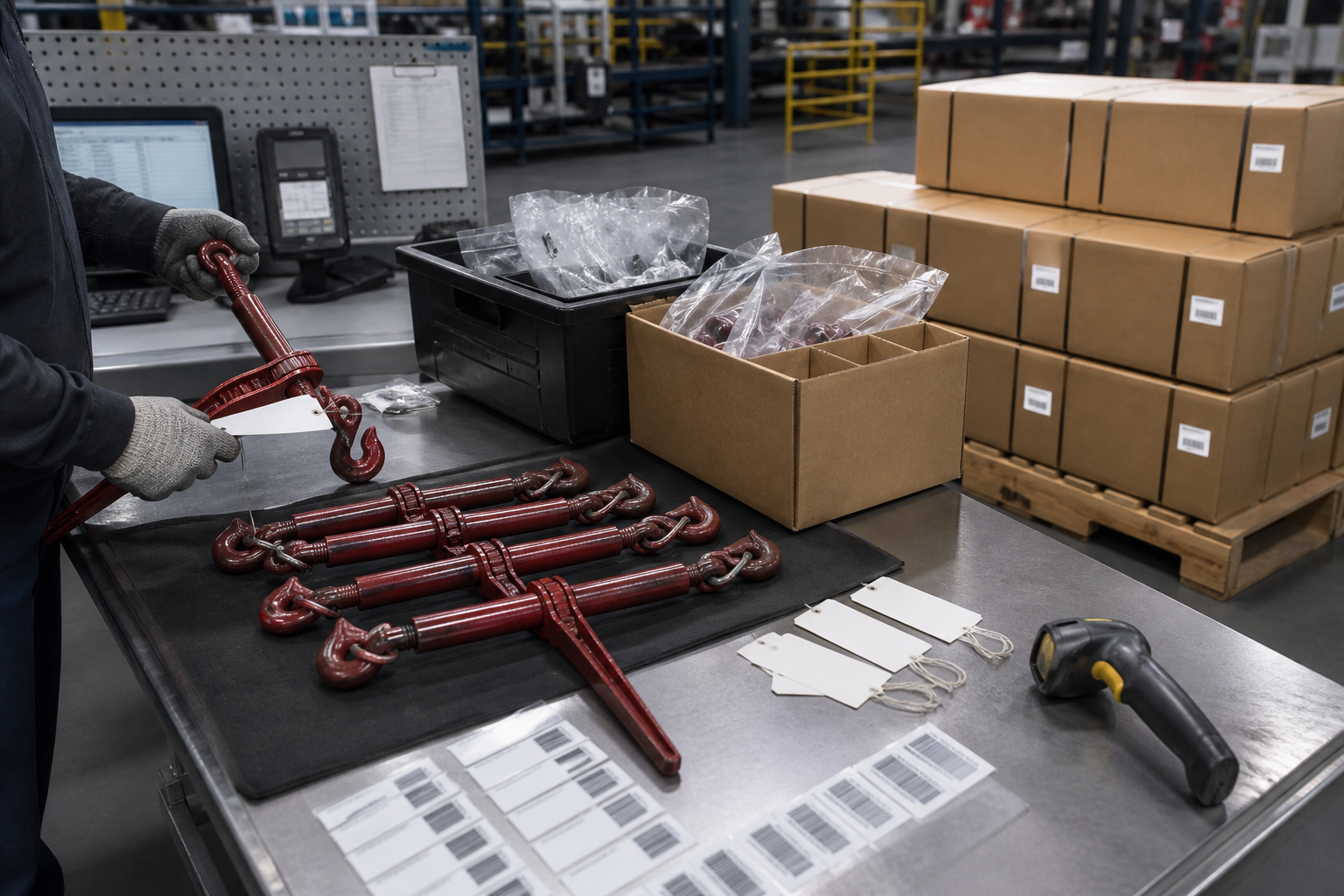
A heavy metal product can damage its own carton, lose labels, chip coating, or create unsafe manual-handling conditions. Review individual protection, moisture control where needed, inner separation, carton strength, gross weight, closure, pallet pattern, edge protection, stretch wrap, and export marks. Simulate ordinary handling or conduct an agreed packaging validation for new programs.
Labels should match the physical binder, approved barcode, working load information, country and importer details where applicable, and the buyer’s artwork. Prevent old labels from remaining at the workstation after a revision.Include spare-label control in the audit because a correct product with an incorrect rating label is a serious release failure. A photograph can support the record, but it can't replace it.
24. Control engineering changes and sub-supplier changes
This is less abstract than it sounds. Ask for the written change process. The factory should obtain buyer approval before changing material grade or source, forging location, heat-treatment supplier or recipe, critical tooling, dimensions, thread process, coating system, marking, test method, or packaging where those changes are controlled by the agreement.
Define the evidence required for approval: revised drawing, risk review, first-article report, material records, test report, samples, and implementation date. The purchase agreement should also state how emergency changes are communicated. Without a change-control clause, a perfectly audited process can gradually become a different process.
25. Close the audit with owners, deadlines, and an approval gate
Classify findings by risk and assign each one to a named owner with an evidence deadline. Separate “must close before sample approval,” “must close before production,” and “monitor during first shipment.” Do not close an action based only on a promise; request a revised document, photograph with identity, test record, sample, or follow-up verification appropriate to the finding.
A buyer can settle this point without a long meeting. The final approval gate should combine audit status, sample results, commercial terms, capacity, lead time, packaging, and contract controls. A technically capable factory can still be a poor fit if it can't protect the agreed lead time or communicate changes. Likewise, a responsive salesperson cannot compensate for missing process evidence. The result should be repeatable on a normal shift.
Audit Evidence Scorecard for Comparing Suppliers
A weighted scorecard keeps the decision from being dominated by price or presentation. Adjust the weight for the intended market and product risk. Require closure of critical findings even if the total score is high.
In other words: check the ordinary process, not the demonstration.
| Audit block | Suggested weight | Minimum evidence | Red flag |
|---|---|---|---|
| Product definition and rating | 15% | Controlled drawing, chain compatibility, approved marking | Rating depends on verbal explanation |
| Material, forging, heat treatment | 25% | Lot trace, process records,property verification | Unidentified stock or hidden subcontracting |
| Assembly and dimensions | 15% | Risk-based control plan and recent records | Frequent uncontrolled hand fitting |
| Proof testing and calibration | 20% | Defined method, suitable machine, traceable results | “Tested” with no load or acceptance rule |
| Traceability and change control | 15% | Lot code, record linkage, buyer approval gate | Cannot trace a finished sample backward |
| Packaging and response system | 10% | Approved pack,complaint and CAPA examples | No owner for field complaints |
Need an Evidence Pack for Your Load Binder RFQ?
Send ZTL your destination market, binder type, chain size and grade, target WLL, annual quantity, finish, marking, and packaging needs. Our team can review the requirement and prepare the relevant drawing, sample, process, test, and packing discussion for your project.
Why does that matter? Because the approved sample is only useful when production can repeat it.Request a Load Binder Sourcing ReviewHow to Request a Quote That Can Be Technically Compared
Pause here and look at the actual production lot. Many RFQs cannot be compared because the suppliers have quoted different assumptions. Give every candidate the same technical and commercial package. Ask each one to return a deviation list instead of silently substituting its standard product.
- Define the exact binder family. State ratchet, lever, or another approved design, not merely “chain binder.”
- Define the chain interface. State chain size, grade, hook requirements, and system context.
- Define rated and dimensional requirements. Include WLL, take-up, handle length, critical dimensions, and marking.
- Define verification. State material records, inspection reports, proof-test method and frequency, certificates, and third-party needs.
- Define finish and packaging. Include color, coating criteria, label artwork, quantity, carton, pallet, barcode, and manuals.
- Define change control. Identify changes that require written approval and new samples.
- Ask for a cost breakdown. Separate product, testing, packaging, tooling, inspection, documents, and logistics assumptions.
When evaluating total landed cost, include inspection, rejected-lot handling, repacking, labeling, inventory delay, and complaint response. A low quote that excludes the agreed proof-test frequency or uses weaker cartons isn't actually comparable. Request the production lead time after sample and artwork approval, the monthly capacity committed to your program, and the recovery plan for a delayed subcontract process. Small variations become expensive when they repeat across a container.
First-Article and Pre-Shipment Approval Sequence
A practical approval sequence reduces the risk of moving directly from a sales sample to full production:
| Gate | Buyer reviews | Release decision |
|---|---|---|
| 1. Requirement freeze | Drawing, specification, market, chain interface, WLL, test rule | Authorize sample preparation |
| 2. Evidence review | Material/process route, audit actions, supplier controls | Authorize formal sample testing |
| 3. First article | Dimensions, function, markings, finish, test records, packaging | Seal sample and revision |
| 4.Pilot lot | Process consistency, lot trace, real packing, inspection time | Authorize mass production |
| 5. Pre-shipment | Quantity, random inspection, documents, labels, pallet and container plan | Release shipment or contain |
The awkward question is usually the useful one. The sealed sample should not become the only acceptance tool. Appearance and function must still be checked against controlled requirements. Keep the approved drawing, inspection plan, evidence package, and sample together. When production moves to a new die, furnace, sub-supplier, or finish system, revisit the appropriate approval gate.
Common Audit Red Flags and the Follow-Up Question to Ask
“We have always made it this way.”
Ask: Which controlled drawing, material specification, process record, and acceptance criterion define “this way”? Experience is valuable, but repeatability needs a shared definition.
“All our load binders are proof tested.”
Ask: At what load, for how long, using which fixture, at what frequency, under which procedure, with what acceptance criteria, and how is the record tied to the shipped lot? It is a modest check, but it exposes a surprising number of problems.
“Heat treatment is our supplier’s secret.”
On an ordinary production day, this should still work. Ask: How do you approve the sub-supplier, specify the required result, identify the batch, verify the output, control changes, and contain a failed lot? Proprietary recipes do not eliminate the need for evidence.
“The working load limit is based on the old sample.”
Ask: Where is the engineering basis, approved test method, material definition, drawing revision, and permanent marking approval? A copied sample isn't a rating system.
“We can change the coating after the order.”
Ask: Which drawing and performance requirements would be affected, and what buyer approval and validation will occur before the change enters production?
“Every product is good; we have no complaints.”
A neat sample doesn't answer this point. Ask: Show the complaint intake, field-trace process, defect trend, corrective-action record, and effectiveness check for a recent issue in any product family. A useful quality system learns visibly. That is the evidence to keep with the order.
Ten Related B2B Sourcing Questions to Link Into One Content Cluster
A buyer may begin with load binders and later need trailer support or broader cargo-control sourcing. The following pillar terms should be handled as distinct decision pages rather than repeated as unrelated keywords:
Why does that matter? Because the approved sample is only useful when production can repeat it.
| Buyer question | Where to continue |
|---|---|
| How do I evaluate a dependable trailer jack manufacturer? | Review ZTL trailer jack product options |
| For my trailer, what size trailer jack do I need? | Use the OEM buyer’s sizing guide |
| Which trailer jack mounting types fit my frame and workflow? | Compare trailer jack configurations |
| Which heavy duty trailer jack applications need additional engineering review? | Discuss intended duty and capacity |
| What evidence supports trailer jack quality control? | See ZTL’s manufacturing background |
| How should I audit a load binder manufacturer? | Start with the load binder range |
| What are the principal types of load binders? | Compare available load binder designs |
| How should I interpret a load binder size chart? | Check size, chain, take-up, and WLL together |
| Which cargo securement equipment belongs in the sourcing specification? | Review load binders as part of the complete system |
| What should buyers know about the rigging hardware manufacturing process? | Learn about ZTL’s company and production focus |
Frequently Asked Questions
What is the most important question in a load binder factory audit?
Ask, “Can we choose one binder from today’s stock and trace it now?” Write down its code and let the normal team work. They should be able to find the released drawing, component or material identity, heat-treatment lot, in-process check, applicable proof-test record, final inspection, marking, and packing entry. Then choose one input lot and trace forward to affected finished stock. This is more revealing than asking whether the factory “has traceability,” because it tests both speed and the links between records.
Is an ISO 9001 certificate enough to approve a load binder supplier?
No. It can be useful evidence that a management system has been audited, provided the issuing body, site, scope, and validity check out. It is not approval of the binder on your quotation. The certificate does not decide chain compatibility, WLL, steel, heat treatment, thread engagement, proof-test method, marking, or the contents of a shipment. Keep the certificate in the supplier file, and continue with the product audit.
Should every load binder be proof tested?
There is no responsible one-word answer without the product specification and applicable market requirements. The buyer and supplier need to agree on the test load, fixture, loading and hold sequence, frequency, sample selection, pass/fail rule, failed-lot action, and whether tested pieces may ship. Ask for a blank record before ordering. If a quotation says “100% tested,” request the exact method and the test-time capacity for the proposed order; the two should make operational sense together.
How do I compare ratchet and lever load binders?
Begin with compatible chain and the required working load limit, then compare take-up, available clearance, operating motion, handle behavior, retention, training, and local operating practice. A lever design and a ratchet design ask different things of the user; price and handle length do not capture that difference. Review the binder as one part of the complete tie-down system, and make sure the delivered marking and instructions identify the design unambiguously.
What records should ship with an OEM order?
Agree on the document pack before the purchase order, not while the container is waiting to sail. Depending on the program, it may include a certificate of conformity, inspection report, proof-test summary, traceability list, named material or process records, packing list, approved deviations, and any required third-party report. Ask for blank or redacted examples during qualification. That exposes missing fields early and avoids a last-minute argument over whether a spreadsheet with one total is the “test report” the buyer expected.
A quick rehearsal helps. Give the supplier a fictitious lot number from the quotation stage and ask the document owner to show where that number would appear on each form. Would the inspection report name the drawing revision? Would the test summary identify the machine and method? Could the packing list connect cartons to the same lot? The forms do not need identical layouts, but they need a common thread. Agree on filenames too. Six attachments called “report-final-new” are surprisingly difficult to audit after a shipment has been received.
How can a buyer reduce substitution risk after sample approval?
Put the drawing revision on the order and list the changes that require written approval: material, heat treatment, tooling, important dimensions, subcontractors, coating, markings, test method, and packaging as applicable. Define when a new first article is needed. Keep a sealed sample as a useful visual reference, but do not let it replace the drawing and test plan. Most importantly, make the change rule part of the commercial agreement so it survives staff changes and old email threads.
What should I send to receive a useful load binder quotation?
Send a one-page brief with the destination market, use case, binder design, chain size and grade, required WLL, take-up, important dimensions, finish, markings, label language, order and annual volume, testing, documents, packaging, target date, and audit or inspection expectations. Attach a drawing when one exists. Ask the supplier to list every deviation instead of quietly quoting the nearest catalog model. Two quotations are comparable only when both suppliers are pricing the same requirement.
Authoritative References for the Buyer’s Compliance Review
Keep the links below beside the sourcing file, but use them for the job they actually do. A regulation can tell a carrier what the securement system must achieve. A product drawing tells the factory what to make. A test plan explains how acceptance will be judged. None of those documents replaces the other two.
- 49 CFR Part 393, Subpart I: start here when the project concerns cargo securement on U.S. commercial motor vehicles. Check the current text and have a qualified reviewer confirm how it applies to the vehicle, cargo, and operating situation.
- FMCSA Driver’s Handbook on Cargo Securement: a useful practical companion for drivers and carriers. It is not an OEM drawing and it does not approve a particular binder SKU.
- ASME B30.26, Rigging Hardware: read the scope before putting the standard number on a specification. Cargo-control products and overhead rigging are not interchangeable categories merely because both involve hardware.
- ISO 9001:2015: useful for understanding the quality-management framework behind document control, purchasing, corrective action, and related processes. It is not a product certificate and does not create a WLL.
- ASTM B117: describes operation of a salt-spray apparatus. The buyer still has to state specimen preparation, duration, inspection method, and the product-specific acceptance limit.
Safety note: This article is a buyer’s factory-audit guide, not a load plan or operating manual. It cannot approve a vehicle, cargo arrangement, chain, binder, or working method. Selection and use must follow current law, the product instructions, real vehicle and cargo conditions, inspection and maintenance rules, and qualified advice for the destination market.
Conclusion: Buy the Evidence, Not Just the Sample
The polished sample on the conference table is easy to remember.The less glamorous evidence is what protects the order: a legible drawing revision, a heat-treatment chart tied to the lot, a test record with a known fixture, markings that match the specification, and a carton that still contains every loose part when it arrives. The audit is successful when those details connect without a salesperson translating every step.
Take the checklist onto the floor. Mark each line “accepted,” “open,” or “not applicable,” and attach the photograph or record that supports the decision. An open point needs a person and a date. Some minor items can close after the visit; compatibility, WLL, critical function, traceability, and shipment integrity should be settled before production release. That creates a clean handoff from sourcing to engineering, quality, and logistics.
When asking ZTL for a comparable review, send the requirement as it will appear on the order: destination, chain size and grade, binder design, WLL, take-up, volume, finish, marking, testing, documents, and packing. If one item is undecided, label it as an open question. That is more useful than burying uncertainty inside a catalog reference.
What a useful audit close-out sounds like
Picture the last twenty minutes of the visit. The sample binder is still on the table. One person has the drawing open; another has the action list. The buyer does not ask, “Is everything okay?” Instead, the group reads the open lines aloud.
“Chain interface: drawing updated, engineering to approve Friday.” “Heat-treatment trace: record found, but the finished-lot link is missing.” “Carton divider: revised sample due next week.” “Marking photograph: accepted.” Short statements work. Each one names the evidence and the next move. If a point cannot be summarized that plainly, it probably needs more work before anyone leaves.
Now look at the physical binder again. Does the model code on the body match the drawing on screen? Can the team point to the lot in the heat-treatment record without searching by memory? Does the ratchet run through its take-up without a catch? Are the loose parts restrained in the carton? These are not new audit questions. They are a final check that the meeting-room decisions still describe the product in front of the group.
The close-out should also say what is not being approved. Perhaps color is accepted but the proof-test plan remains open. Perhaps dimensions pass but destination-language artwork needs legal review. Splitting the decision this way prevents a friendly handshake from being interpreted as blanket production approval. The purchase order can then refer to a dated list instead of somebody’s recollection of the meeting.
After the visit, send the list back with evidence attached and keep the same item numbers. Do not start a fresh spreadsheet for every reply. When the last high-risk line closes, the release decision becomes simple to explain: what was required, what was shown, who accepted it, and which revision will be produced. That is the sort of audit trail a buyer can use months later, when the people in the room are busy with a different order.
Planning a Load Binder OEM or Bulk Purchase?
Send the destination market, binder type, chain size and grade, WLL, annual volume, finish, branding, test evidence, and packing requirements. We will use those details to identify the remaining technical questions and prepare the next commercial step.
Send Your RFQ to ZTL