English


 How to Choose a Trailer Jack: Capacity, Top Wind vs Side Wind, and an OEM Buyer’s Guide
A trailer jack looks simple until the wrong one reaches the assembly line. Then the real costs appear: a crank collides with a toolbox, the foot plate sinks into soft ground, the tube is too short to level the coupler, or the nominal capacity is misunderstood. For an individual owner, that is frustrating. For a trailer builder, parts distributor, fleet operator, or private-label buyer, the same mistake can repeat across an entire production batch.
This guide explains how to choose a trailer jack from two perspectives at once. First, it covers the practical engineering questions: supported load, top-wind versus side-wind operation, travel, drop leg, mounting style, materials, finish, and operating environment. Second, it shows procurement teams how to evaluate a trailer jack manufacturer for consistent bulk supply, customization, testing, packaging, and documentation.
The short answer is this: choose the jack around the maximum real load at the jack point, not the trailer’s total weight alone. Next, stand at the drawbar and picture the crank making a complete turn. Does it hit the toolbox, a gas bottle, or the frame? Check the lift range and the height when fully retracted. Only then move on to the bracket and the finish. In an OEM program, a smart buyer also pins down the less visible details—the approved drawing, the inspection record, the lot code, the carton, and who must approve a later design change. A polished sample cannot answer those questions.
Sizing a jack for a real trailer? Start with the measurements.
Send us your maximum tongue load, required travel, mounting drawing, finish requirement, annual volume, and target market. Our team will help you narrow the specification before quotation.
✉ Request a Trailer Jack RecommendationWhat a Trailer Jack Is Actually Supporting
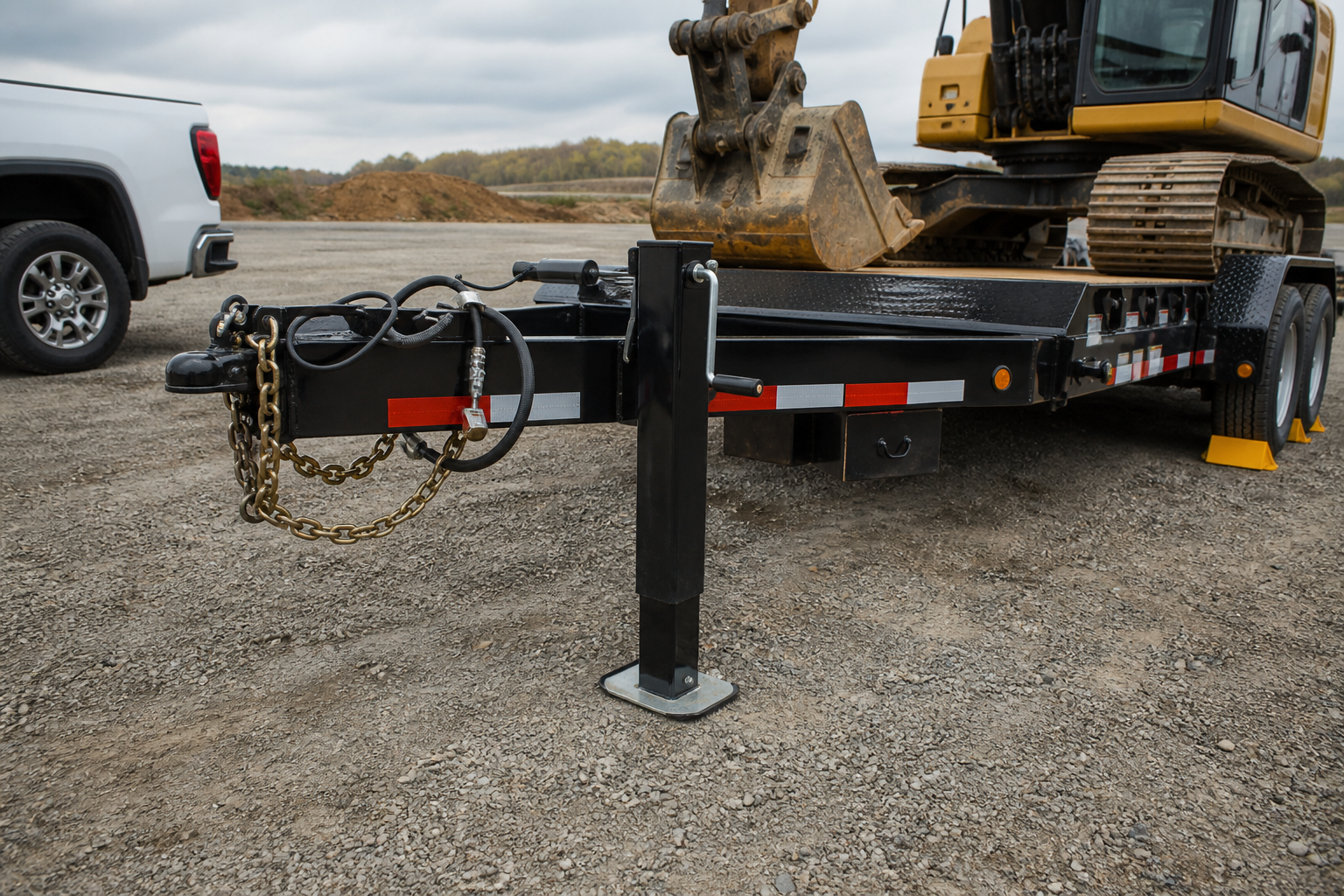
Watch a trailer being uncoupled and the jack’s job becomes obvious: it takes over the load at the front while the axles remain on the ground. The operator uses it to bring the coupler up, bring it down, and hold the tongue at a practical parking height. In other words, the jack usually sees the vertical load at the tongue or drawbar. It does not suddenly inherit every pound shown on the trailer’s gross-weight plate. Miss that distinction and it is easy to buy a jack that is needlessly bulky—or one with too little reserve.
Take a 10,000 lb loaded trailer as an example. Its axles do not stop working when the tongue jack comes down; they still carry most of the mass. The number we need is the load that reaches the jack in the particular operation being studied. Shift a machine forward, uncouple the tow vehicle, add a second jack, or move the jack point, and that load changes. So does an apparently minor change to drawbar geometry.
The U.S. National Highway Traffic Safety Administration advises purchasers to obtain the fully loaded trailer’s tongue-weight information from the manufacturer and relate it to the towing vehicle’s ratings. That official guidance is aimed at safe vehicle loading, but it also reinforces a sound jack-selection habit: work from verified loaded conditions rather than a convenient guess. See the NHTSA interpretation on loaded tongue weight and vehicle ratings.
For a new trailer, calculate the harshest loading case that can reasonably occur and check it on a representative build. Replacing an old jack? Measure the tongue with the trailer loaded the way its owner actually uses it. If the readings wander, the high reading is the useful one. Empty-trailer crank effort can be misleading; machinery, cattle, a pallet of blocks, or a full cargo box can turn an easy crank into a strained one.
How to Choose Trailer Jack Capacity
1. Start with the maximum supported load, not a brochure assumption
The capacity printed on a jack is a limit under defined conditions. It is not a target operating point and it does not cancel the need to understand the application. Ask these questions before selecting a rating:
- What is the maximum measured or calculated vertical load at the jack location?
- Is the towing vehicle connected or disconnected during the lift?
- Can cargo shift toward the tongue during loading or transport?
- Will one jack carry the load, or will two jacks share it?
- Is the jack used occasionally, daily, or repeatedly on a production or rental fleet?
- Will side loads occur because the ground is uneven or the trailer is moved while supported?
Do not divide a total load equally between two jacks unless the structure and operating procedure actually distribute it equally. Small differences in ground height, mounting position, frame stiffness, and operator sequence can make one jack carry more than half.
2. Apply an engineering margin
Once the maximum support load is known, do not pick a rating that merely meets it on paper. A 20–30% cushion is a common first pass in purchasing departments, but it is only a screening habit—not a law and not a substitute for engineering review. A rental trailer cranked twenty times a day has a different life from a privately owned utility trailer used twice a month. Shock, a slightly crooked mount, winter grease, road salt, and uncertain cargo position can all argue for more room. The trailer designer’s assessment and the jack maker’s instructions still have the last word, along with any rules in the destination market.
Oversizing has limits too. A much larger jack can increase cost, weight, crank effort, packaging volume, and mounting demands without solving a real problem. The useful question is not “What is the biggest jack available?” It is “What rating and configuration provide reliable operation in the worst expected condition?”
3. Use capacity bands to narrow the product family
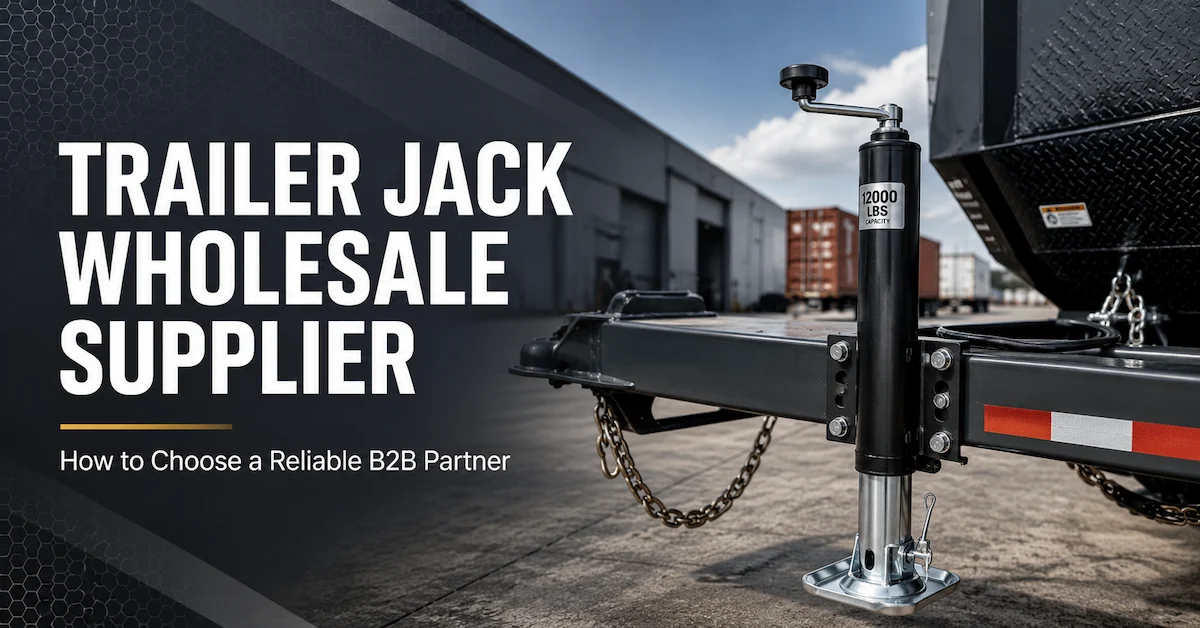
Ningbo Zhongteli’s current trailer-jack range includes models at 2,000 lb, 5,000 lb, 7,000 lb, and 12,000 lb, with top-wind and side-wind options. These ratings allow buyers to match compact utility applications, medium-duty trailers, and heavier commercial platforms without forcing one design into every use case. View the current trailer jack product series for available configurations.
Two jacks can share a 7,000 lb label and still be poor substitutes for one another. Put a top-wind crank beside a low toolbox and it may never complete a turn. Put a side-wind crank beside a crowded A-frame and the same problem appears from another direction. Gear layout, travel, bracket position, and where the operator must stand all change the experience. Capacity gets a product onto the shortlist; it does not finish the specification.
Top Wind vs Side Wind Trailer Jack: Which Is Better?
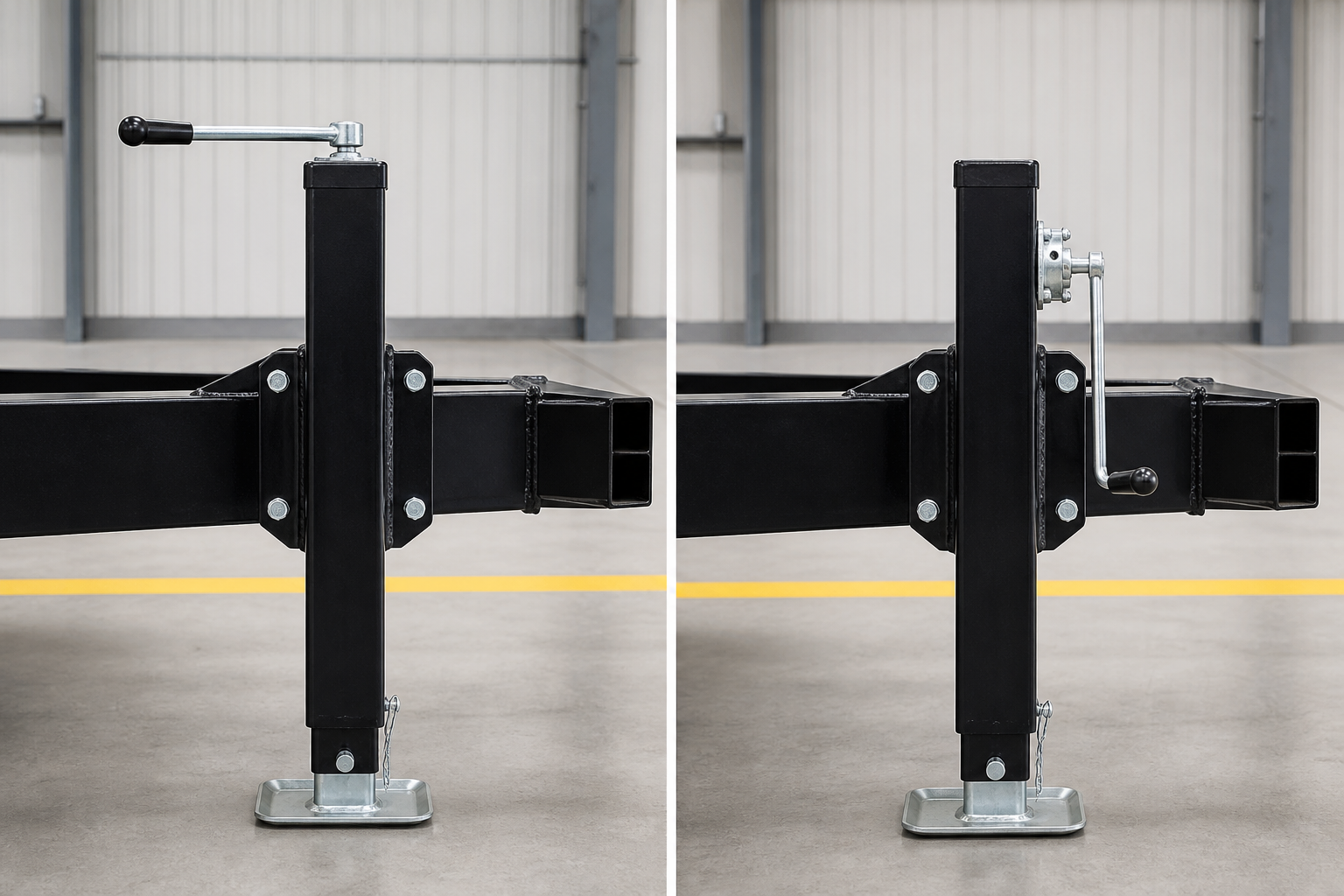
The terms describe where the crank is located and how the operator moves it. A top-wind handle sits at the top and rotates in a horizontal circle. A side-wind handle projects from the gearbox or tube and rotates in a vertical circle. Neither layout is automatically superior. Clearance and duty determine the better choice.
| Decision factor | Top-wind trailer jack | Side-wind trailer jack |
|---|---|---|
| Handle movement | Horizontal rotation above the jack | Vertical rotation beside the jack |
| Best clearance condition | Limited side clearance; open space above | Open side clearance; restricted space above |
| Operator position | Hands remain near the top of the tongue | Operator cranks from the side |
| Typical interference risk | Toolboxes, covers, or low structures above | Frame rails, propane bottles, winches, chains, or accessories beside the tube |
| Good purchasing use case | Compact drawbars and clean side profiles | Frequent operation and heavy-duty layouts with generous side access |
Choose top wind when side clearance is the constraint
A top-wind jack is often the neatest answer when the drawbar carries a toolbox, winch post, gas bottle rack, battery box, spare-wheel carrier, safety-chain bracket, or other equipment close to the jack tube. The operator needs a clear circular area above the jack, so check the handle radius at every height and at every nearby lid or cover position. A handle that clears when a toolbox is shut may still collide when the lid is open.
Zhongteli lists top-wind models at 2,000 lb and 7,000 lb. Look closely at the company’s 7,000 lb top-wind weld-on trailer jack: the specification calls out 15 inches of powered travel, a 13-inch drop leg, alloy steel, a black powder-coated body, and zinc-plated parts. None of those entries is decorative. Together they tell a buyer how quickly the foot reaches the ground, how far the coupler can move, how the unit joins the frame, and what protection exposed surfaces receive.
Choose side wind when operator leverage and access favor the side
A side-wind jack is familiar to many operators and can be comfortable during repeated use, especially when there is open space beside the tongue. It is a practical option for equipment, utility, agricultural, cargo, and other commercial trailers where the crank can sweep freely. Before approval, model the full handle path. Check it against the trailer frame, coupler, drawbar braces, wiring, safety chains, storage boxes, and the towing vehicle in the coupled position.
Zhongteli’s current range includes 2,000 lb side-wind, 5,000 lb side-wind, and 12,000 lb side-wind configurations. The spread makes it possible to standardize a family appearance while matching different trailer classes.
Travel, Drop Leg, and Retracted Height
Buyers frequently focus on lifting capacity and overlook geometry. Yet many field complaints are geometry complaints: the jack cannot raise the coupler high enough, takes too many crank turns to reach the ground, or hangs too low during travel.
Travel
Travel is the powered vertical movement produced by the screw or gear mechanism. More travel offers a wider adjustment range, but it can also increase the number of crank turns and affect overall length. Measure the required coupler heights in the lowest and highest expected conditions. Include tire size, suspension deflection, towing-vehicle hitch height, ground slope, and any planned model variants.
Drop leg
A drop leg provides quick coarse adjustment before the screw mechanism performs the final lift. It reduces unnecessary cranking when the jack starts far above the ground. The drop-leg hole spacing, pin engagement, foot design, and retention method deserve attention. Operators should be able to set it without placing fingers in pinch points or struggling with a contaminated pin.
Retracted and extended dimensions
Ask the supplier to state dimensions from consistent reference points. “Retracted height” is ambiguous unless the drawing shows whether it is measured from the mounting point to the foot, from the top of the tube, or from another datum. For OEM release, put the exact datums and tolerances on the approved drawing.
Also check road clearance in the fully retracted position. A long foot or poorly positioned drop leg can become a strike point on ramps, curbs, uneven yards, and approach transitions. If the jack can swivel, verify the stowed envelope and locking-pin engagement.
Mounting Style and Trailer Structure
A strong jack attached to a weak or poorly reinforced frame is not a strong system. The mounting choice must transfer load into the trailer structure without excessive local deformation, weld cracking, fastener movement, or misalignment.
Weld-on trailer jacks
Weld-on construction gives a square-tube heavy-duty jack a clean, permanent home. It works well on an OEM line when the frame steel, bracket, access, and weld procedure are known quantities. The trailer builder must still validate the joint and the metal around it. There is also a mundane production detail worth settling early: welding burns coatings. The work instruction should say what is masked, when the weld is made, how the area is cleaned, and how corrosion protection is restored afterward.
Bolt-on trailer jacks
A bolt-on jack is attractive when the frame is already painted or when a fleet wants straightforward field replacement. The convenience ends if the clamp does not fit the drawbar. Confirm the frame section, fastener grade, tightening requirement, locking method, and whether a wrench can actually reach the hardware. Thin tubing may need a reinforcement plate; otherwise the bracket can pinch the wall before the joint is truly secure. “Universal” is a word to test with a drawing, not trust on a carton.
Swivel and fixed mounts
A swivel jack folds out of the way, which is useful on many light and medium trailers. A fixed jack is simpler and common once loads become heavier. On a swivel design, inspect the pin, the depth of engagement, bracket wear, and what keeps the jack from shaking loose in the stowed position. On a fixed design, crouch down and look at the lowest point when retracted. That is the part a ramp, kerb, or rough yard will find first.
Materials, Surface Finish, and Corrosion Resistance
Few components live in a dirtier place than a trailer jack. Spray from the tyres brings water, grit, winter salt, mud, fertiliser, and whatever else is on the road or farmyard. Washdown chemicals add another attack. Calling the body “steel” tells purchasing very little. Calling a finish “corrosion resistant” tells quality control even less, because neither phrase can be inspected against a number.
Put the details on paper: tube grade and wall, shaft and gear materials, foot-plate thickness, weld acceptance, and any heat treatment that the design relies on. Do the same for the finish. Is it zinc plate, powder, wet paint, or a mixed system? A plating note should name the standard, thickness window, visual limit, and what happens to threads. A powder-coat note should cover pretreatment, colour, film build, adhesion, and—when the application justifies it—the agreed salt-spray method and acceptance point.
Catalog shots rarely show the places that decide coating life. Turn the sample over. Look along the tube seam, under the foot, inside pin holes, around weld toes, beside fastener recesses, and where a plated handle meets a coated housing. Water collects in corners; assembly tools nick edges. Rust tends to announce the overlooked process, not the best-looking flat panel.
Private-label buyers should sign a physical colour standard and agree on its tolerance instead of approving a phone photo. The same black shifts with gloss, texture, steel preparation, and lighting. Packaging needs similar realism. If a loose crank can rub the tube for five weeks at sea and another week on a truck, it will arrive with a bright scar no matter how good the coating looked at final inspection.
OEM sourcing checkpoint
A product photo is not a specification.
For a comparable quotation, provide a drawing or a controlled requirement sheet covering rating, travel, drop leg, retracted height, handle layout, mounting, materials, coating, label, packaging, inspection and annual volume.
➜ Send Your RFQ DetailsMatch the Jack to the Application
Utility and light cargo trailers
Priorities often include compact size, easy replacement, moderate capacity, and simple operation. A 2,000 lb top-wind or side-wind jack may fit many designs, but only after the actual support load and geometry are verified. Swivel mounting can improve clearance, while a fixed mount may be preferred for a cleaner production design.
Boat and marine trailers
Water exposure makes corrosion protection and drainage especially important. If a wheel is used, confirm the expected surface, wheel load, fork design, and maneuvering limits. A trailer jack is not automatically a powered mover; side loading can damage the tube, bracket, or wheel assembly.
Livestock and agricultural trailers
These applications see dirt, washdown, uneven yards, high usage, and changing loads. A broad foot, robust drop leg, accessible grease points, and a finish that tolerates contamination may matter more than visual gloss. Side-wind operation can be convenient where there is room, while top-wind can avoid nearby equipment on a crowded drawbar.
Equipment, dump, and commercial cargo trailers
Higher support loads and frequent cycles push buyers toward heavy-duty square-tube designs. Check frame reinforcement, weld details, gearbox performance, handle effort, foot stability, and service access. For fleet programs, standardization across trailer models can reduce spare-parts complexity, but do not force one rating onto incompatible load cases.
OEM and private-label programs
OEM buyers need repeatability. A sample that works once is not enough. Establish critical-to-quality dimensions, inspection frequency, gauge methods, coating criteria, functional testing, label content, packaging, and an engineering-change approval process before mass production.
How to Evaluate a Trailer Jack Manufacturer
The lowest unit price can become the highest landed cost when dimensions drift, coatings chip, handles are packed loosely, or replacement parts do not match the original batch. A qualified OEM trailer jack supplier should make the product easier to control, not harder to explain.
1. Follow the part through the factory
Ask the salesperson to walk you through one jack, from raw tube to sealed carton. Where is the tube cut? Who welds the bracket, machines the gear parts, coats the body, plates the crank, runs the load check, and packs the handle? Some work may leave the factory, and that is not automatically a problem. The revealing part is whether anyone can show the outside processor’s specification, approval status, incoming check, and lot record. A vague “our partner handles it” is not process control.
2. Review the drawing before negotiating price
A drawing exposes assumptions. It should identify capacity, travel, drop-leg adjustment, mounting interface, handle envelope, key materials, finish, dimensions, tolerances, labels, and revision level. If the quote is based only on a picture and a capacity number, suppliers may be pricing different products.
3. Define testing and inspection
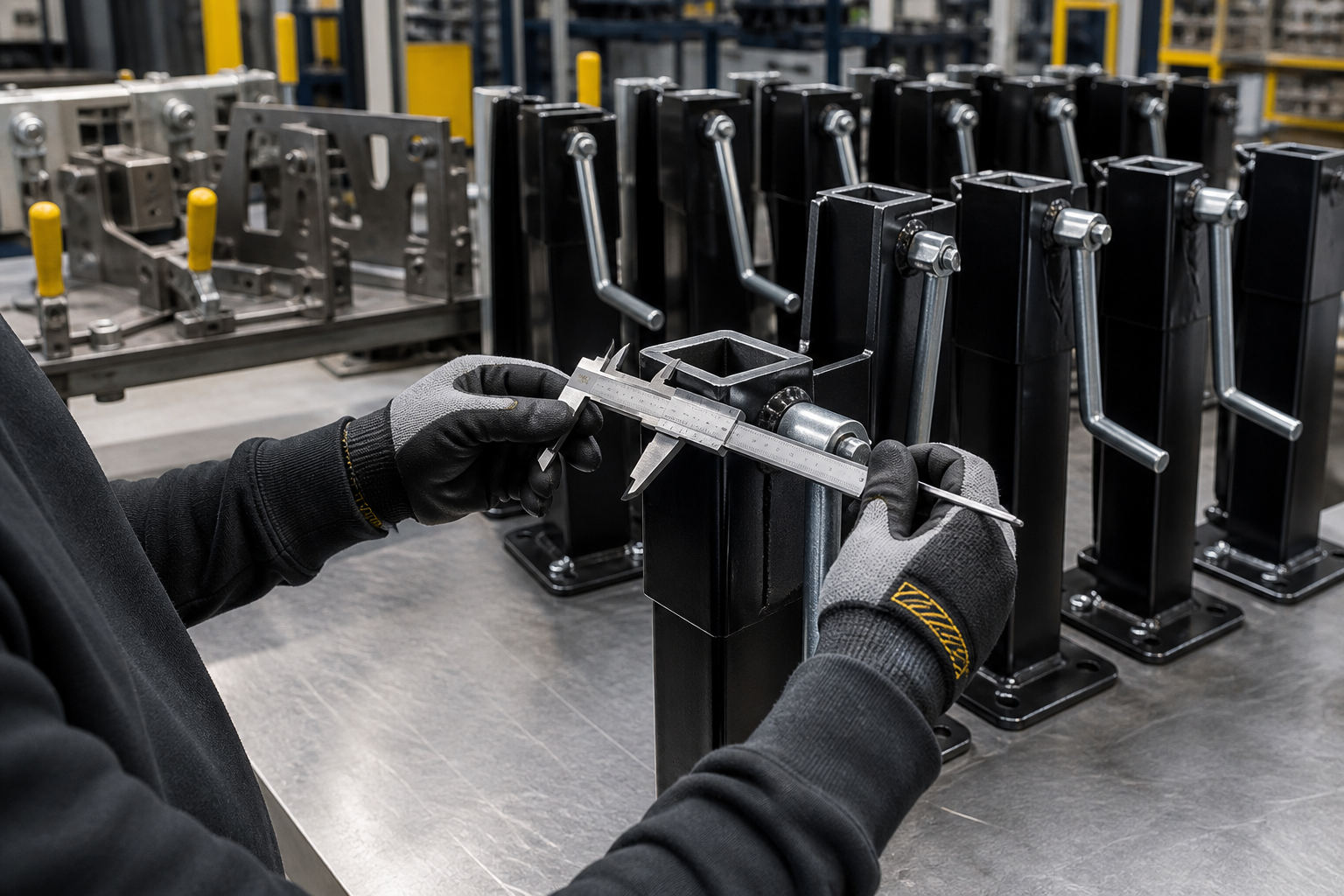
Ask how incoming materials, welds, dimensions, gear operation, extension limits, coatings, and final assemblies are checked. Define what is tested on every unit, every batch, or during periodic validation. For load-related tests, agree on fixtures, load direction, hold time, acceptance criteria, sample size, and record format. A test number without a method is difficult to compare.
4. Check batch consistency and traceability
For distributors and trailer factories, one good sample has limited value if later shipments change. Purchase documents should tie the product to an approved drawing, sample, material requirement, finish standard, label artwork, and packaging specification. A visible lot code or other trace method makes complaints easier to isolate and correct.
5. Evaluate customization realistically
Useful customization may include capacity class, travel, drop leg, mounting bracket, handle arrangement, foot plate, finish color, label, carton, pallet pattern, and documentation. Each change can affect tooling, minimum order quantity, lead time, validation, and price. A responsible supplier will distinguish a cosmetic change from an engineering change.
6. Price the problem you are trying to avoid
A unit quotation is only one line in the cost. Put tooling, samples, lab work, cartons, pallet utilisation, duty, replacement pieces, incoming inspection, and slow after-sales response on the same sheet. A jack that costs a little more can still be the cheaper buy if assemblers fit it without rework, more pieces fit safely in a container, and the coating survives the customer’s environment. The uncomfortable warranty call is part of landed cost too, even if it arrives six months later.
Ningbo Zhongteli Rigging Co., Ltd. describes a business built over more than 15 years, with shipments to 20-plus countries and regions. Its published annual output for trailer jacks is about 200,000 sets. The wider factory range includes load binders, torque shafts, forged hooks, and related rigging products, while the service offer covers custom work, production control, quality management, and export support. Buyers can review the company background on the Zhongteli manufacturing page.
Trailer Jack RFQ Checklist for Bulk Buyers
A complete RFQ gets a faster, more comparable answer. Include the following information:
- Application: utility, boat, livestock, equipment, dump, cargo, agricultural, or custom trailer.
- Maximum support load: measured or calculated load at the jack point, including the worst loading case.
- Required rating: your specified capacity after the engineering margin is applied.
- Operation: top wind or side wind, with a drawing of the available crank envelope.
- Travel and geometry: powered travel, drop-leg range, retracted height, extended height, and reference datums.
- Mounting: weld-on, bolt-on, swivel, fixed, bracket dimensions, frame section, and reinforcement.
- Material and finish: tube and component requirements, plating or coating system, color, and corrosion criteria.
- Foot or wheel: size, material, ground condition, and any maneuvering requirement.
- Testing: functional, dimensional, load, coating, and packaging tests with acceptance criteria.
- Marking: rating label, warnings, brand, part number, lot code, language, and target-market requirements.
- Packaging: individual protection, carton quantity, pallet limits, barcode, and drop or transport requirements.
- Commercial data: sample quantity, annual forecast, order quantity, delivery destination, target date, and Incoterm.
Common Trailer Jack Buying Mistakes
Choosing from gross trailer weight alone
Gross trailer weight is important to the overall towing system, but it is not the same as load at the jack. Use the actual vertical support load at the jack location, then apply the selected margin.
Ignoring handle clearance
A correct capacity does not help if the crank hits a toolbox, spare tire, frame rail, battery box, tow vehicle, or the operator’s body. Validate the full handle sweep on a real trailer or a reliable digital model.
Comparing suppliers with incomplete specifications
“7,000 lb black trailer jack” leaves too much open to interpretation. Travel, drop leg, retracted height, tube size, wall thickness, mount, handle, foot, materials, coating, label, testing, and packaging can all change the product and price.
Using the jack as a substitute for safe support practices
Do not work beneath a raised trailer supported only by a tongue jack. OSHA’s construction rule for jacks states that after a load is raised it must be cribbed, blocked, or otherwise secured at once. The rule’s exact applicability depends on the workplace and jurisdiction, but the underlying precaution is sound: a lifting device is not a substitute for properly rated support equipment and a controlled procedure. Review OSHA 29 CFR 1926.305 and follow the trailer and jack manufacturers’ instructions.
Approving a golden sample without controlling later changes
The sample should be tied to a drawing, bill of materials, finish note, test method, carton plan, and revision letter. Write the change rule into the order: a different steel source, coating supplier, die, weld fixture, or critical dimension must come back for approval before it quietly appears in production.
A Two-Minute Check Before the Crank Turns
A correctly sized jack can still be unsafe after a season of neglect. Before use, read the maker’s instructions and give the hardware a deliberate look. Is the tube straight? Is there a hairline at a weld, a loose bracket, a chewed fastener, a badly rusted foot, or a missing pin clip? Turn the crank and listen. Grinding, a tight spot, a bent handle, or a label that can no longer be read deserves attention before the trailer is uncoupled. Marks above the intended extension are another warning.
Choose firm, reasonably level ground and chock the wheels first—not after the coupler is already free. Keep boots and fingers out of the pinch path. On soft ground, place a suitable load-spreading pad under the foot. A tongue jack is built for vertical work; dragging the trailer sideways on it can bend the tube or punish the bracket unless the product and the written procedure expressly allow that use.
Grease only where, when, and with what the manufacturer specifies. Too little raises friction, but a sticky excess can turn road grit into lapping compound; some greases also stiffen badly in winter. Wipe the exposed tube, screw area, and pins clean, and replace a damaged capacity label rather than guessing later. Fleet managers get better results from a pocket-size check card and a red defect tag than from a general reminder to “look it over.”
Frequently Asked Questions
What capacity trailer jack do I need?
Use the heaviest vertical load that can actually reach the jack point. Do not copy the trailer’s entire gross weight into the jack column and call the job finished. Measure a loaded trailer or calculate its worst loading case, leave enough reserve for the duty, and have the trailer designer and jack maker agree with the choice.
Is a 2,000 lb trailer jack enough for a 5,000 lb trailer?
It may be, because the axles usually carry most of the trailer weight, but the answer depends on actual tongue load, cargo distribution, geometry, duty cycle, and the jack’s instructions. Never approve the size from gross trailer weight alone.
Is top wind or side wind better?
Top wind is often better when side clearance is tight. Side wind is often comfortable when the side of the drawbar is open and the operator wants a vertical cranking motion. Check the complete handle envelope, not just the jack tube location.
What is the difference between travel and a drop leg?
Travel is the distance produced by cranking the screw or gear. The drop leg is the quick, pin-adjusted section that takes up empty space before cranking starts. One supplies controlled lift; the other saves time. Their combination decides how many turns the operator makes, how high the coupler reaches, and how much metal hangs below the frame on the road.
Should I choose a weld-on or bolt-on trailer jack?
A weld-on jack is compact and permanent, which suits a controlled trailer production line. A bolt-on unit is easier to replace and does not scorch a finished frame. Neither choice rescues an under-reinforced drawbar; the trailer structure still has to carry the load introduced at the bracket.
Can a trailer jack hold a trailer while someone works underneath?
Do not rely on the tongue jack alone. Chock the trailer and use properly rated stands, cribbing, or other support in accordance with the equipment instructions and applicable safety rules. Never place yourself beneath an inadequately secured load.
What information does an OEM trailer jack manufacturer need?
Provide the application, maximum support load, rating, top- or side-wind preference, travel, drop leg, retracted and extended dimensions, mounting drawing, finish, label, testing, packaging, quantity, destination, and target date. Photos help, but a controlled drawing is better.
Can trailer jacks be customized for private-label programs?
Yes. Depending on volume and engineering review, customization can include dimensions, mounting, handle arrangement, foot plate, finish, color, branding, labels, cartons, pallets, and documentation. Engineering changes may require samples, tooling, testing, and a revised lead time.
Final Selection Summary
The selection can be reduced to a practical sequence. Find the load at the jack point. Leave reserve for the way the trailer is really used. Swing a top-wind and a side-wind handle through their full paths on the drawing—or, better, on the trailer. Check the powered travel, drop leg, road clearance, bracket, steel, coating, and weather exposure. After that, turn to the supply paperwork. The drawing, test setup, inspection points, warning label, carton, and change rule are all part of the jack you are buying, even though none of them appears in a beauty shot.
Zhongteli’s range gives buyers several places to start: top-wind and side-wind models at 2,000, 5,000, 7,000, and 12,000 lb capacity classes. The right one still comes from the application data. For trailer plants, distributors, fleets, and private-label programs, the company can combine that product range with custom engineering review, production, inspection, and export support.
From specification to shipment
Get a trailer jack quotation built around your real application
Tell us the supported load, handle preference, travel, mounting, finish, quantity and destination. We will review the specification and respond with a suitable product or customization path.
✉ Contact Zhongteli for a QuoteAuthoritative References
- National Highway Traffic Safety Administration, Interpretation nht76-1.46: guidance to obtain fully loaded trailer tongue-weight information and relate it to towing-vehicle ratings.
- Occupational Safety and Health Administration, 29 CFR 1926.305, Jacks: rated-capacity, inspection, and load-securing requirements for covered jack use.
Safety note: This article provides general purchasing and selection guidance. It does not replace the trailer designer’s calculations, the product manufacturer’s instructions, workplace procedures, or laws and standards applicable to a specific vehicle, product, country, or use.