English


What Should B2B Buyers Expect From a Ratchet Load Binder Supplier?
A ratchet load binder supplier should do more than provide a product that can tighten transport chain. For distributors, cargo-control brands, trucking fleets, trailer-equipment buyers, and industrial procurement teams, the real purchasing decision involves matching the binder to the chain system, verifying rated performance, controlling manufacturing consistency, and reducing risk across repeated bulk orders.
A ratchet load binder is used to remove slack and apply controlled tension to a chain tie-down system during cargo transportation. Compared with a lever-style binder, the ratcheting mechanism allows tension to be applied progressively rather than through one large lever movement. A commercial ratchet binder product should therefore be evaluated as part of the complete cargo securement system, not as an isolated piece of hardware.
Zhongteli lists its Ratchet Type Load Binder within its broader Load Binder product range. Its published product information highlights a ratchet operating design, drop-forged construction, heat treatment, short-reach hooks, individual proof testing, and customization availability.
For procurement teams, however, these features are only the starting point. Before approving a supplier, buyers should also confirm the exact chain grade and size, working load limit, take-up range, hook configuration, markings, surface finish, inspection method, documentation, packaging, and batch consistency.
Why Ratchet Load Binders Are Common in Commercial Cargo Securement
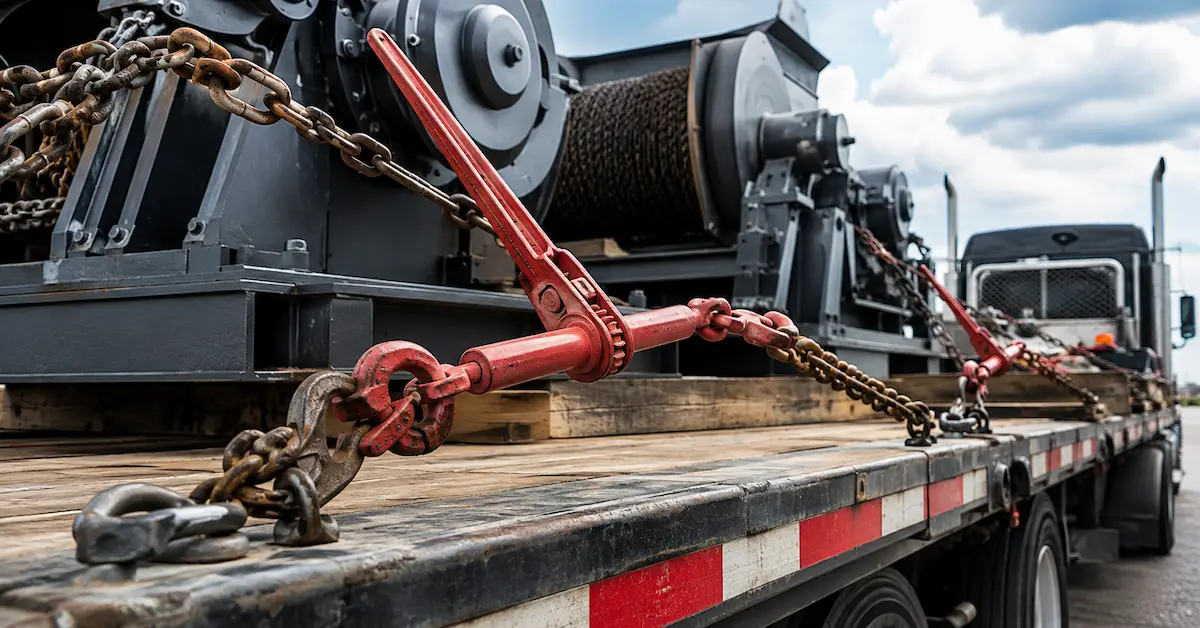
Ratchet binders are widely associated with transport-chain applications because the screw-and-ratchet mechanism allows the operator to tighten a chain incrementally.
This operating principle is particularly useful when cargo securement requires controlled adjustment rather than a single rapid tensioning movement.
Typical applications include:
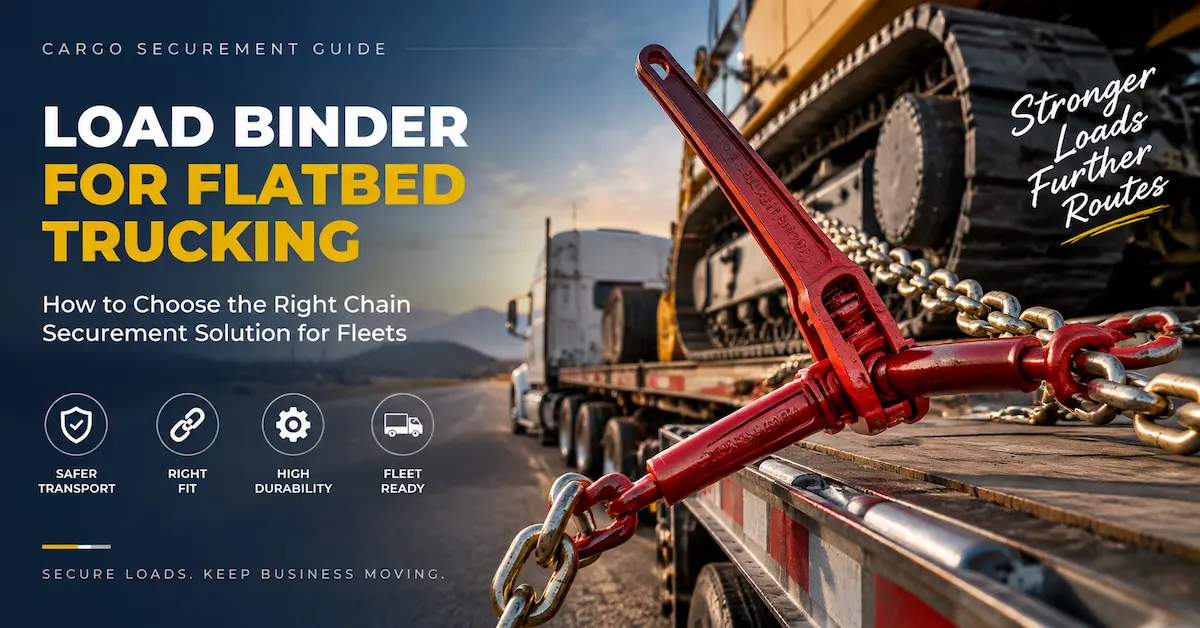
- Flatbed trucking
- Heavy machinery transportation
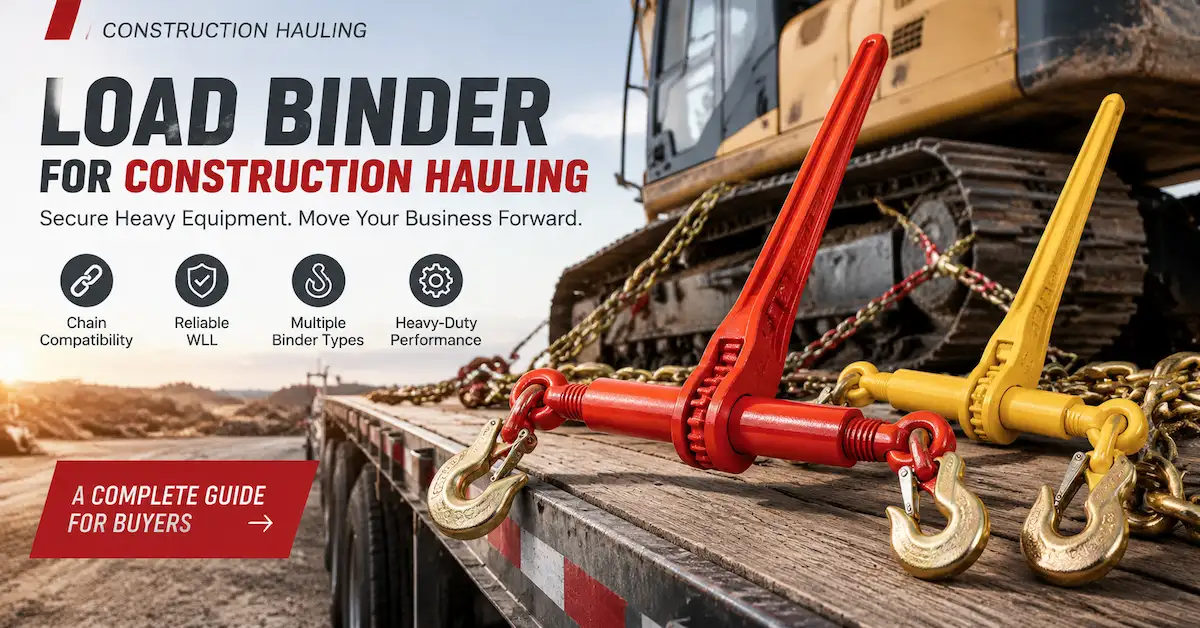
- Construction equipment hauling
- Steel and fabricated component transport
- Agricultural machinery transport
- Industrial equipment delivery
- Trailer cargo securement
- Long-distance logistics operations
Peerless, for example, describes standard ratchet load binders as devices used to tighten chain that anchors cargo to a trailer and lists chain size, take-up, handle length, and WLL as key product specifications. This illustrates why professional buyers should purchase against a technical specification rather than only a product name.
Who Is This Sourcing Guide For?
This guide is primarily intended for:
- Rigging and cargo-control distributors
- Importers and wholesalers
- Flatbed transportation companies
- Heavy-haul fleet procurement teams
- Trailer equipment distributors
- Construction equipment transport companies
- Private-label cargo-control brands
- OEM transportation-equipment buyers
It is not intended as a substitute for a qualified cargo-securement plan or applicable transport regulations. Cargo weight, equipment type, anchor points, chain grade, tiedown configuration, and local regulations all affect the final securement system.
Start With Chain Compatibility, Not Binder Price
One of the most common purchasing mistakes is choosing a ratchet binder based primarily on price or overall physical size.
The better starting question is:
Which transport chain will the binder be used with?
A procurement specification should normally identify:
- Chain grade
- Chain diameter
- Required WLL
- Binder hook compatibility
- Required take-up range
- Cargo type
- Tie-down configuration
- Target market or regulatory requirement
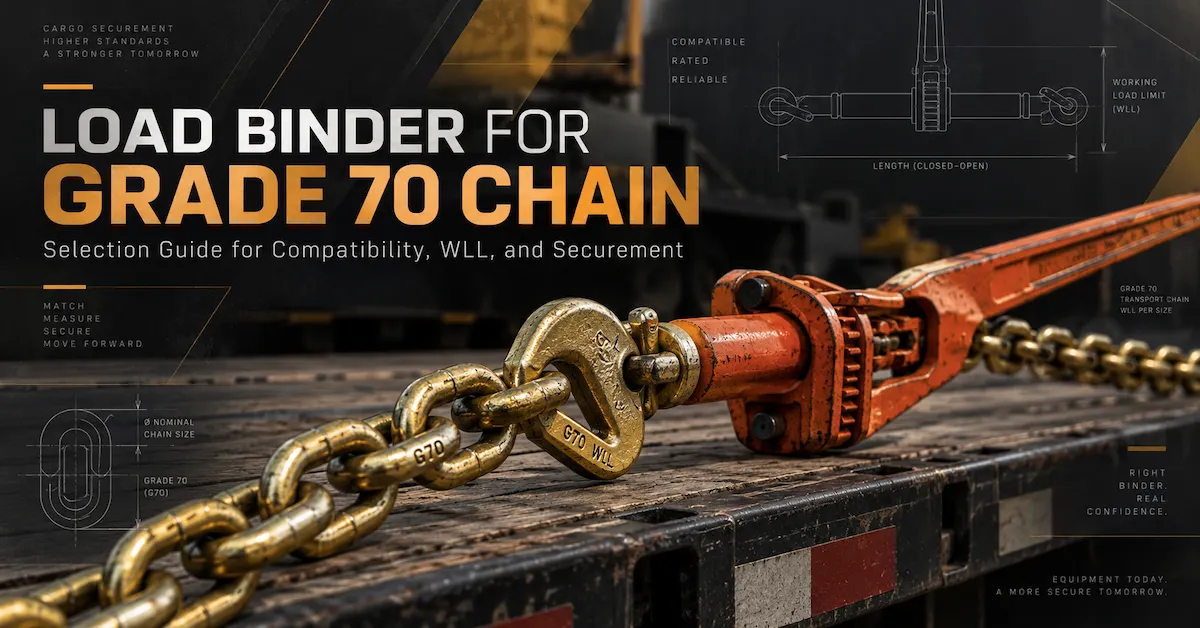
This matters because chain grade and diameter affect rated capacity.
Under 49 CFR §393.108, the WLL of a tiedown system is determined by the lowest-rated component, including the tensioner or the anchor point. The regulation also provides different WLL values for different chain grades and sizes.
That creates an important B2B purchasing principle:
A stronger-looking binder does not increase the rated capacity of a weaker chain, connector, or anchor point.
The complete assembly must be evaluated as a system.
What Specifications Should Buyers Confirm Before Ordering?
A serious RFQ to a ratchet load binder supplier should contain more than quantity and target price.
Recommended RFQ Checklist
| Specification | Why It Matters |
|---|---|
| Chain grade | Determines compatibility and rated system performance |
| Chain size | Must match the binder hook and intended tie-down |
| Binder WLL | Critical for securement-system calculations |
| Take-up range | Determines how much chain slack can be removed |
| Handle length | Affects operating leverage and packaging |
| Hook type | Must interface correctly with the selected chain |
| Material | Influences mechanical performance and durability |
| Forging process | Important for high-load structural components |
| Heat treatment | Influences strength and mechanical properties |
| Proof testing | Helps verify production performance |
| Surface finish | Important for corrosion protection |
| Product marking | Supports identification and traceability |
| Packaging | Important for distributors and private-label buyers |
| OEM requirements | Covers logo, color, label, carton and specifications |
For ZTL-specific models, buyers should request the current technical sheet before assigning WLL or chain-size values to a purchase order. The public ZTL page confirms the construction and testing features but does not provide enough model-level data to justify assuming one universal WLL for every ratchet binder.
That is a good procurement practice for any supplier: use approved specifications, drawings, test documents, and markings rather than generic industry numbers.
Working Load Limit Is a System Requirement
WLL is one of the most important terms in cargo-control procurement, but it is also frequently misunderstood.
The U.S. eCFR states that the WLL of a tiedown, connector, attachment mechanism, or tensioner is governed by the lowest-rated component or anchor point in the system.
For general cargo securement, 49 CFR §393.106 states that the aggregate WLL of tiedowns used to prevent movement must be at least one-half of the weight of the cargo being secured, subject to the way the tiedowns are configured.
Why This Matters When Buying Load Binders
Suppose a buyer purchases a high-capacity binder but uses it with:
- Lower-rated transport chain
- Lower-rated hooks
- Inadequate anchor points
- Incorrectly marked components
The binder alone does not determine the securement-system capacity.
This is why experienced procurement teams normally ask the supplier for:
- WLL identification
- Compatible chain grades
- Compatible chain sizes
- Test documentation
- Product markings
- Batch inspection records where required
For U.S. commercial-vehicle applications, buyers should also review the current FMCSA Cargo Securement Rules for the cargo being transported.
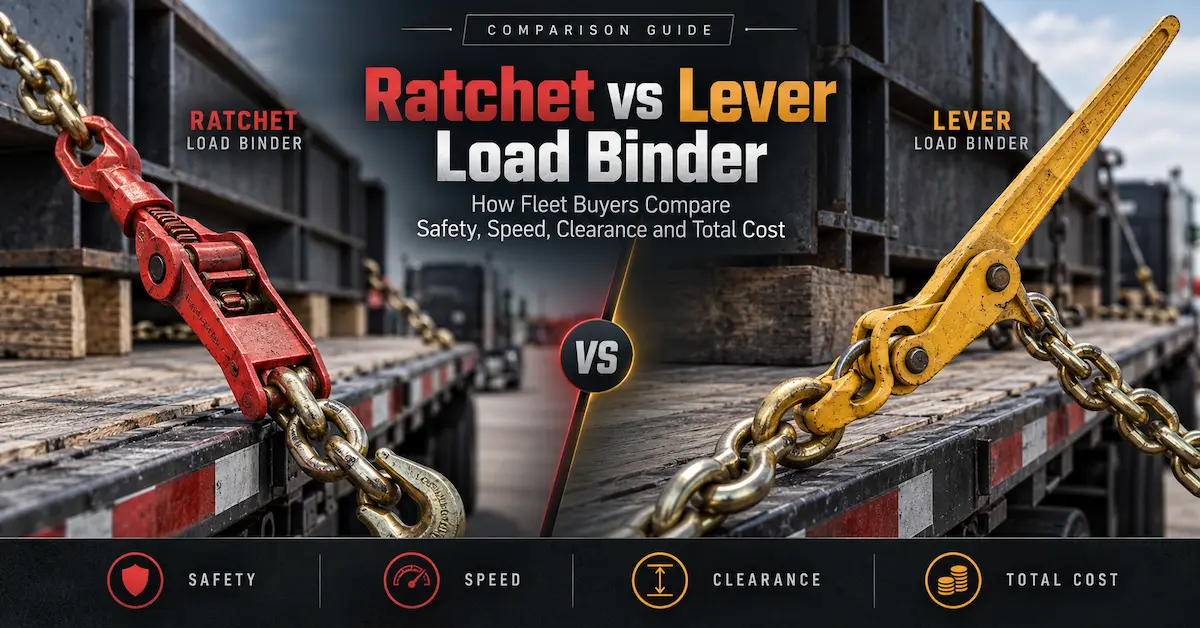
Ratchet Load Binder vs Lever Load Binder
Both designs tension chain, but their operating characteristics differ.
| Factor | Ratchet Load Binder | Lever Load Binder |
| Tensioning method | Progressive ratcheting | Lever action |
| Adjustment | Incremental | Faster single movement |
| Handle behavior | Controlled through ratchet mechanism | Greater lever movement |
| Take-up control | Generally easier to fine-tune | More dependent on lever position |
| Typical buyer priority | Control and repeated commercial use | Speed and simple operation |
| Purchasing decision | Mechanism, take-up, WLL, chain fit | Handle design, WLL, chain fit |
ZTL describes its ratchet-type design as not requiring the same handle-locking approach as its lever-type binder and positions the product as a safe, reliable design for easier operation. Its separate lever binder is described for heavy-duty transport use and uses drop-forged, heat-treated steel construction with 360° swivel hooks.
The correct choice should therefore depend on the buyer's operating procedure, transport application, chain system, required take-up, workforce preference, and applicable securement rules—not simply on which binder has the lower purchase price.
Why Forging and Heat Treatment Matter
A ratchet load binder repeatedly experiences tensile forces during chain tensioning and transportation.
This makes material processing particularly important for structural components such as hooks and load-bearing sections.
ZTL states that its rigging manufacturing capabilities include forging, heat treatment, and surface treatment, while its published ratchet binder information identifies drop-forged construction and heat treatment as product features.
Drop Forging
Forging shapes metal under compressive force rather than simply pouring molten metal into a mold.
For a B2B buyer, the important question is not merely whether the word “forged” appears in a catalog. The supplier should be able to control:
- Raw material
- Forging temperature
- Die condition
- Flash and trimming
- Dimensional consistency
- Surface defects
- Heat-treatment process
Heat Treatment
Heat treatment is used to achieve the required balance of mechanical properties after forming.
Poor heat-treatment control can create inconsistent performance between production batches. A sourcing team should therefore ask how the supplier monitors the process and what inspection or test records are available for the ordered model.
Proof Testing and Quality Control Should Be Discussed Before the PO
“High strength” is a marketing phrase.
Proof testing is a measurable production-control topic.
ZTL states that its ratchet-type load binder is individually proof tested, while its About Us page says every batch is subject to material inspection, process inspection, and finished-product inspection.
For bulk buyers, a useful supplier discussion should include:
Incoming Material Control
Ask how material identity and incoming quality are verified before production.
Process Inspection
Confirm which dimensions or functional characteristics are checked during forging, machining, assembly, heat treatment, and finishing.
Proof Testing
Clarify:
- Test method
- Test load
- Sampling or individual testing
- Acceptance criteria
- Record availability
- Traceability method
Do not assume that one supplier's proof-load percentage or test procedure applies to another supplier's product.
Finished Product Inspection
Typical purchasing concerns include:
- Ratchet function
- Thread movement
- Hook geometry
- Dimensions
- Surface finish
- Product marking
- Packaging
- Quantity verification
The goal is not simply to pass one sample.
The goal is repeatable batch performance.
Surface Protection Matters in Real Transport Environments
Load binders are often exposed to more than clean warehouse conditions.
Actual transport environments may include:
- Rain
- Road spray
- Dust
- Mud
- Temperature changes
- Storage humidity
- De-icing salts
- Repeated handling
A low-cost finish that looks acceptable at shipment may create complaints later if corrosion develops quickly.
Therefore, when comparing suppliers, ask for the exact surface-treatment option rather than accepting “anti-rust finish” as a complete specification.
For distributors and OEM brands, surface appearance also affects:
- Product presentation
- Warehouse life
- Brand consistency
- Customer complaints
- After-sales cost
If corrosion resistance is a priority, include the expected operating environment in the RFQ so the supplier can recommend an appropriate finish.
What Makes a Ratchet Load Binder Supplier Suitable for Bulk Orders?
For a one-time purchase, a buyer may focus on a sample.
For recurring B2B procurement, supplier capability becomes equally important.
According to its current About Zhongteli page, Ningbo Zhongteli Rigging Co., Ltd. was established in 2008 and reports a 15,000 m² factory, more than 50 production lines, more than 200 skilled workers, an ISO 9001 quality system, and exports to more than 20 countries and regions.
Those figures are useful qualification signals, but buyers should still evaluate the specific production line and documentation relevant to the product being purchased.
Ask These Questions Before Supplier Approval
- Is the ratchet binder manufactured in-house or subcontracted?
- What operations are completed internally?
- How is forging controlled?
- How is heat treatment controlled?
- Is proof testing performed on the ordered model?
- What data appears on the product marking?
- Can the supplier provide approved samples?
- How is batch traceability handled?
- What packaging formats are available?
- What is the production lead time for the required quantity?
- How is inspection handled before shipment?
These questions usually reveal more about supplier reliability than a generic factory presentation.
OEM and Private-Label Options for Distributors
For importers and cargo-control brands, the purchasing requirement may extend beyond the standard binder.
ZTL states that customization is available for its ratchet load binder and describes custom product solutions as part of its broader manufacturing service.
Depending on technical feasibility and confirmed specifications, an OEM discussion may include:
- Product marking
- Handle color
- Surface finish
- Packaging
- Carton artwork
- Labels
- Barcode requirements
- Instruction sheets
- Private-label branding
- Model-specific dimensional requirements
However, safety-related dimensions, rated capacity, material, and structural design should never be changed only for visual differentiation without engineering review and validation.
What to Send With an OEM RFQ
A useful RFQ package should contain:
- Required binder type
- Chain grade
- Chain size
- Required WLL
- Quantity
- Target market
- Application
- Surface finish
- Packaging requirements
- Branding requirements
- Testing/document requirements
- Target delivery schedule
The more complete the RFQ, the easier it is to compare quotations on equal technical terms.
Unit Price Is Only One Part of the Real Purchasing Cost
The cheapest ratchet binder quotation is not always the lowest-cost sourcing option.
A better comparison considers:
Unit price + quality risk + inspection cost + replacement risk + delay risk + complaint cost + inventory impact.
Common Hidden Risks
Inconsistent Chain Fit
Hooks that do not consistently fit the specified chain create usability and customer-return problems.
Unverified Ratings
If markings or documentation do not match the supplied model, the buyer may face compliance and traceability problems.
Poor Surface Durability
Premature corrosion increases replacement and after-sales cost.
Variable Ratchet Operation
Inconsistent threads, pawls, or assemblies can affect operation between batches.
Weak Packaging
Heavy forged products require packaging capable of surviving export handling and transport.
For distributors, the lowest purchase price only creates value when the product remains consistent after hundreds or thousands of units.
A Practical Supplier Comparison Table
Use a structured comparison instead of choosing from quotation price alone.
| Supplier Evaluation Item | Supplier A | Supplier B | Supplier C |
| Chain size confirmed | ✓ / ✕ | ✓ / ✕ | ✓ / ✕ |
| WLL documented | ✓ / ✕ | ✓ / ✕ | ✓ / ✕ |
| Forged construction | ✓ / ✕ | ✓ / ✕ | ✓ / ✕ |
| Heat treatment defined | ✓ / ✕ | ✓ / ✕ | ✓ / ✕ |
| Proof-testing method | ✓ / ✕ | ✓ / ✕ | ✓ / ✕ |
| Product marking | ✓ / ✕ | ✓ / ✕ | ✓ / ✕ |
| Batch QC records | ✓ / ✕ | ✓ / ✕ | ✓ / ✕ |
| OEM support | ✓ / ✕ | ✓ / ✕ | ✓ / ✕ |
| Export packaging | ✓ / ✕ | ✓ / ✕ | ✓ / ✕ |
| Lead time confirmed | ✓ / ✕ | ✓ / ✕ | ✓ / ✕ |
| Technical response quality | High/Low | High/Low | High/Low |
| Total landed-risk assessment | High/Low | High/Low | High/Low |
This approach moves supplier selection away from subjective claims such as “best quality” and toward information that procurement teams can verify.
When Should You Request a Sample Before Bulk Production?
A sample is particularly useful when:
- You are changing suppliers
- You are launching a private-label range
- Chain compatibility is critical
- A customized finish is required
- Packaging is customized
- The destination market has specific documentation requirements
- The order quantity is large
- The product will be integrated into an established cargo-control range
The sample should be checked against the same technical specification that will later control mass production.
A common sourcing mistake is approving a visually acceptable sample without documenting the characteristics that made it acceptable.
The better sequence is:
Specification → sample → inspection → written approval → production → final inspection.
FAQ
What is a ratchet load binder used for?
A ratchet load binder is used to take up slack and apply tension to transport chain in a cargo tie-down system. It is commonly associated with flatbed trucking, machinery transportation, construction equipment hauling, and other cargo-control applications.
How do I choose the correct ratchet load binder size?
Start with the chain grade and chain diameter, then verify the binder's compatible chain range, WLL, hook design, take-up, and application. Do not select a binder only by its overall physical dimensions.
Is the binder WLL the same as the complete tie-down system WLL?
Not necessarily. Under 49 CFR §393.108, the effective WLL is governed by the lowest-rated component or anchor point in the tiedown system.
What is the difference between a ratchet binder and a lever binder?
A ratchet binder applies tension incrementally through a ratcheting mechanism, while a lever binder uses lever action. The preferred option depends on application, operating method, chain system, and buyer requirements.
Should a ratchet load binder be proof tested?
For B2B sourcing, buyers should confirm the manufacturer's test requirements and documentation. ZTL states that its ratchet-type load binder is individually proof tested.
What information should I send to a ratchet load binder supplier?
Send the chain grade, chain size, required WLL, quantity, target market, application, finish, packaging requirements, branding requirements, and any required testing or documentation.
Can ratchet load binders be customized for private-label brands?
ZTL states that customization is available. Buyers should discuss branding, finish, packaging, marking, and any technical changes separately because safety-related design changes may require engineering validation.
How should I compare two load binder suppliers?
Compare verified specifications, chain compatibility, WLL documentation, manufacturing process, proof testing, QC, traceability, OEM support, packaging, lead time, and technical response—not only unit price.
How many tiedowns are required for heavy equipment?
The answer depends on cargo type, weight, length, configuration, and jurisdiction. Under U.S. rules, wheeled or tracked heavy vehicles, equipment, and machinery weighing 10,000 lb or more are subject to specific securement requirements, including a minimum of four tiedowns under 49 CFR §393.130. Buyers and operators should always check the current applicable regulations.
Where can I request ZTL ratchet load binder specifications or a quotation?
You can review ZTL's load binder range and submit your chain size, required rating, quantity, market, packaging, and OEM requirements through the ZTL contact page. ZTL's current contact page provides direct inquiry channels for international customers.
Conclusion
Selecting a ratchet load binder supplier is ultimately a system-sourcing decision.
The buyer needs to confirm more than whether the binder can tighten a chain. Chain compatibility, WLL, hook design, take-up, forged construction, heat treatment, proof testing, markings, corrosion protection, batch consistency, packaging, and supplier traceability all influence the real value of a bulk order.
For cargo-control distributors, trucking-equipment buyers, private-label brands, and transportation OEMs, the safest procurement process is to define the technical specification first and compare suppliers against the same measurable requirements.
Zhongteli offers ratchet, lever, folding-handle, indirect, and EU-type options within its load binder product range, supported by forging, heat treatment, surface treatment, inspection, and customization capabilities described on its website.
If you are sourcing ratchet load binders for distribution, flatbed cargo securement, an OEM program, or a private-label product line, send your chain grade, chain size, required WLL, quantity, target market, application, and packaging requirements through Contact ZTL Rigging so the product specification can be evaluated before quotation.