English


What Should You Check Before Choosing a Lever Load Binder Supplier?
A reliable lever load binder supplier should provide more than a competitive quotation. For cargo-control distributors, flatbed fleets, heavy-equipment transport companies, and private-label buyers, the main sourcing questions are whether the binder fits the specified chain, whether its rated capacity is properly documented, and whether production quality remains consistent across large orders.
A lever load binder uses mechanical leverage to remove slack and apply tension to a chain tie-down system. Its relatively simple operating mechanism can make it attractive for experienced operators who value fast tensioning, but the product must still be selected as part of the complete securement system.
ZTL's Lever Type Load Binder is described for heavy-duty transport applications and uses drop-forged steel, 360° swivel hooks, heat treatment, individual proof testing, and customizable configurations.
For a B2B buyer, those product features should be verified together with chain size, working load limit, take-up requirements, markings, surface treatment, packaging, and destination-market requirements before a purchase order is released.
Where Are Lever Load Binders Commonly Used?
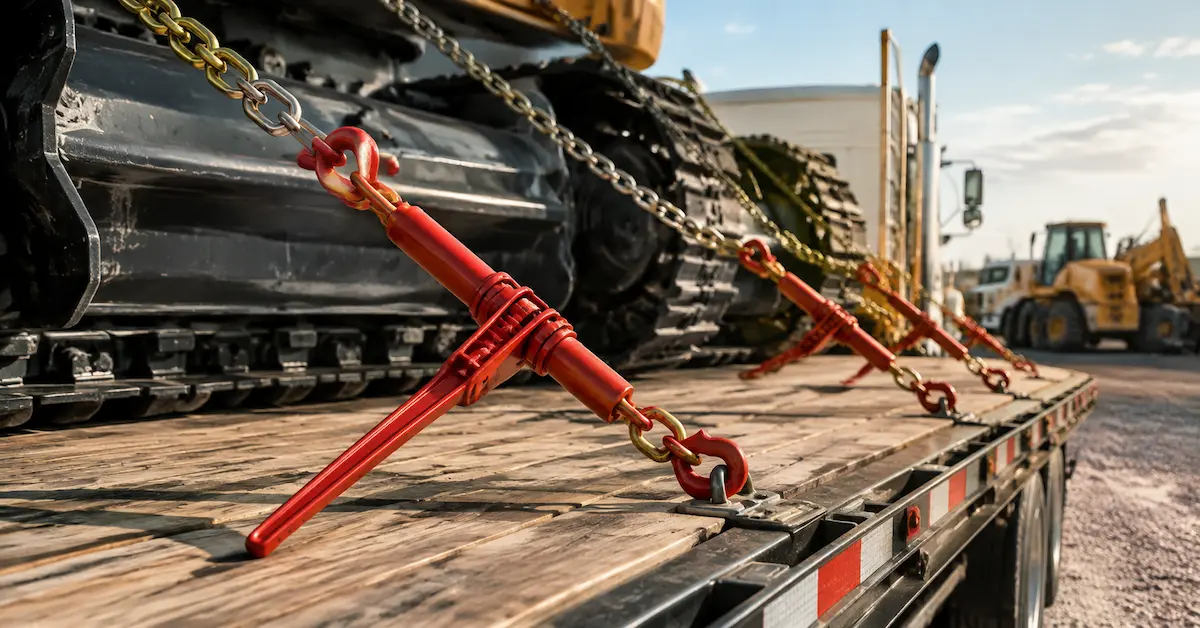
Lever binders are designed to take up chain slack and apply tension in transport tie-down systems. ZTL specifically positions its lever model for heavy-duty transport use.
Typical commercial applications include:
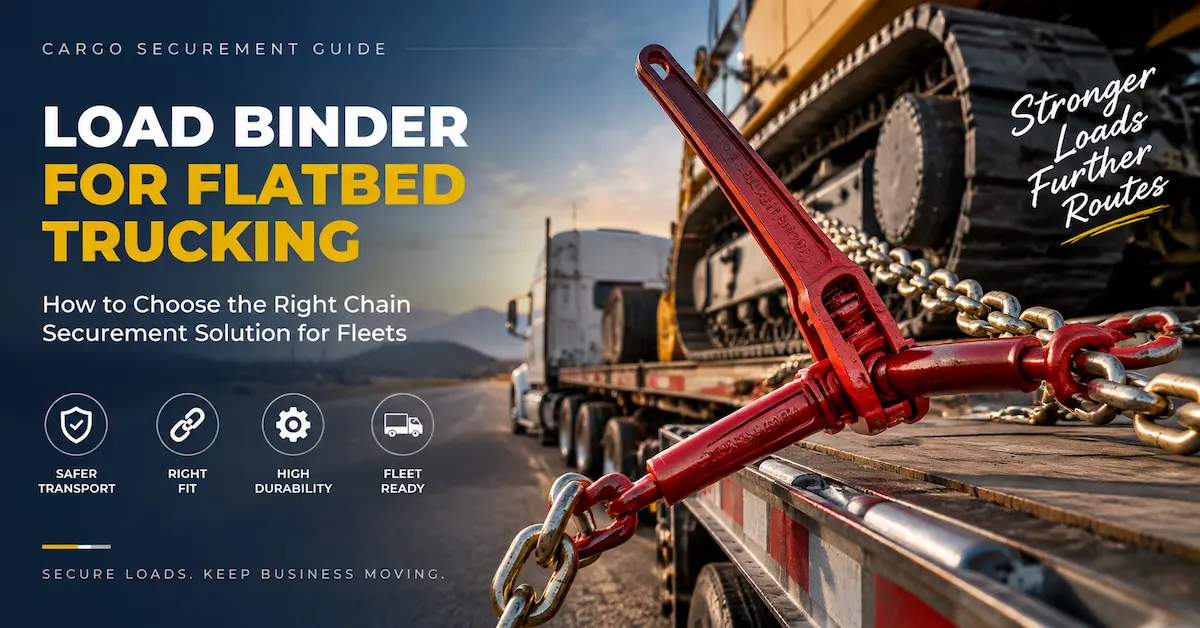
- Flatbed trucking
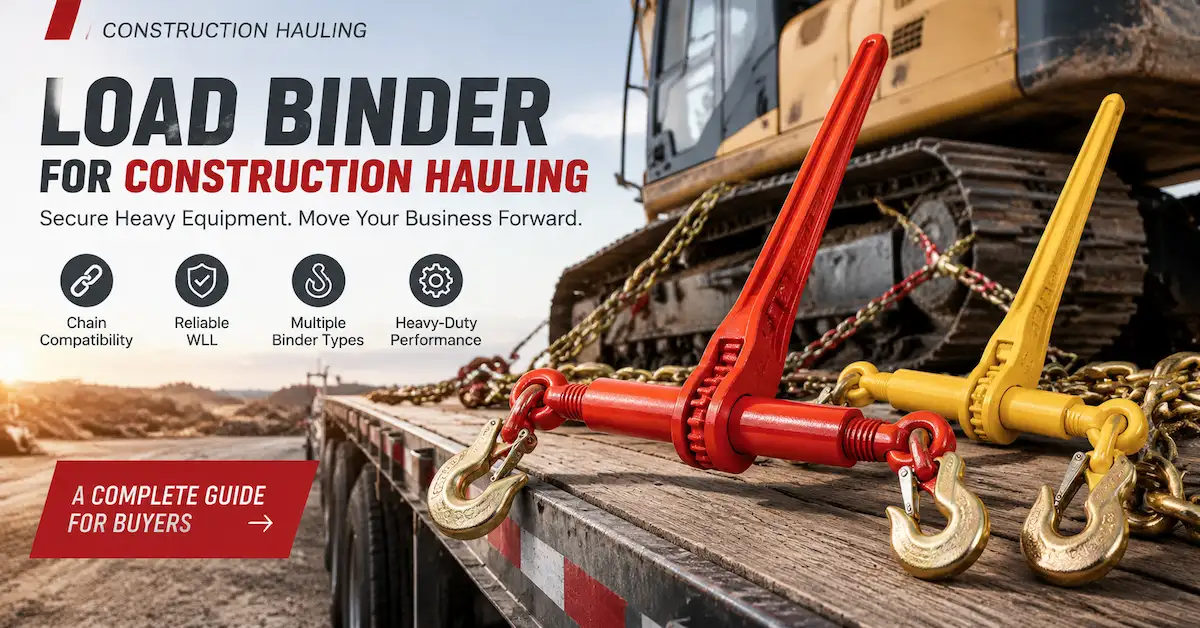
- Construction machinery transport
- Agricultural equipment hauling
- Steel and fabricated component transport
- Industrial machinery delivery
- Trailer cargo securement
- Heavy equipment logistics
- General chain tie-down applications
The main advantage for many users is the direct lever-action mechanism. It can apply tension quickly without repeatedly operating a ratchet mechanism.
However, application suitability should never be decided by operating speed alone. The chain, binder, hooks, attachment points, cargo configuration, and applicable securement rules must work together as one system.
Who Usually Buys Lever Load Binders in Bulk?
The main B2B customer groups include:
- Rigging distributors
- Cargo-control wholesalers
- Importers
- Truck and trailer equipment distributors
- Flatbed transport fleets
- Heavy-haul contractors
- Construction equipment logistics companies
- Private-label cargo-control brands
- Industrial hardware buyers
These buyers typically care about more than the product appearance. They need repeatable specifications, predictable quality, packaging suitable for distribution, traceable production, and dependable replenishment.
Start With Chain Size and Working Load Limit
The first technical question to ask a lever load binder supplier is not “What is your lowest price?”
It is:
Which chain grade and size is this binder designed to work with?
Working load limit, or WLL, is a key part of this decision.
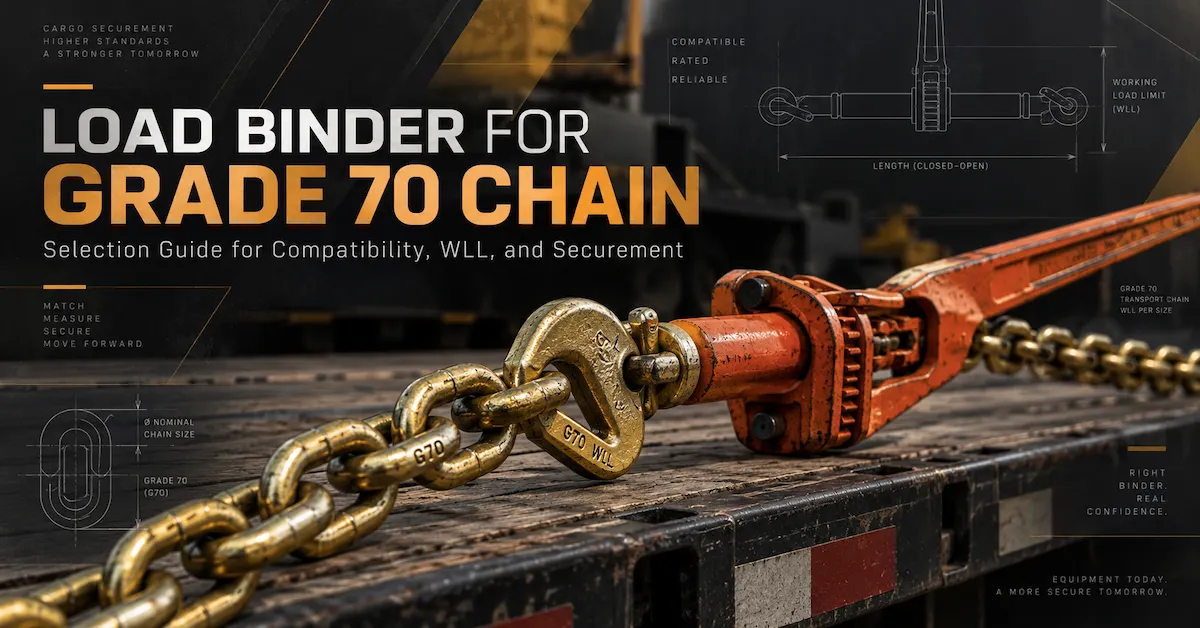
Under 49 CFR §393.108, the WLL of a tiedown is determined by the lowest-rated component in the system, including the tensioner, connector, attachment mechanism, or anchor point.
That means a higher-rated binder does not compensate for a lower-rated chain or anchor point.
Information to Confirm Before Ordering
| Item | Why Buyers Should Confirm It |
|---|---|
| Chain grade | Affects rated chain capacity |
| Chain size | Must physically match the binder hooks |
| Binder WLL | Must suit the securement system |
| Hook configuration | Affects chain connection |
| Take-up requirement | Determines usable adjustment |
| Handle design | Affects operation and clearance |
| Material | Influences strength and durability |
| Heat treatment | Influences mechanical properties |
| Surface finish | Affects corrosion resistance |
| Proof testing | Provides production verification |
| Product marking | Supports identification |
| Packaging | Important for distribution and export |
| OEM requirements | Needed for private-label programs |
For ZTL products, the current product page confirms the general construction and testing features but does not publish every chain-size and WLL combination. Buyers should therefore request the current model-specific specification before approving an order.
Why WLL Must Be Evaluated as a Complete System
A common procurement error is treating the load binder as an isolated safety component.
Cargo securement systems are only as strong as their limiting component.
The eCFR explicitly states that the WLL of the tiedown is the lowest WLL among its components or the anchor points to which it is attached.
For U.S. interstate commercial transport, FMCSA also states that the aggregate WLL of the securement system used to prevent cargo movement must generally be at least one-half of the weight of the cargo being secured.
What This Means for Procurement Teams
Before sourcing lever binders, confirm:
- Binder WLL
- Transport chain grade
- Chain diameter
- Connector ratings
- Vehicle anchor points
- Number of tiedowns
- Cargo weight
- Cargo configuration
- Applicable transport rules
A purchasing team should not infer the securement capacity from binder size, handle length, or appearance.
For U.S. applications, buyers and operators can review the current FMCSA Cargo Securement Rules before establishing their operating procedures.
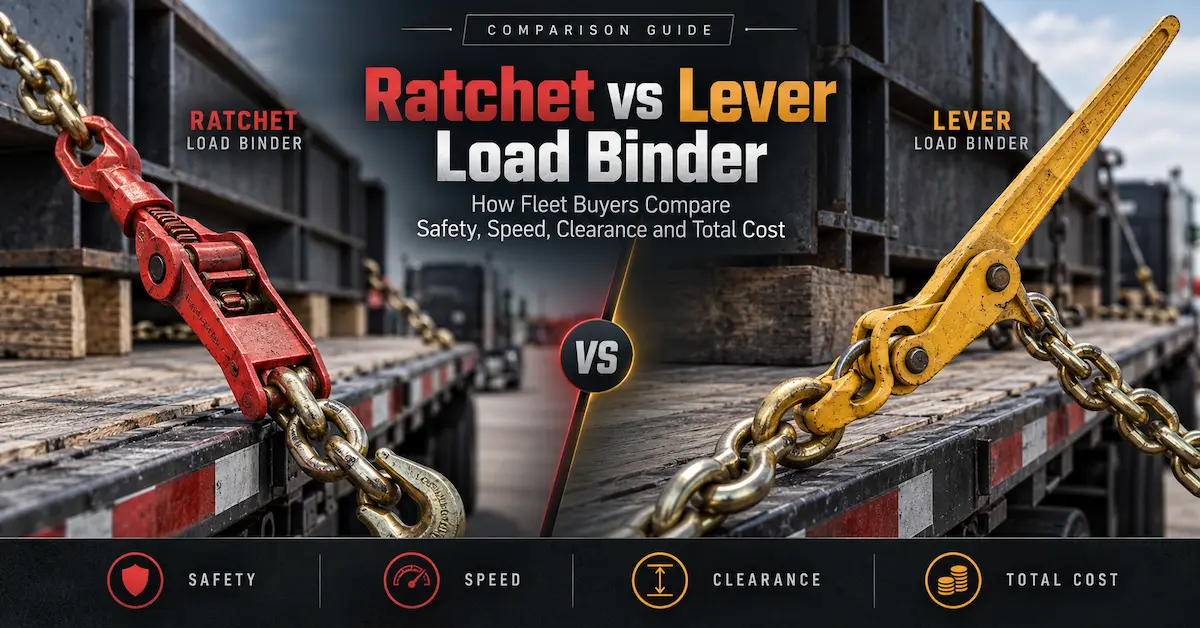
Lever Load Binder vs Ratchet Load Binder
This comparison is one of the most important decisions for distributors and fleet buyers.
Both products tension transport chain, but they do so differently.
| Factor | Lever Load Binder | Ratchet Load Binder |
| Operating principle | Direct lever action | Ratchet and screw mechanism |
| Tensioning speed | Generally faster | More gradual |
| Fine adjustment | More limited | Easier incremental adjustment |
| Handle movement | Larger lever movement | Repeated ratchet movement |
| Mechanism | Relatively simple | More mechanical components |
| Typical priority | Fast operation | Controlled tensioning |
| Best evaluation criteria | WLL, chain fit, handle design | WLL, chain fit, take-up |
A lever binder may suit experienced operators who value a direct and fast tensioning method. A ratchet binder may be preferred where gradual adjustment and controlled take-up are priorities.
Neither design is automatically better for every application.
If your procurement team is comparing the two mechanisms, see ZTL's related guide: Ratchet Load Binder Supplier: A B2B Sourcing Guide.
Why Lever Binder Operating Safety Deserves Extra Attention
Lever binders store mechanical energy while the chain is under tension.
Because the handle is used to create leverage, buyers should consider the intended operating method, available clearance, operator training, and release procedure when selecting a binder.
FMCSA requires cargo securement components to be in proper working order without damaged or weakened components that could adversely affect performance. It also requires tiedowns to be attached and secured so that they do not become loose, open, or release during transit.
Buyers Should Evaluate More Than Handle Length
Important factors include:
- Handle geometry
- Required operating clearance
- Hook alignment
- Chain tension
- Wear condition
- Deformation
- Corrosion
- Operator procedure
- Inspection frequency
A long handle may provide more leverage, but leverage alone should not be treated as a measure of product suitability.
Procurement specifications should be based on rated product information and intended use.
Why Drop Forging Matters for Heavy-Duty Load Binders
ZTL states that its lever-type binder uses drop-forged high-strength steel and heat treatment.
Forging is particularly relevant to heavily loaded rigging hardware because the process forms metal under compressive force rather than simply shaping it through a casting process.
For buyers, however, “forged” should not be accepted as the complete quality specification.
A professional supplier should control the entire production sequence.
Important Forging Control Points
Raw Material
Material identity and incoming quality should be verified before production.
Forging Process
Temperature, die condition, forming consistency, trimming, and visible defects should be controlled.
Heat Treatment
Heat treatment must be matched to the material and required mechanical properties.
Dimensional Inspection
Hooks, connecting sections, handle geometry, and functional interfaces should remain within specification.
Surface Treatment
Surface preparation and coating affect corrosion resistance and appearance.
ZTL's About Us page identifies forging, heat treatment, and surface treatment as core manufacturing processes and states that material, process, and finished-product inspections are used in production.
Why Heat Treatment Is Important
A forged component still requires appropriate material and process control to achieve the required performance.
Heat treatment is used to modify mechanical properties after forming.
For bulk buyers, the practical concern is consistency.
Poor process control may result in different performance between production batches even when the products appear visually similar.
A supplier evaluation should therefore include questions such as:
- Is heat treatment performed in-house or outsourced?
- How are process parameters controlled?
- Is hardness checked?
- Are records retained?
- How are nonconforming batches handled?
- Can testing documentation be supplied when required?
These questions are especially important for importers and private-label brands that may be responsible for downstream customer complaints.
Why Individual Proof Testing Matters
ZTL states that its lever-type load binder is individually proof tested.
For a B2B buyer, this is more meaningful than a general claim such as “heavy duty” or “high quality.”
Proof testing introduces a measurable quality-control step.
However, buyers should still verify the actual test requirements for the ordered model.
Ask the Supplier to Clarify
- Proof-test load
- Test method
- Acceptance criteria
- Testing frequency
- Test equipment calibration
- Product identification
- Record retention
- Batch traceability
Do not automatically assume one manufacturer's test load or procedure applies to another manufacturer's binder.
What Quality Control Should a B2B Buyer Expect?
A reliable lever load binder supplier should control quality at several stages rather than depending only on final inspection.
ZTL states that every batch undergoes material inspection, process inspection, and finished-product inspection. Its About page also lists a 15,000 m² factory, more than 50 production lines, more than 200 skilled workers, and an ISO 9001 quality system.
Incoming Inspection
Check:
- Raw material identification
- Material documentation
- Visible defects
- Dimensional requirements
In-Process Inspection
Potential checkpoints include:
- Forged shape
- Hook geometry
- Critical dimensions
- Assembly
- Heat treatment
- Handle operation
Finished Inspection
Check:
- Product dimensions
- Lever operation
- Hook movement
- Surface finish
- Markings
- Proof-test status
- Packaging
The key objective is not simply to produce one good sample.
For distributors and OEM brands, the real objective is repeatable performance from batch to batch.
What Role Do 360° Swivel Hooks Play?
ZTL's lever load binder uses hooks that can swivel 360°, which the company says improves handling.
For users, swivel movement can make chain connection and binder positioning easier when the chain approaches the binder from different angles.
However, the hook still needs to match the intended chain.
Buyers should confirm:
- Hook opening
- Chain compatibility
- Hook geometry
- Freedom of rotation
- Deformation criteria
- Surface condition
A swivel hook should not be treated as a substitute for correct alignment and securement practices.
Surface Treatment Should Match the Operating Environment
Lever load binders are frequently used outdoors.
They may be exposed to:
- Rain
- Mud
- Road spray
- Dust
- Storage humidity
- Temperature changes
- Repeated handling
- Road salts
For distributors, coating quality affects more than appearance.
Poor corrosion protection can lead to:
- Customer complaints
- Difficult operation
- Product deterioration in inventory
- Shorter service life
- Increased replacement cost
A professional RFQ should therefore state the expected operating environment.
Instead of requesting only “anti-rust treatment,” specify whether the product will be used in general trucking, agricultural transport, coastal regions, construction sites, or other demanding environments.
How to Evaluate a Lever Load Binder Supplier for Bulk Orders
Bulk purchasing changes the supplier-selection criteria.
One good sample is not enough.
A distributor purchasing thousands of units needs to know whether the supplier can reproduce the approved product consistently.
Supplier Evaluation Checklist
| Evaluation Item | What to Verify |
| Product specification | Chain size, WLL, design |
| Manufacturing | Forging and production control |
| Heat treatment | Process consistency |
| Proof testing | Method and records |
| Quality management | Incoming, process, final QC |
| Traceability | Batch/product identification |
| Capacity | Ability to support repeat orders |
| OEM support | Marking, finish, packaging |
| Export experience | Documentation and shipment handling |
| Communication | Technical response quality |
| Lead time | Realistic production schedule |
| Corrective action | Process for handling defects |
ZTL states that its current annual load binder production is about 500,000 sets and that its products are exported to more than 20 countries and regions.
Those figures can be useful during supplier qualification, but buyers should still confirm available capacity and delivery schedule for the specific order.
OEM and Private-Label Options
ZTL states that customization is available for its lever-type load binder.
For distributors and private-label brands, OEM discussions may include:
- Product marking
- Handle color
- Surface finish
- Brand identification
- Labels
- Carton design
- Barcode
- Instruction materials
- Export packaging
Technical changes should be treated differently from cosmetic changes.
A change to hook geometry, material, handle design, or load-bearing dimensions may affect product performance and should be reviewed and validated before production.
What Should Be Included in an OEM RFQ?
Send the supplier:
- Binder type
- Chain grade
- Chain size
- Required WLL
- Quantity
- Destination market
- Application
- Surface treatment
- Product marking requirements
- Packaging requirements
- Test/documentation requirements
- Target delivery schedule
A complete RFQ reduces misunderstanding and makes quotations easier to compare.
Why the Lowest Unit Price Can Create a Higher Total Cost
Unit price is only one part of B2B sourcing cost.
A lower quotation may become expensive if the order creates:
- Product returns
- Chain-fit complaints
- Corrosion claims
- Documentation problems
- Packaging damage
- Delivery delays
- Reinspection costs
- Inventory shortages
The better comparison is:
Purchase price + quality risk + compliance risk + logistics risk + after-sales cost.
Common Procurement Risks
Incorrect Chain Compatibility
A binder that does not consistently fit the specified chain creates immediate field problems.
Inconsistent Heat Treatment
Products may look identical while having different mechanical characteristics.
Poor Marking
Missing or unclear identification can make downstream verification difficult.
Weak Surface Protection
Corrosion can begin during storage or after short periods of outdoor use.
Unverified Testing
Generic “tested” claims are not a substitute for an agreed test method and acceptance standard.
Batch Variation
One approved sample does not guarantee that future production will remain identical.
When Should You Request Samples?
A pre-production sample is especially useful when:
- Changing suppliers
- Launching a new brand
- Adding a new chain size
- Changing surface treatment
- Introducing custom packaging
- Entering a new market
- Placing a large first order
The approval sequence should be:
Specification → Sample → Inspection → Written Approval → Mass Production → Final Inspection
Avoid approving a sample based only on appearance.
Record the dimensions, function, markings, finish, packaging, and documentation that must be reproduced in mass production.
For additional product questions, buyers can also review the ZTL Rigging FAQ.
FAQ
What is a lever load binder?
A lever load binder is a mechanical chain-tensioning device that uses lever action to remove slack and apply tension to a cargo tie-down system. It is commonly used in transport and heavy-equipment securement applications.
What is the main difference between lever and ratchet load binders?
A lever binder applies tension through direct handle movement, while a ratchet binder uses a ratcheting screw mechanism for more gradual adjustment. The correct choice depends on the operating method, chain system, application, and buyer requirements.
How do I choose the right lever load binder size?
Start with chain grade and chain diameter. Then confirm the binder's compatible chain range, WLL, hook configuration, and required take-up before ordering.
Is binder WLL the same as the entire tie-down system WLL?
No. Under 49 CFR §393.108, the effective WLL is limited by the lowest-rated component or anchor point in the tiedown system.
Are ZTL lever load binders forged?
Yes. ZTL describes its lever-type load binder as using high-strength drop-forged steel with heat treatment.
Are ZTL lever binders proof tested?
ZTL's current product page states that its lever-type load binders are individually proof tested. Buyers should request the applicable test specification for the exact model being purchased.
Can lever load binders be customized?
ZTL states that customization is available. Depending on requirements, buyers can discuss branding, finish, markings, packaging, and other OEM details before quotation.
What should I send to a lever load binder supplier for quotation?
Provide chain grade, chain size, required WLL, quantity, target market, application, finish, packaging, testing requirements, and OEM needs.
How should distributors compare lever load binder suppliers?
Compare verified specifications, forging and heat-treatment control, proof testing, QC procedures, traceability, production capacity, OEM support, export packaging, lead time, and technical communication—not only unit price.
Where can I request ZTL product specifications?
Review ZTL's Load Binder range and Lever Type Load Binder, then send your project specifications through the Contact ZTL Rigging page.
Conclusion
Choosing a lever load binder supplier is a technical sourcing decision, not simply a price comparison.
For distributors, cargo-control brands, flatbed fleets, and heavy-equipment transport companies, the most important factors include chain compatibility, WLL, hook design, forged construction, heat treatment, proof testing, markings, corrosion protection, batch consistency, and supplier traceability.
Lever and ratchet binders each have different operating characteristics. Buyers should select the mechanism that fits their application and operating procedure rather than assuming one type is universally superior.
ZTL's Load Binder product range includes lever, ratchet, folding-handle, indirect, and EU-type designs. Its lever model is described as drop forged, heat treated, equipped with 360° swivel hooks, individually proof tested, and available for customization.
For a bulk or OEM quotation, send your chain grade, chain size, required WLL, quantity, destination market, application, surface finish, packaging, and testing requirements through Contact ZTL Rigging.