English


Why Choose a Folding Handle Load Binder Supplier for Cargo Securement?
For transportation companies, cargo-control distributors, and private-label buyers, selecting the right folding handle load binder supplier is not only about purchasing a chain tensioning tool. It is about finding a product solution that improves operational safety, reduces storage and transportation issues, and maintains consistent performance during repeated commercial use.
A folding handle load binder is designed with a movable or foldable handle structure that helps reduce the space occupied by the operating handle after installation or storage. Compared with traditional long-handle lever binders, the folding design can provide advantages in applications where clearance, handling space, and transportation safety are important considerations.
Typical buyers evaluate folding handle load binders based on:
- Chain compatibility
- Working Load Limit (WLL)
- Hook design
- Handle clearance
- Forged construction
- Heat treatment
- Proof testing
- Surface protection
- OEM customization capability
- Production consistency
ZTL Rigging includes folding handle load binder solutions within its Load Binder product range. The company positions its load binder products for transportation and cargo securement applications, with manufacturing capabilities covering forging, heat treatment, surface treatment, inspection, and customization.
(ZTL Load Binder Products)
For professional buyers, the key question is not simply “Which binder is cheapest?” but:
Which folding handle load binder supplier can provide reliable specifications, stable production, and long-term supply support?
What Is a Folding Handle Load Binder?
A folding handle load binder is a chain tensioning device designed to secure cargo by tightening chain tie-down systems.
The main difference from conventional lever-type binders is the handle structure.
Traditional lever binders normally use a fixed operating handle. A folding handle design allows the handle to fold or reduce its protruding position, which can help in applications where surrounding space is limited.
The design can be valuable for:
- Flatbed trailers
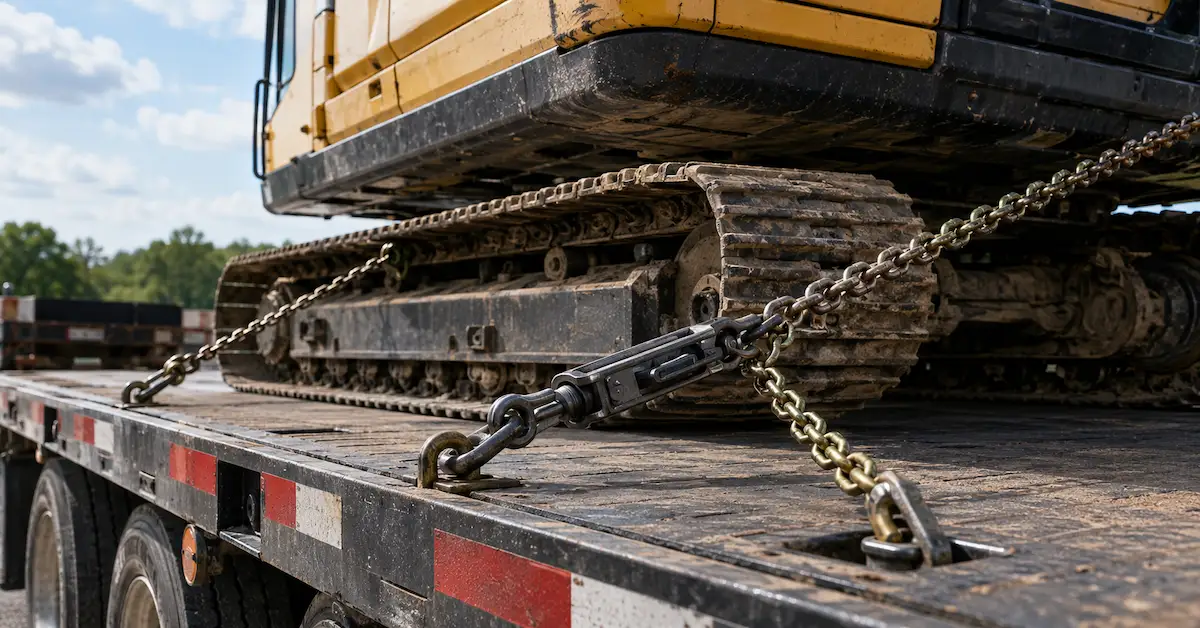
- Heavy equipment transportation
- Construction machinery hauling
- Industrial cargo transportation
- Equipment shipping
- Limited-clearance transport environments
Main Design Advantages
A folding handle load binder can provide several practical benefits:
| Feature | Buyer Benefit |
|---|---|
| Folding handle structure | Reduces external protrusion |
| Compact storage profile | Improves warehouse and transport efficiency |
| Improved clearance | Helps avoid interference with surrounding equipment |
| Heavy-duty construction | Supports demanding transportation applications |
| Chain compatibility | Allows integration with existing tie-down systems |
However, buyers should still verify the exact technical specifications before ordering because different models may vary in chain compatibility, capacity, dimensions, and operating method.
Who Should Buy Folding Handle Load Binders?
The ideal customers for folding handle load binders are mainly B2B buyers who need reliable cargo-control equipment.
Cargo Control Distributors
Distributors often need products that:
- Have stable quality
- Cover different customer applications
- Offer repeatable supply
- Support private labeling
- Reduce after-sales complaints
A folding handle model can expand a distributor's product portfolio by serving customers who need more compact or safer operating solutions.
Flatbed Transportation Companies
Flatbed operators frequently work with:
- Heavy machinery
- Steel products
- Construction equipment
- Industrial components
For these users, equipment clearance and secure handling are important operational concerns.
Trailer Equipment Suppliers
Trailer accessory companies may source folding handle binders as part of a wider cargo securement product range.
They usually evaluate:
- Product consistency
- Packaging
- OEM options
- Delivery capability
- Documentation support
Private Label Brands
Brands selling cargo-control products may require:
- Custom marking
- Packaging design
- Product identification
- Color options
- Technical documentation
A capable supplier should support these requirements without compromising product performance.
Common Applications of Folding Handle Load Binders
The biggest advantage of folding handle designs appears in applications where traditional handles may create space challenges.
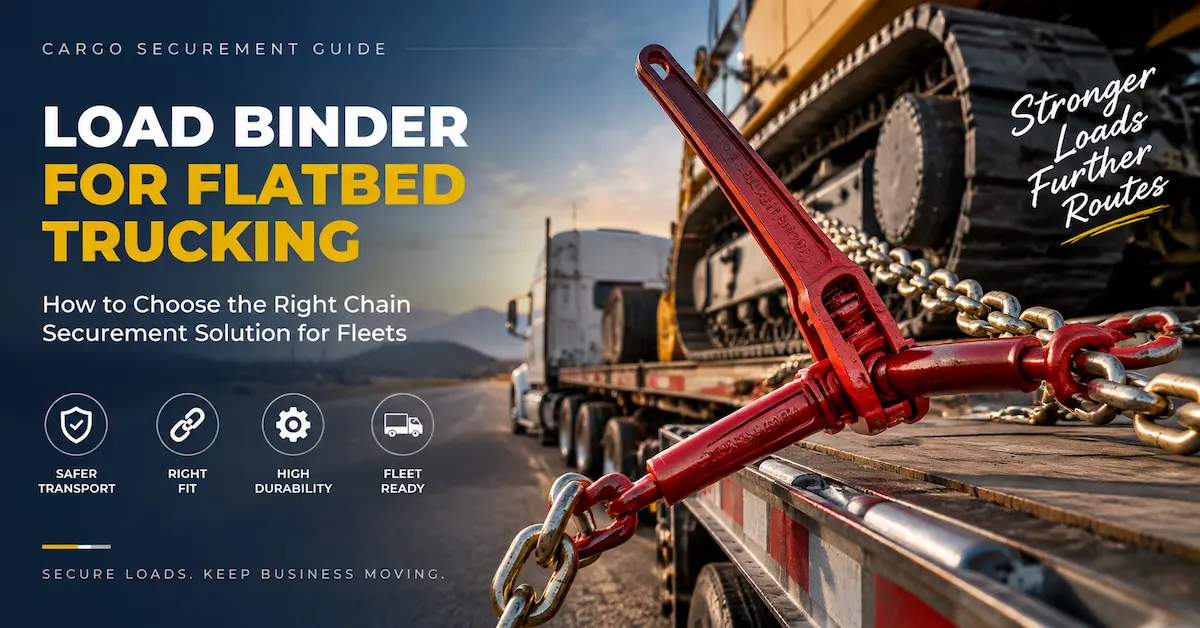
Flatbed Cargo Transportation
Flatbed transportation is one of the most common applications for load binders.
Typical cargo includes:
- Excavators
- Loaders
- Agricultural machines
- Steel structures
- Large industrial components
During transportation, equipment vibration, turning, and braking create dynamic forces. The complete tie-down system must therefore be correctly selected.
According to FMCSA cargo securement requirements, tiedown systems must be properly rated and maintained to prevent cargo movement during transportation.
(FMCSA Cargo Securement Rules)
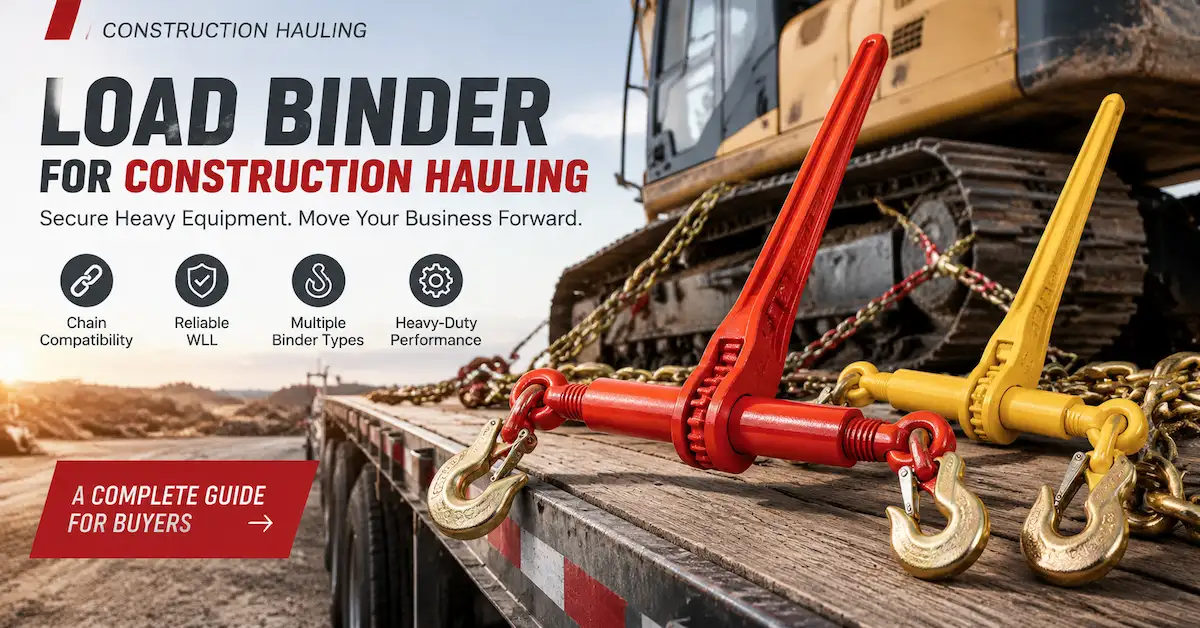
Construction Equipment Transport
Construction equipment often creates challenges because:
- Equipment dimensions are large
- Tie-down points may be difficult to access
- Transport space is limited
- Loading environments are demanding
A compact handle design can help reduce unnecessary protrusions around secured equipment.
Agricultural Equipment Transport
Agricultural machinery transportation may involve:
- Outdoor exposure
- Mud
- Dust
- Moisture
- Long storage periods
For these applications, buyers should consider corrosion protection and maintenance requirements in addition to mechanical performance.
Industrial Cargo Transportation
Industrial manufacturers often transport:
- Fabricated steel parts
- Machinery components
- Large assemblies
For these shipments, securement reliability and repeatable product performance are critical.
What Specifications Should Buyers Confirm?
A professional RFQ should contain detailed requirements instead of only requesting:
“Please quote folding handle load binders.”
A complete inquiry should include:
| Specification | Why It Matters |
| Chain grade | Determines compatibility |
| Chain size | Ensures proper hook matching |
| Required WLL | Defines securement capability |
| Hook type | Affects connection reliability |
| Handle design | Influences operating clearance |
| Finish requirement | Affects corrosion resistance |
| Quantity | Determines production planning |
| Packaging | Important for distribution |
| OEM requirements | Supports private-label programs |
| Destination market | May affect documentation needs |
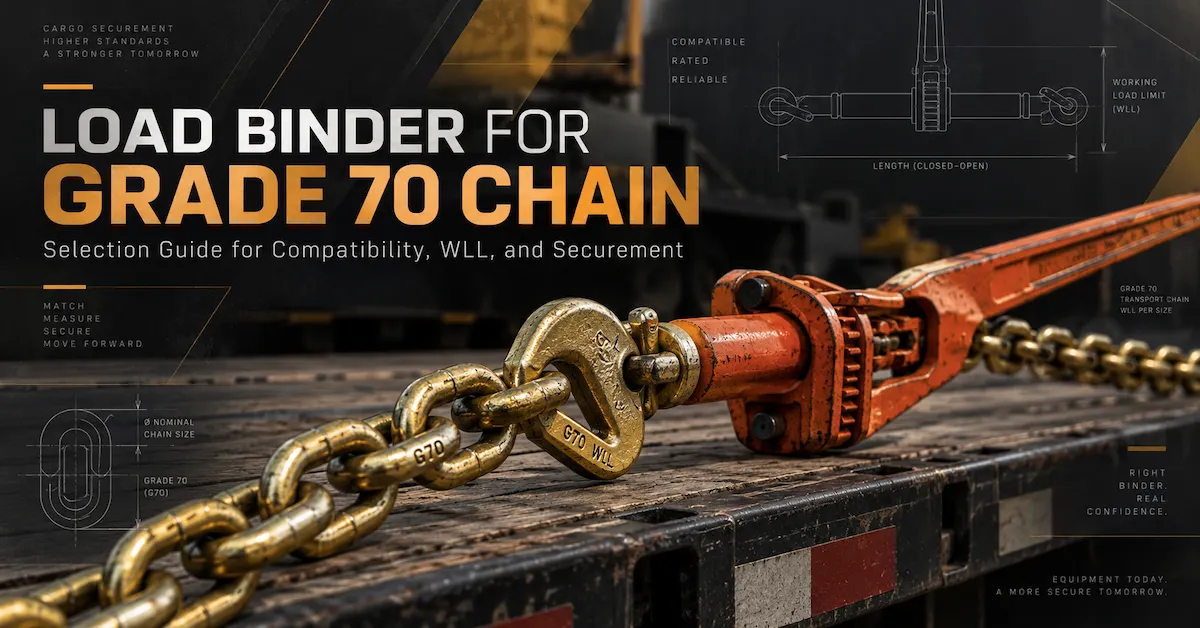
Working Load Limit is especially important because the binder is only one part of the complete securement system.
Under 49 CFR §393.108, the effective WLL of a tiedown system is limited by the lowest-rated component in the system.
(eCFR)
This means buyers should evaluate:
- Binder
- Chain
- Hooks
- Connectors
- Anchor points
as one complete system.
Material Selection and Manufacturing Process
For heavy-duty cargo securement products, manufacturing quality directly affects reliability.
ZTL identifies forging, heat treatment, surface treatment, and inspection as important parts of its manufacturing capability.
(ZTL About Us)
Drop Forged Construction
Forging is commonly used for high-load components because it forms metal through controlled deformation.
For buyers, important manufacturing considerations include:
- Raw material control
- Forging consistency
- Dimensional accuracy
- Surface condition
- Heat-treatment control
A supplier should be able to explain how these processes are controlled during mass production.
Heat Treatment
Heat treatment influences mechanical properties after forging.
A professional supplier should control:
- Process parameters
- Hardness requirements
- Batch consistency
- Inspection records
For distributors and OEM customers, consistent production is often more valuable than a single high-performing sample.
Quality Control Requirements Before Bulk Ordering
Before approving a folding handle load binder supplier, buyers should review the supplier's quality-control process.
Important checkpoints include:
Incoming Material Inspection
Verify:
- Material source
- Documentation
- Visual condition
- Required specifications
Production Inspection
Monitor:
- Forging quality
- Component dimensions
- Handle function
- Hook condition
- Assembly quality
Finished Product Inspection
Check:
- Appearance
- Operation
- Markings
- Packaging
- Test requirements
For long-term B2B cooperation, the goal is not only receiving one acceptable shipment.
The goal is achieving consistent performance across repeated orders.
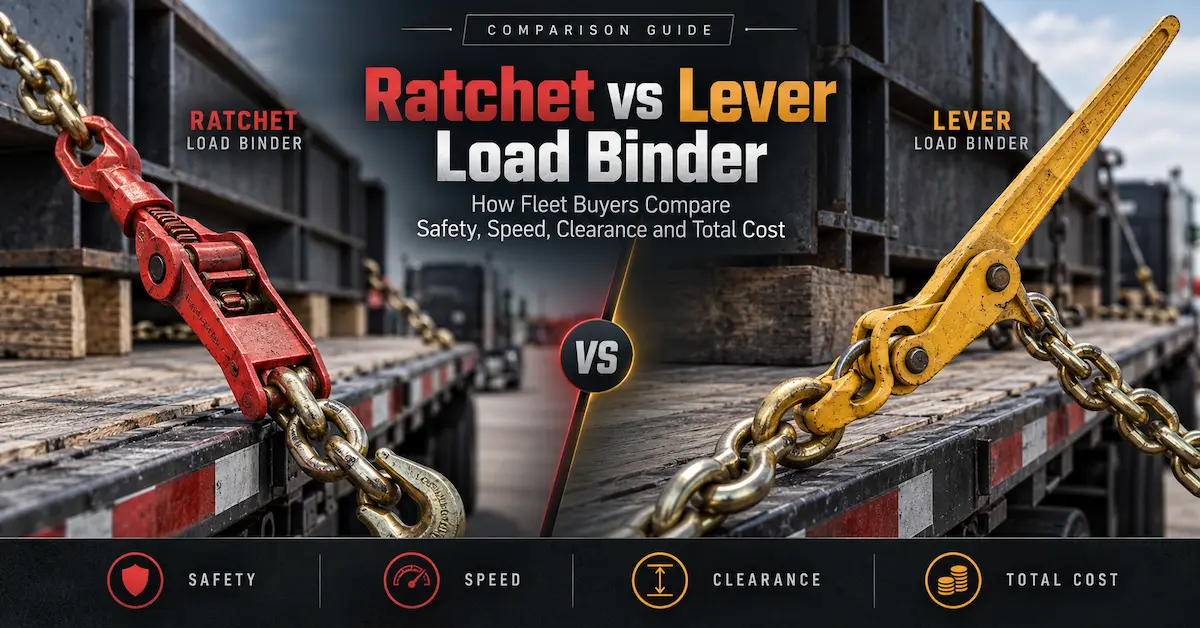
Folding Handle Load Binder vs Lever Load Binder vs Ratchet Load Binder
For buyers building a cargo-control product portfolio, understanding the differences between binder designs helps avoid selecting the wrong product for the application.
Although all three designs perform the same basic function—tensioning chain for cargo securement—their operating characteristics are different.
| Type | Main Design Feature | Main Advantage | Suitable Applications |
|---|---|---|---|
| Folding Handle Load Binder | Foldable handle structure | Reduced protrusion and improved clearance | Space-limited transport, flatbed applications |
| Lever Load Binder | Traditional lever operation | Fast tensioning and simple operation | Heavy-duty hauling and common transport |
| Ratchet Load Binder | Ratchet mechanism | Controlled adjustment and gradual tensioning | Frequent commercial cargo securement |
When Should Buyers Choose Folding Handle Load Binders?
A folding handle model is especially suitable when:
- Equipment dimensions create limited working space
- Protruding handles may interfere with surrounding components
- Storage efficiency is important
- Transport operators need safer equipment positioning
- Distributors want a differentiated cargo-control product
However, it should not be selected only because of the handle design.
The complete evaluation should include:
- Chain compatibility
- Working Load Limit
- Hook design
- Manufacturing quality
- Operating environment
- Supplier reliability
Why Handle Clearance Matters in Cargo Transportation
One often overlooked factor in cargo securement equipment is the physical space occupied by the hardware after installation.
During transportation, excessive protrusion may create several practical concerns:
- Interference with nearby cargo
- Contact with equipment surfaces
- Increased handling difficulty
- Storage challenges
- Higher risk of accidental impact
A folding handle design addresses this specific operational concern by reducing the external profile of the binder.
For fleet operators and equipment transport companies, this can be valuable when securing:
- Excavators
- Loaders
- Agricultural machinery
- Industrial equipment
- Oversized components
The correct product choice depends on the actual loading configuration and transport requirements.
What Makes a Reliable Folding Handle Load Binder Supplier?
A professional supplier should provide more than finished products.
For long-term B2B cooperation, buyers should evaluate:
Manufacturing Capability
Important questions include:
- Is forging performed internally?
- Is heat treatment controlled?
- Are critical dimensions inspected?
- Are finished products tested?
- Can production remain consistent for repeat orders?
ZTL states that its manufacturing capabilities include forging, heat treatment, surface treatment, and quality inspection processes.
(ZTL About Us)
Production Capacity
For distributors and importers, supplier capacity directly affects:
- Order stability
- Replenishment speed
- Market expansion
- Customer satisfaction
ZTL reports a manufacturing facility with production resources including more than 50 production lines and more than 200 skilled workers.
(ZTL About Us)
For specific projects, buyers should still confirm available capacity, production schedule, and lead time before placing orders.
OEM and Private Label Solutions for Folding Handle Load Binders
Many cargo-control distributors do not simply purchase standard products.
They require products adapted to their own market.
Typical OEM requirements include:
- Brand marking
- Custom labels
- Packaging design
- Carton requirements
- Product identification
- Surface finish options
- Market-specific documentation
A suitable folding handle load binder supplier should be able to support communication between engineering, production, and quality teams.
What Information Should Be Included in an OEM Request?
A complete OEM inquiry should include:
| Information | Purpose |
| Product type | Confirm correct binder structure |
| Chain specification | Ensure compatibility |
| Quantity | Plan production |
| Target market | Understand requirements |
| Packaging | Prepare distribution solution |
| Branding | Support private label |
| Testing needs | Confirm quality expectations |
| Delivery schedule | Coordinate supply planning |
The more complete the information, the easier it is for suppliers to provide an accurate quotation.
Common Purchasing Risks When Sourcing Folding Handle Load Binders
Price comparison alone is not enough when selecting a supplier.
The lowest quotation may create additional costs if quality or specifications are inconsistent.
Risk 1: Incorrect Product Specification
A binder may look similar while having different:
- Chain compatibility
- Hook dimensions
- Working capacity
- Handle design
- Material performance
Always compare technical specifications rather than product photos.
Risk 2: Inconsistent Production Batches
For distributors, the first shipment is only the beginning.
Future orders must maintain:
- Same dimensions
- Same operating performance
- Same finish quality
- Same packaging standard
Supplier quality systems are therefore important.
Risk 3: Poor Surface Protection
Outdoor cargo equipment faces:
- Rain
- Dust
- Road salt
- Humidity
- Temperature changes
An unsuitable finish can increase corrosion complaints and replacement costs.
Risk 4: Lack of Technical Support
A reliable supplier should help buyers confirm:
- Application suitability
- Chain matching
- Product selection
- Custom requirements
A supplier that only provides pricing may create problems later during mass production.
How to Compare Folding Handle Load Binder Suppliers
A structured evaluation process helps buyers avoid selecting only based on price.
| Evaluation Area | Key Questions |
| Product specification | Are dimensions and requirements clearly defined? |
| Manufacturing | Does the supplier control forging and processing? |
| Quality | Are inspections and tests documented? |
| Customization | Can OEM requirements be supported? |
| Communication | Are technical questions answered effectively? |
| Capacity | Can repeat orders be supported? |
| Export experience | Can documentation and packaging requirements be handled? |
| After-sales | Is there a process for handling quality issues? |
For professional buyers, supplier evaluation should focus on total sourcing value:
Product quality + supply reliability + technical support + risk control
rather than only initial unit price.
Cost Factors That Influence Folding Handle Load Binder Pricing
The purchase price of a folding handle load binder depends on multiple factors.
Common cost drivers include:
Material Selection
Higher-grade materials and stricter requirements can affect cost.
Manufacturing Process
Forging, machining, heat treatment, and inspection requirements influence production cost.
Surface Treatment
Different corrosion-protection requirements affect finishing costs.
Customization
OEM marking, packaging, and special configurations may increase initial investment.
Order Quantity
Large-volume orders may improve production efficiency and pricing.
A professional buyer should compare the total value rather than requesting only the lowest unit price.
How to Prepare an RFQ for Folding Handle Load Binders
A detailed RFQ helps suppliers provide accurate technical recommendations.
Recommended information:
- Product type
- Chain grade
- Chain size
- Required quantity
- Application environment
- Destination country
- Packaging requirements
- Branding requirements
- Inspection requirements
- Target delivery date
Example:
Instead of asking:
“Please quote folding load binders.”
Provide:
“We need folding handle load binders for flatbed equipment transportation. Please quote based on chain size, required quantity, OEM marking, export packaging, and inspection requirements.”
This allows suppliers to evaluate the project correctly.
FAQ
What is a folding handle load binder?
A folding handle load binder is a chain tensioning device with a foldable handle design that helps reduce the external space occupied by the operating handle during transportation and storage.
Why choose a folding handle load binder instead of a traditional lever binder?
The main advantage is improved clearance. Folding handle designs can reduce protrusion in applications where surrounding space is limited.
Are folding handle load binders suitable for flatbed trailers?
Yes. They can be used in flatbed cargo securement applications when the product specification matches the chain system, cargo requirements, and applicable securement practices.
How do I select the correct folding handle load binder?
Confirm chain size, chain grade, required WLL, hook compatibility, application environment, and supplier technical documentation before ordering.
What should I ask a folding handle load binder supplier?
Important questions include manufacturing process, material control, heat treatment, proof testing, customization capability, packaging, and production capacity.
Can folding handle load binders be customized?
Customization may include product marking, packaging, labels, colors, and other OEM requirements. Technical changes should be reviewed by the supplier before production.
What is the difference between folding handle and ratchet load binders?
Folding handle binders focus on reducing handle clearance, while ratchet binders focus on gradual tension adjustment through a ratchet mechanism.
What is the difference between folding handle and lever load binders?
Both may use lever-style operation, but folding handle models are designed to reduce handle protrusion and improve space efficiency.
Are folding handle load binders proof tested?
Testing methods depend on the supplier and product model. Buyers should request the applicable test information for the specific product being purchased.
Where can I request ZTL folding handle load binder information?
Buyers can review ZTL's Load Binder products and submit technical requirements through the Contact ZTL Rigging page.
Conclusion
Selecting the right folding handle load binder supplier requires a complete evaluation of product design, application requirements, manufacturing capability, quality control, and long-term supply reliability.
For transportation companies, distributors, and OEM brands, the folding handle design provides a practical solution where clearance, handling efficiency, and equipment positioning are important considerations.
However, the best supplier is not simply the one offering the lowest price. Buyers should evaluate:
- Chain compatibility
- Working Load Limit
- Hook design
- Forging process
- Heat treatment
- Surface protection
- Quality inspection
- OEM capability
- Production consistency
ZTL provides a range of load binder solutions, supported by manufacturing capabilities in forging, heat treatment, surface treatment, inspection, and customization.
(ZTL Load Binder Range)
For distributors, fleet operators, and private-label buyers sourcing folding handle load binders, prepare your chain specification, quantity, application, packaging requirements, and OEM needs before requesting a quotation to achieve a more accurate sourcing solution.