English


A trailer jack can look perfect in a sample room and still become an expensive problem after the first production batch. The failure may not be dramatic. A crank clips a toolbox. A mounting plate pulls out of alignment during welding. A drop leg rattles because the hole pattern wandered. Powder coat hides a rough weld toe. A carton lets a loose handle rub through the finish during ocean transport. For a trailer builder, distributor, fleet, or private-label brand, these small defects multiply across every unit shipped.
Pause here and look at the actual production lot. This factory-audit guide is written for the buyer who needs more than a polished quotation. It explains how to qualify a trailer jack manufacturer by following the product from the drawing through incoming steel, fabrication, assembly, load testing, coating, final inspection, packaging, and change control. It also shows which records are useful, which answers are too vague, and what evidence should be attached to the purchase specification before a bulk order is released.
Why a Trailer Jack Factory Audit Must Start with the Application
A factory audit isn't a general tour. It is a test of whether a specific supplier and process can support a specific product program. That means the audit begins before anyone reaches the factory gate. The buyer should first define the trailer, the maximum supported load at the jack point, the expected operating frequency, the environment, the mounting arrangement, the required travel, the retracted and extended dimensions, the handle envelope, the finish, the destination market, and the annual demand. Small variations become expensive when they repeat across a container.
These inputs determine what the auditor should examine. A 2,000 lb jack for a light utility trailer does not create the same manufacturing controls as a 12,000 lb square jack for a commercial equipment trailer. A marine application makes coating preparation and drainage more important. A high-cycle rental fleet makes gear condition, lubrication, wear, and serviceability more important.A private-label program adds artwork, carton, label, manual, pallet, and change-approval controls. When the application is vague, the audit becomes vague as well.
The awkward question is usually the useful one. Capacity deserves particular care. The jack normally supports the vertical load at the tongue or drawbar while the trailer axles continue to carry most of the trailer mass. The buyer should not select a jack only from the trailer’s gross weight. The useful input is the maximum load that can reach the jack in the defined operating condition, including cargo position, ground slope, duty cycle, side load, and any imbalance between paired jacks. Buyers who still need the engineering sequence can use our detailed guide on what size trailer jack do I need before preparing the audit specification.
Once the application is fixed, the audit has a reference point. The question is no longer “Does this factory make jacks?” It becomes “Can this factory make our jack, to our controlled requirements, across repeated lots, without undocumented substitutions?”
Why does that matter? Because the approved sample is only useful when production can repeat it.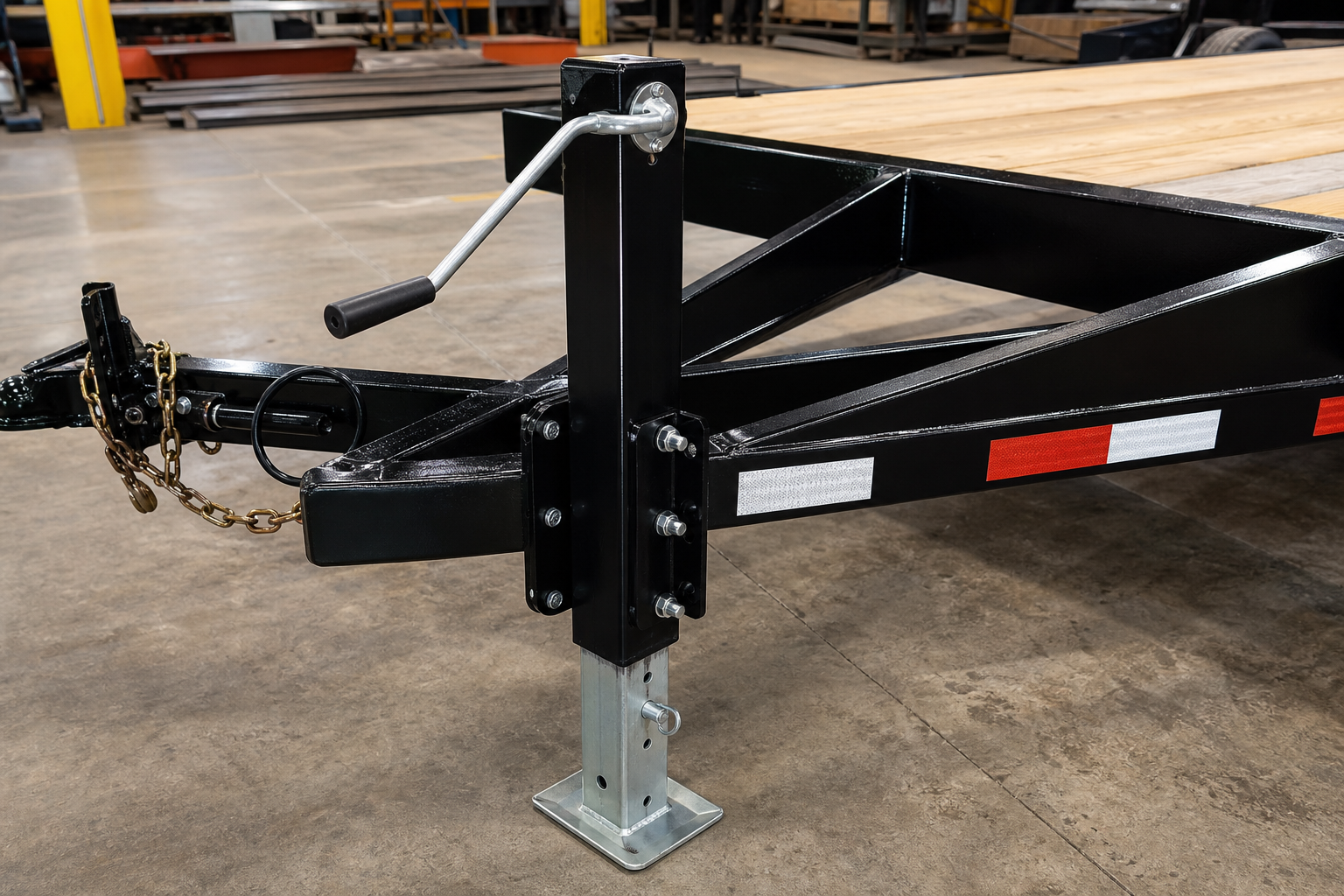
The 27-Point Trailer Jack Factory Audit Checklist
1. Confirm the legal manufacturer and the actual production location
Put the quotation, business identity, invoice details, factory sign, product label, and export paperwork on one sheet. The names and addresses should make sense together. Then draw the jack’s route through tube preparation, gears, welding, coating, assembly, testing, and packing. Mark each step with the location that normally performs it.
Outside processing is common and is not automatically a finding. The question is whether it is visible and controlled. For a critical subcontractor, ask who approved the source, what specification travels with the parts, how lots keep their identity, what record comes back, and who checks the result.A powder line shown during the tour is irrelevant if the quoted product normally goes somewhere else.
2. Match the product family to real production evidence
Ask for one recent job from the same jack family. Follow its part number through the bill of material, work route, instructions, in-process check, final report, and packing record. Do the revisions agree? Can the team find the files without borrowing documents from a different metal product? The exercise should feel routine.
Zhongteli publishes top-wind and side-wind jacks in several capacity classes. On the floor, similar models still need unmistakable identities. A tube, gear set, handle, bracket, foot, finish, travel, or rating may change while the silhouette barely does. Ask an operator how the quoted variant is separated from its nearest neighbor and check the answer against the labels at the station.
3. Review drawing control before discussing price
Open the released drawing before discussing a price reduction. A photograph cannot define mounting datums, travel, retracted height, drop-leg adjustment, wall thickness, welds, materials, finish, markings, or the interfaces with packaging. Circle any requirement that is still described only by a catalogue phrase.
Now try to inspect the drawing. Where is the datum? Can the stated tolerance be measured with the tool on the control plan? “Black powder coat” still needs preparation, color, film or performance requirement, masking, appearance limits, and protection. “Zinc plated” also needs a referenced finish and an acceptance rule.
Finally choose a recent shop record and read the revision printed on it. It should match the live drawing. Ask who may issue a change and who approves it for the customer. An elegant drawing stored in an office does not help when an obsolete copy is hanging beside the welder.
4. Identify critical-to-quality characteristics
Not every dimension deserves the same attention. Highlight the features that decide fit and function: tube relationship, screw and nut engagement, gears, mounting holes, bracket squareness, retracted height, travel, drop-leg holes and pin, crank clearance, foot orientation, weld integrity, finish coverage, marking, and the agreed functional test.
Each highlighted feature needs four companions: the operation that creates it, the check, the frequency, and the response to failure. If bracket angle matters, production needs a datum or fixture and a rule for holding product after a miss. A photograph can explain an appearance limit; it cannot measure an angle or decide which lot must be contained.
5. Verify incoming steel and purchased components
Choose an opened tube bundle, not the newest tagged delivery. Can its grade, size, supplier, receiving lot, and job still be identified? Repeat the check for plate, gears, fasteners, pins, handles, grease, coating material, and cartons at a depth proportionate to risk. Unmarked remnants, mixed bins, and steel stored on a wet floor deserve a note before the certificate folder is opened.
A material certificate supports the story only when its number connects to receiving, storage, issue, and the finished lot. Ask the warehouse operator what happens after a tag is torn or a bundle is split. For an important property, the control plan may call for independent chemistry, mechanical, coating, or fastener verification. The factory should be able to show both the record and the physical identity it belongs to.
6. Examine tube forming, cutting, and dimensional consistency
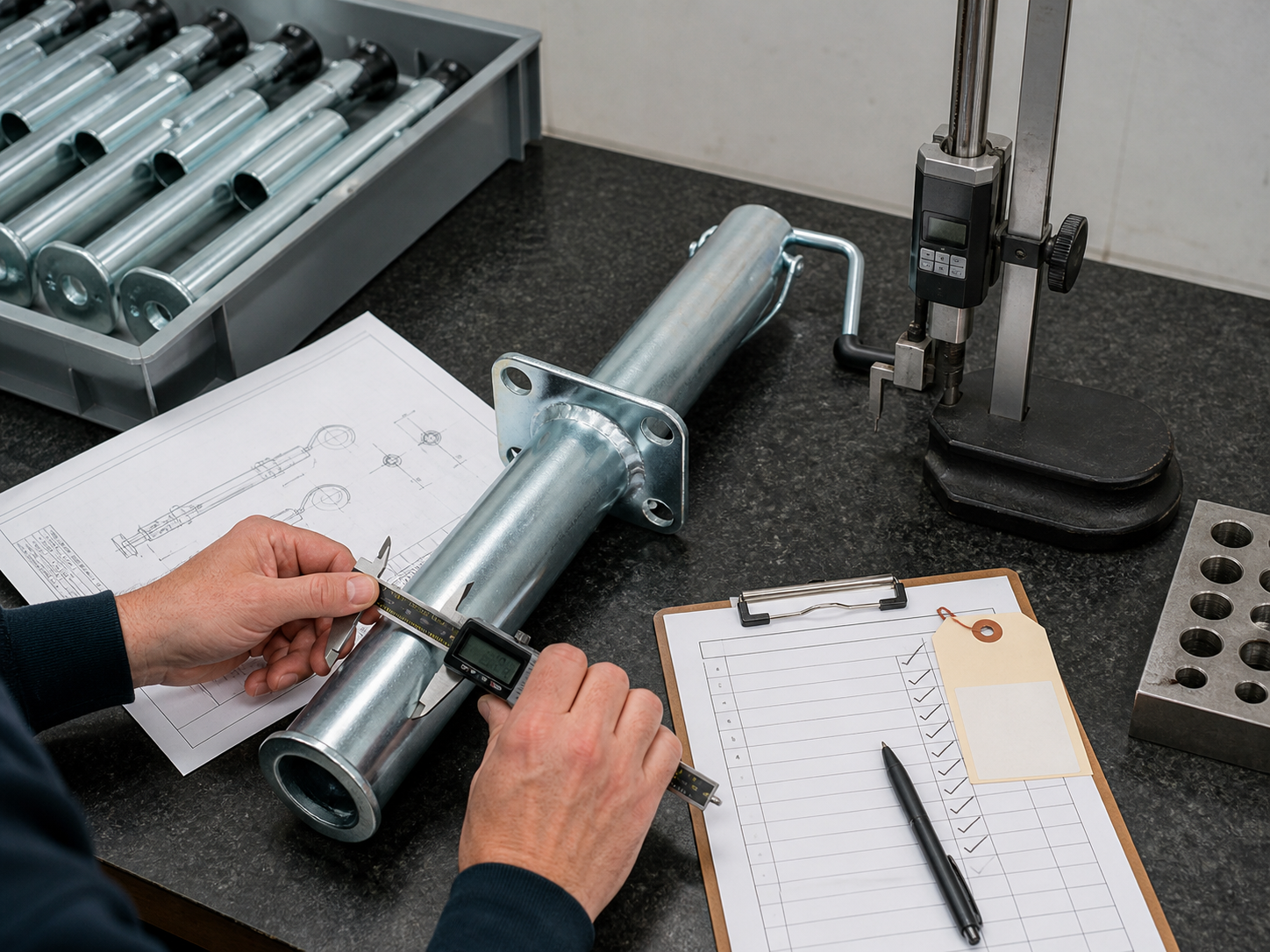
Take three tube sets from different points in the run and slide them by hand before reaching for a gauge. One pair may reveal a burr, bow, twist, tight seam, or local dent immediately. Then measure near both ends and through the middle.One outside dimension written on an inspection form can miss taper or ovality, and one wall reading says little about the fit between the inner and outer members.
Look at cut faces, deburring, straightness, seam orientation where it matters, and the tools that set length and shape. Ask when the forming tool was last checked and how a new steel lot is introduced. Finally compare an uncoated set with a finished set. Clearance that feels generous in bare steel can disappear under powder if masking and film build were designed separately.
7. Audit gears, screw mechanisms, nuts, and lubrication
Choose a mechanism from regular work-in-process and ask the assembler to talk through it. Which screw, nut, gear, shaft, bushing, bearing, and retainer belongs to this model? Where are hardness, thread form, runout, fit, and surface condition verified? Look for chips trapped in grease, bruised threads, rough gear teeth, missing retainers, and a grease amount that depends entirely on personal feel.
Crank through the complete travel. Two easy turns near the top prove very little. Pause at several positions, reverse direction, and listen for a repeating click or tight point. On a drop-leg model, pull and replace the pin while watching hole alignment and full engagement. A pin that appears installed but catches only one wall is exactly the sort of small issue that escapes a showroom check.
8. Inspect welding qualifications, fixtures, and heat effects
Begin at the fixture, not the prettiest bead.Are locators clean and unworn? Can a bracket be loaded backward? Does spatter keep the part from seating? A fixture will repeat a bad location all day if nobody verifies it. Match the process and operator qualification to the product requirements, then compare the drawing callouts with weld size, length, position, continuity, starts, stops, corners, and the hard-to-see underside.
Set the welded part on the inspection datum after it cools. Heat may pull a bracket out of square even when the bead looks consistent. Ask how that movement is checked and what the welder does when it appears. Before coating, look for spatter, scale, oil, sharp edges, and inaccessible pockets. The finish cannot repair geometry, and it should not be used to hide preparation that was never completed.
9. Evaluate mounting geometry as a system
The jack and trailer frame share the load. The audit should therefore include the product’s mounting interface, not merely the jack tube. Review hole positions, bracket thickness, weld-on surfaces, clamp geometry, fastener access, and the envelope needed for assembly tools. A dimension that looks harmless on a component drawing may cause interference on the trailer line.
Different trailer jack mounting types create different controls. Weld-on designs need reliable fixture datums and a defined coating-restoration plan at the trailer builder. Bolt-on designs need clamp fit, fastener specification, torque guidance, and resistance to local frame crushing. Swivel designs add pin engagement, bracket wear, and stowed-position retention.Fixed designs demand careful road-clearance review.
10. Check handle layout and complete crank envelope
Think about the next five thousand pieces, not the one on the desk. A handle that turns freely on a bench can collide with a toolbox, propane bottle, winch post, frame brace, safety chain, wiring loom, spare wheel, or towing vehicle. Confirm that the drawing shows the complete swept envelope at relevant jack heights. For side-wind designs, inspect lateral clearance. For top-wind designs, inspect the horizontal circle above the jack.
Audit the handle joint, knob, retaining hardware, plating or coating, and any folding feature. Operate several samples. Listen and feel for inconsistent engagement. Check whether the handle can be packed without rubbing the jack body during transport. It is a modest check, but it exposes a surprising number of problems.
11.Verify travel, drop-leg adjustment, and retracted height
Measure from defined datums. The word “height” is ambiguous unless both endpoints are shown. Confirm powered travel, drop-leg adjustment, fully retracted dimension, fully extended dimension, foot position, and stowed clearance. Compare actual results with the released drawing and inspection record.
Why does that matter? Because the approved sample is only useful when production can repeat it.
A good record should survive one blunt follow-up question. don't assume that more travel is always better. Extra travel may add crank turns, length, weight, or clearance risk. The correct geometry comes from the trailer’s coupler-height range, ground conditions, tire and suspension variation, and operating sequence.
12. Observe assembly sequence and error prevention
Watch production rather than a demonstration arranged for the audit. Check how operators identify parts, apply grease, install retainers, orient gears, tighten fasteners, set pins, and perform functional checks. Look for operations that depend on memory or personal feel when a fixture, gauge, torque tool, visual standard, or work instruction would reduce variation.
Ask what mistakes have occurred and what prevented recurrence. A factory that can explain a real problem, root cause, corrective action, and verification is often more credible than one claiming that no defect has ever happened. That is the evidence to keep with the order.
13. Review test-method definition before looking at a result
Before reading the number on a certificate, stand at the test frame and ask the technician to set up a normal sample. Where does the load enter? How is the jack mounted? Does the fixture brace a tube or bracket that the trailer would leave unsupported? A result becomes useful only after the buyer can see the fixture drawing, loading rate, hold time, measuring range, sample rule, acceptance limit, and response to failure.
Keep the test names separate. Rated capacity is a product designation; a proof test checks a defined load without a defined unacceptable result; an ultimate test explores failure margin; an endurance test repeats operation; and a functional check confirms that the mechanism still works. One cannot silently stand in for another. For example, a clean static pull says little about grit in the screw, repeated cranking, side load, or coating damage. Write the real application risk beside the test that addresses it. Any blank line is a design-review question, not an invitation to invent a passing number.
14. Verify test-equipment calibration and capacity
A bright calibration sticker is only the beginning. Match the instrument ID on the sticker to the record and to the result sheet. Then check range and resolution. A load cell calibrated far above the working range may be a poor choice for a lighter jack; a caliper can be in date and still be the wrong tool for a functional relationship between two tubes.
Ask the technician what happens if a gauge fails its next calibration. The useful answer identifies the last known acceptable check, the product that may be affected, who evaluates risk, and how customers are notified when necessary. If the answer stops at “we send the gauge out,” the product side of the problem has been missed. Record one instrument ID during the tour and find it again on a real inspection sheet. That small cross-check is harder to rehearse than a speech.
15. Examine sampling plans and lot definition
When someone says “every batch,” ask them to circle the batch boundary. Is it one shift, steel heat, coating lot, assembly order, purchase order, or container? The distinction matters because a sample of five has a very different meaning in a lot of fifty than in a lot of five thousand. Note which features are checked on every piece and which are sampled. Then watch how samples are chosen. The first five units made after a careful setup are not representative of an entire run.
Sampling should reflect severity, process stability, the chance of detection, and the cost of an escape. A high-risk mounting feature may deserve a fixture check on every jack even when finish appearance is sampled. The buyer does not need to dictate a fashionable statistical table for every characteristic, but the factory should be able to explain the logic and the reaction when one result fails.
16. Audit nonconforming-product control
Walk into the quarantine area rather than discussing it in the meeting room.Can a red-tagged pallet be scanned into a shipment? Are rejected and uninspected parts physically distinct? Open one recent record and follow the quantity: found, contained, reworked, scrapped, released. The arithmetic should close, and disposition authority should be clear.
Rework deserves particular caution. Grinding a weld, chasing a thread, straightening a bracket, touching up powder, or replacing a label may affect strength, fit, corrosion protection, appearance, or traceability. Ask for the instruction actually used and the check performed afterward. If the method lives only in a supervisor’s head, it will change with the supervisor. An approved, model-specific rework route is far safer than the phrase “make it good.”
17. Inspect surface preparation before coating
Coating trouble often begins while the steel still looks dull and unfinished.Walk the sequence: degreasing, scale or rust removal, surface conditioning, rinsing, drying, clean handling, and the wait before coating. Look into seams, holes, weld toes, recessed corners, sharp edges, and the underside of the foot. A broad flat panel is the easiest place to coat and the least interesting place to audit.
Next inspect masking. Threads, sliding fits, bearing surfaces, grease paths, electrical grounds, and assembly datums may need protection. Too much coating can jam a tube or change a mounting fit; too little leaves steel exposed. Pick one part before coating and find the corresponding feature on a finished unit. This before-and-after comparison usually makes the masking requirement obvious, even to people who do not work in a paint shop.
18. Check powder coating, plating, and corrosion verification
For powder coating, match the powder identity to the job, review oven time and actual part temperature, check film thickness at several geometries, and examine the adhesion method, color standard, texture, and touch-up rule. For plating, identify the agreed finish, performance or thickness requirement, treatment of threads and contact surfaces, appearance limit, and controls at any outside processor. If the coating is subcontracted, trace one shipment out and back.
Be careful with shorthand such as “marine grade” or “salt spray passed.” ASTM B117 describes how to operate a salt-spray apparatus; it does not assign a universal number of hours that predicts field life for every jack.The order must state test duration, specimen preparation, any scribe, inspection points, evaluation method, and acceptance criteria. It should also explain why the test relates to the intended environment. A measurable requirement can be reviewed and improved. An adjective cannot.
19. Compare cosmetic standards with functional standards
Put two headings in the audit notebook: “customer can see it” and “trailer depends on it.” They overlap, but they are not the same list. A glossy black jack may photograph beautifully even though coating has crept onto a sliding surface. Another unit may carry a small rack mark on a protected face while every functional dimension is correct. Without two acceptance standards, inspectors tend to argue from taste.
Bring an approved limit sample, or at least dated photographs that show acceptable and unacceptable color, gloss, orange peel, runs, edge coverage, dirt, handling marks, bare spots, and touch-up. Then operate the same unit through full travel, check the mounting interface and pin engagement, and look for coating flakes or tight spots. The point is not to excuse poor appearance. It is to stop a cosmetic discussion from crowding out the checks that carry load.
20. Confirm markings, warnings, and label durability
Start with an ordinary packed unit, not the display sample. Does the capacity marking agree with the product, carton, drawing, and order? Rub the label with a dry cloth and inspect the edges. Check whether the lot or date code remains readable after normal handling. For a private-label program, compare the live artwork file with what is actually on the line; a familiar logo can hide an old rating or obsolete warning.
Destination language and safety wording need named approvers. A factory should not translate a warning from memory or copy a symbol from a neighboring product. The buyer and qualified compliance advisers should approve the wording, symbols, instructions, label location, and revision. Record that approval with the specification. It is a quiet detail until a mixed carton reaches a customer.
21. Trace one finished jack backward and forward
Make this a live exercise. Pick a sealed carton from finished stock and write its code on the audit sheet.Ask the team to find the packing record, final inspection, load-test entry where applicable, coating batch, assembly order, drawing revision, and important material or component lots. Do not announce the serial or lot in advance. A trace that only works after the audit host makes several phone calls is worth noting honestly.
Now reverse the direction. Choose one tube bundle or coating lot and ask which finished units and shipments could contain it. That second route matters during containment: the buyer needs to know what to hold without freezing every product in the warehouse. Not every low-risk consumable needs individual identity, but the depth must match the agreed risk. A handwritten number is useful only when a normal employee can explain the records behind it.
22. Review packaging through the entire logistics route
A carton is part of the product during a six-week logistics route. Follow that route on paper: factory movement, truck vibration, container loading, humid ocean transit, unloading, warehouse stacking, and distributor handling. Then shake and turn a packed sample. Listen for a loose handle. Check whether the crank, foot, bracket, pin, and sharp edges can touch a coated surface. Look at divider strength, bag ventilation where appropriate, moisture protection, pallet overhang, strap pressure, carton weight, and lifting labels.
One practical test needs no elaborate laboratory. Mark the location of loose parts, close the carton as production does, put it through the agreed handling rehearsal, and open it in front of the packing supervisor.If the heavy end has migrated, the answer may be a small restraint rather than a thicker carton. Photograph the final arrangement and add it to the packing specification; otherwise the improvement disappears when the next shift takes over.
23. Verify capacity planning and bottleneck control
Machine count makes a tidy slide, but it does not reveal the bottleneck. Ask for demonstrated weekly output from a comparable jack family and walk the route in sequence. Tube preparation may have spare hours while coating slots, load testing, or one experienced assembler sets the real pace. Include maintenance, fixtures, operators, inspection time, subcontractor lead time, packaging, and seasonal demand.
Compare the promised lead time with two or three recent production orders. Count material procurement, sample or artwork approval, production, test time, packing, and vessel booking—not just days on the assembly line. Then ask what happens during overtime. Who trains temporary operators? Which checks stay at the same frequency? A credible answer usually contains numbers and names, not only “no problem.”
24. Examine preventive maintenance and tool control
Choose one high-wear item and follow it. A fixture bushing, locating pin, thread gauge, coating hook, clamp, or saw stop is more revealing than a binder full of generic maintenance forms.Who checks it, at what interval, against what limit, and what happens to product made since the last acceptable check? Look at the actual surface. Wear often speaks before the record does.
Customer-owned tooling needs its own identity, storage location, maintenance rule, and permission boundary. The agreement should cover ownership, repair, modification, use for other customers, and disposal. Take a photograph for identification, but connect that image to a tooling record. A photograph alone cannot show that a worn locator was replaced before it shifted a mounting hole.
25. Assess engineering-change and substitution control
Ask a blunt question: “What changed on this product family in the last twelve months?” The answer might be a steel source, powder, gear vendor, bracket thickness, lubricant, carton size, subcontractor, fixture, or inspection program. None is automatically wrong. The risk is that a sensible local decision quietly escapes the approved sample and purchase specification.
Put the notification rule in the purchase agreement. State which changes need advance written approval and what evidence must accompany the request. A useful change package identifies the reason, affected part numbers, old and new conditions, risk review, validation result, first affected lot, and plan for remaining stock. During the audit, open one recent change record and check the warehouse. Old and new material should be separated well enough that the first changed shipment can be named without guessing.
26. Review complaint response and corrective action
Review an anonymized complaint from beginning to end.Fit, stiff operation, coating damage, noise, missing hardware, a crushed carton, or a wrong label will do. First look for containment: which stock and shipments were held? Then separate symptom from cause. “Operator error” is not a useful root cause unless the factory explains why the process allowed the error and what changed afterward.
The file should show correction, corrective action, an owner, a due date, and an effectiveness check on later production. Before ordering, agree on response times, field evidence, sorting responsibility, replacement or rework rules, and escalation contacts. This commercial groundwork does not make defects acceptable; it keeps the technical team from losing two days deciding who is allowed to act.
27. Finish with a controlled RFQ and approval package
End the visit by building the release list while the evidence is still on the table. It should name the drawing, specification, CTQ list, control plan, sample report, test method, appearance limit, labels, packing arrangement, pallet pattern, traceability rule, change-notification rule, and commercial terms. Give each item a revision, owner, and approval status. “Discussed during audit” is not a revision.
Production approval should use representative units made with intended material, tooling, operators, subcontractors, coating, markings, and packaging. A hand-finished sample is valuable for design conversation, but it cannot prove that the line will repeat the result. Leave unresolved items on a dated action list and link order release to closure of the items that affect fit, function, safety, identity, or delivery.
Why does that matter? Because the approved sample is only useful when production can repeat it.
Need a comparable trailer jack quotation?
Pause here and look at the actual production lot. Send the maximum supported load, capacity class, top- or side-wind preference, travel, drop leg, retracted height, mounting drawing, finish, annual volume, destination, packaging, and target date. Zhongteli can review the specification and identify the questions that must be resolved before sampling.
How the Audit Changes for Heavy-Duty Trailer Jack Applications
Audit depth should increase with the consequence of failure and the uncertainty of the application. For heavy duty trailer jack applications, pay extra attention to the real load path, frame reinforcement, weld geometry, side loading, high-cycle operation, contamination, lubrication, foot stability, paired-jack imbalance, proof-test fixture stiffness, endurance validation, and service inspection.
The awkward question is usually the useful one.Equipment, dump, livestock, agricultural, and commercial trailers often operate on uneven yards rather than smooth showroom floors. Mud, fertilizer, road salt, water, stone impact, and careless repositioning can create conditions that a clean static test doesn't reproduce. The buyer’s engineering review should define realistic misuse boundaries and warnings without pretending that a jack can compensate for an unstable trailer or unsafe support practice.
OSHA’s construction standard for jacks, 29 CFR 1926.305, includes principles such as marked rated capacity, inspection, and proper blocking or cribbing where the standard applies. The article is not a substitute for that regulation, the product instructions, or the trailer designer’s analysis. It is a reminder that a jack rating does not authorize a person to work under an inadequately supported trailer.
Trailer Jack Quality Control Documents to Request
A practical trailer jack quality control package should be proportionate to risk. The following documents give buyers a useful starting point: It is a modest check, but it exposes a surprising number of problems.
| Document | What it should prove | Common weakness |
|---|---|---|
| Approved drawing | The exact released geometry, materials, finish, markings, and revision | Photo or catalog page used as a specification |
| Control plan | Where CTQs are controlled, by whom, how often,and with what reaction | Generic plan unrelated to the jack model |
| Material and component records | Identity and traceability of important inputs | Certificates cannot be connected to production lots |
| Dimensional report | Production-intent samples meet critical drawing requirements | Only easy dimensions measured |
| Load-test record | Defined samples meet a controlled test and acceptance rule | A result with no fixture, method, or calibration trace |
| Coating report | Pretreatment, film or plating control, appearance, and agreed corrosion checks | “Rustproof” claim with no measurable requirement |
| Final and packing inspection | Correct function, identity, quantity, labels, protection,and carton | Inspection before loose parts are added |
| Change log | No material or process change bypassed customer approval | Change control starts only after a complaint |
A B2B Sourcing Map for Related Rigging Products
On an ordinary production day, this should still work. Trailer-jack and cargo-control buyers often manage related programs. The links below keep each research question connected to the appropriate Zhongteli product or capability page without mixing search intent inside one article.
| Buyer research topic | Best next page |
|---|---|
| trailer jack manufacturer | Trailer Jack product range and OEM inquiry |
| what size trailer jack do I need | Capacity, tongue load, travel, and selection guide |
| trailer jack mounting types | Top/side wind, weld-on, bolt-on, swivel, and fixed options |
| heavy duty trailer jack applications | Trailer Jack product category |
| trailer jack quality control | Manufacturing and quality capability |
| load binder manufacturer | Load Binder product range and OEM inquiry |
| types of load binders | Ratchet, lever, indirect, folding-handle, and EU-type products |
| load binder size chart | Chain compatibility and product specifications |
| cargo securement equipment | Cargo-control product selection |
| rigging hardware manufacturing process | Forging, heat treatment, surface treatment, and quality overview |
Frequently Asked Questions
What is the most important evidence in a trailer jack factory audit?
The most important evidence is the connection between the approved product specification and actual production. A buyer should be able to trace a finished jack to the correct drawing revision, critical materials or components, process records, dimensional checks, load-test record, coating lot, final inspection, and packaging. Machines and certificates matter, but this connected record shows whether the system controls the product.
Should every trailer jack be proof tested?
There is no universal answer for every design, market, and customer. The buyer and manufacturer should define which tests are performed on every unit and which are performed by lot or validation sample. The decision should consider product risk, design validation, process capability, applicable standards, customer requirements, and the consequences of a failure. The test method and acceptance criteria must be documented.
How do I audit a coating subcontractor?
A neat sample doesn't answer this point. Identify the approved subcontractor, specification, incoming and outgoing checks, bath or powder controls, cure or plating parameters, inspection equipment, lot traceability, nonconformance handling, and change-notification process. Review actual records for the jack program. If corrosion performance is important, agree on sample preparation, test method, duration, evaluation, and acceptance criteria rather than relying on a generic “salt spray tested” claim. That is the evidence to keep with the order.
What should be included in a trailer jack RFQ?
Include application, maximum load at the jack point, desired capacity class, top- or side-wind preference, powered travel, drop leg, retracted and extended dimensions, mounting drawing, materials, finish, labels, warnings, test requirements, packaging, annual volume, order quantity, destination, target date, and required documents. Photos are helpful, but a controlled drawing or requirement sheet creates a comparable quotation.
Why does that matter? Because the approved sample is only useful when production can repeat it.
How can I prevent a supplier from changing materials after approval?
Put a change-control clause in the specification and purchase agreement. Define which materials, sources, dimensions, processes, subcontractors, tools, treatments, finishes, lubricants, labels, tests, and packaging elements require written approval before change. Require lot identification and records that distinguish old and new production. Audit a real change example to verify that the rule is used.
Ask the team to rehearse one plausible change. Suppose the approved powder is temporarily unavailable.Who opens the request? Which part numbers are affected? What evidence would the alternative need, and who at the buyer may approve it? How will old and new powder be separated, and what is the first affected lot? Write the answers on the change form. If the route depends on calling one salesperson and waiting for a chat reply, it is too fragile for production. A usable system leaves a dated decision that the warehouse, coating line, quality inspector, and buyer can all understand.
In other words: check the ordinary process, not the demonstration.
Is a factory certificate enough to approve a supplier?
There is a practical reason for checking this early. No. A valid quality-system certificate can support supplier qualification, but it does not prove that a particular trailer jack meets its drawing, rating, functional, coating, and packaging requirements. Verify certificate scope and validity, then audit the product-specific controls and records.
What sample should be used for production approval?
Use samples made from production-intent materials, tooling, operators, processes, subcontractors, coating, markings, and packaging. Document dimensional results, functional operation, required tests, appearance, and deviations. A hand-finished sample made outside the normal process can't demonstrate repeatability. A photograph can support the record, but it cannot replace it.
How often should a trailer jack supplier be re-audited?
Frequency should be risk based.Consider product safety, order volume, performance, complaints, process changes, site changes, certificate status, delivery problems, and the time since the last review. Between full audits, monitor change notifications, lot records, inspection reports, delivery performance, and corrective actions.
Can a buyer rely on the trailer jack’s labeled capacity alone?
Watch what the operator does before reading the form. No. The buyer must confirm how the capacity was defined and validated, whether the product is suitable for the actual load and geometry, and what limitations appear in the manufacturer’s instructions. The trailer designer must also verify the mounting structure and operating condition. A rating doesn't excuse an unstable setup, side loading, inadequate blocking, or unsafe work under a trailer.
What makes a factory audit useful for price negotiation?
A good audit turns a vague product into a comparable specification. When every bidder quotes the same material, geometry, tests, finish, records, packaging, and change controls, the buyer can separate real cost differences from omitted requirements. The lowest number on an incomplete quotation is often the most expensive number after rework, delay, sorting, damage, or warranty claims.
Final Buyer Decision
A reliable trailer jack program isn't created by choosing the largest rating, approving one attractive sample, or visiting a factory with many machines. It is created by controlling the connection between application, drawing, material, process, inspection, test, coating, packaging, and change approval. The factory audit should make that connection visible.The result should be repeatable on a normal shift.
The fastest check starts with a random part, not a prepared sample. Use the 27 checks in this guide to build a focused audit plan. Follow one real production lot. Measure the characteristics that control fit and function. Understand the test before accepting the result. Look beneath the finish. Open the carton. Trace the lot. Ask what changes after approval and who has the authority to stop them. Those actions protect more value than a superficial price comparison.
Ningbo Zhongteli Rigging Co., Ltd. publishes trailer-jack options in 2,000 lb, 5,000 lb, 7,000 lb, and 12,000 lb capacity classes, with top-wind and side-wind configurations. The correct starting point remains the buyer’s real application data. Send the supported load, geometry, mounting, finish, quantity, destination, and quality-document needs so the discussion begins with an auditable specification.
Authoritative References
- U.S. Occupational Safety and Health Administration, 29 CFR 1926.305 — Jacks. Consult the current regulation and determine whether it applies to the specific workplace and use.
- ASTM International, ASTM B117 — Standard Practice for Operating Salt Spray (Fog) Apparatus. The practice describes apparatus operation; the product specification must define duration and acceptance.
- International Organization for Standardization, ISO 9001:2015 — Quality management systems.Verify the supplier’s current certificate, issuing body, site, and scope.
- U.S. National Highway Traffic Safety Administration interpretation on fully loaded trailer tongue-weight information. Use current vehicle, trailer, and product instructions for the actual application.
Safety and compliance note: This article provides general OEM sourcing and audit guidance. It does not replace the trailer designer’s calculations, the product manufacturer’s instructions, a qualified engineer’s review, workplace procedures, or laws and standards applicable to a particular product, vehicle, country, or use.