English


Ratchet vs Lever Load Binder: The Decision in One Minute
The practical answer to the ratchet vs lever load binder question is not that one design is universally better.
A ratchet load binder is commonly preferred when buyers want incremental tensioning, controlled handle movement, easier fine adjustment and a smaller operating arc. It can be especially useful where trailer-side clearance is limited, different operators use the same equipment, or the fleet wants a more standardized tensioning procedure.
A lever load binder is commonly preferred when fast application and release are important, sufficient handle-sweep clearance is available, operators are properly trained and the fleet has a clear procedure for controlling the handle during tensioning and release.
Neither operating style automatically determines the product’s Working Load Limit. Capacity, compatible chain range, hook geometry, take-up, material, construction and marking must be confirmed for the exact model.
The selection should therefore answer five questions:
- Which design fits the available operating space?
- Which release behavior can the operator control consistently?
- Which design matches the fleet’s loading frequency and work cycle?
- Which model is compatible with the complete chain securement system?
- Which product can the supplier reproduce consistently across production batches?
Buyers can review the available product families in the ZTL load binder range, but final approval should always be based on the intended chain, application, market and operating procedure.
| Decision factor | Ratchet load binder | Lever load binder |
|---|---|---|
| Tensioning action | Multiple incremental handle strokes | One primary over-center handle movement |
| Adjustment control | Generally easier to increase tension gradually | Faster transition from loose to tensioned condition |
| Operating clearance | Usually needs repeated short handle movements | Requires a clear handle-sweep path |
| Release behavior | Usually released through controlled ratchet operation | Handle movement must be carefully controlled during release |
| Speed | Typically slower per binder | Typically faster when space and procedure are suitable |
| Moving components | More mechanism-related parts | Mechanically simpler in many designs |
| Training focus | Pawl engagement, directional control and thread condition | Handle control, body position and release path |
| Typical buyer preference | Fleets prioritizing control and repeatability | Operations prioritizing speed and simplicity |
| Capacity assumption | Must be confirmed by exact model | Must be confirmed by exact model |
| Best decision basis | Application, clearance, chain and operator workflow | Application, clearance, chain and operator workflow |
This table is a screening tool, not a substitute for the product drawing, manufacturer’s instructions or destination-market requirements.
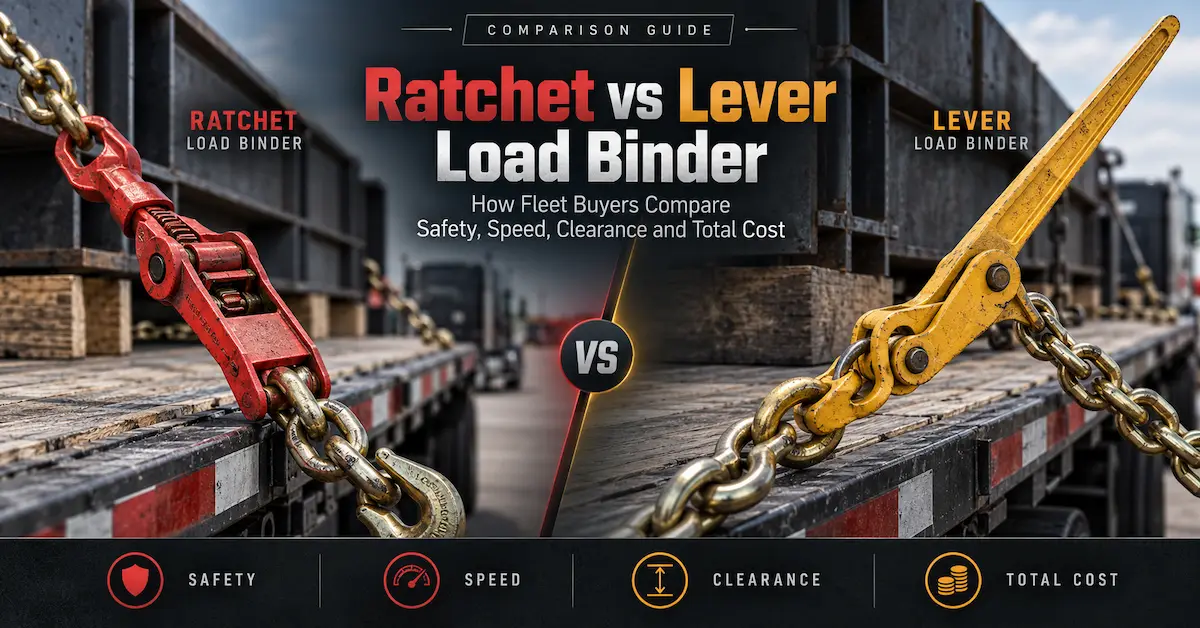
How Ratchet and Lever Load Binders Apply Chain Tension
Both products perform the same broad function: they remove slack and apply tension to a chain tiedown system.
They achieve that function through different mechanisms.
Understanding the mechanism matters because it affects operator movement, clearance, inspection points, maintenance, training and release behavior.
How a Ratchet Load Binder Works
A ratchet binder generally uses a threaded body together with a ratchet gear, pawl and handle.
The operator moves the handle through repeated strokes. The ratchet mechanism converts those strokes into gradual adjustment of the threaded components, shortening the effective distance between the hooks and increasing chain tension.
The primary operational advantage is control.
Instead of moving the handle through one large closing arc, the operator can build tension in smaller steps. This can make it easier to:
- stop at a desired tension level;
- work beside trailer structures;
- operate where the handle cannot complete a large sweep;
- adjust the binder after initial settling;
- release tension through a more gradual process.
That does not mean a ratchet binder is automatically risk-free.
A worn pawl, damaged gear, contaminated thread, bent handle, incomplete engagement or mismatched chain can still create an unsafe system. The operator must also verify that the selector and pawl are fully engaged before applying force.
How a Lever Load Binder Works
A lever binder is commonly described as an over-center binder.
The operator connects the hooks, removes available chain slack and moves the handle through its closing arc. The lever geometry applies mechanical advantage and moves the binder into its tensioned position.
The main operational advantage is speed.
Once the chain is correctly positioned and the binder is connected, tension can often be applied with fewer handle movements than with a ratchet design.
This can benefit operations where:
- multiple tiedowns must be installed quickly;
- the trailer layout provides ample handle clearance;
- trained operators use a consistent procedure;
- the same chain and binder combination is used repeatedly;
- loading and unloading cycles are time-sensitive.
The main operating consideration is stored energy and handle movement.
The handle should not be treated as an ordinary hand tool that can be released without planning. The operator must maintain control, keep the body away from the expected handle path and follow the product manufacturer’s procedure.
Why the Mechanism Changes the Purchasing Decision
A procurement team that compares only nominal capacity misses much of the operational difference.
The mechanism affects:
- the space needed beside the load;
- the number of hand movements per tiedown;
- the operator’s body position;
- how tension is increased;
- how tension is released;
- which components require inspection;
- how contamination affects operation;
- the type of training the fleet must provide.
That is why a strong comparison starts with the work process, not the catalogue photograph.
Which Is Safer: Ratchet or Lever Load Binder?
The statement “ratchet binders are safe and lever binders are unsafe” is too simplistic for a professional purchasing decision.
The ratchet design is often selected because incremental operation can reduce the need for a large over-center handle movement. It may also make controlled release easier for operators who follow the correct procedure.
However, safety depends on much more than binder type.
It also depends on:
- product condition;
- compatible chain size and grade;
- correct hook engagement;
- proper tensioning procedure;
- operator position;
- available clearance;
- cargo configuration;
- anchor-point condition;
- training;
- inspection;
- manufacturer instructions.
A damaged ratchet binder used with the wrong chain is not a safer system than a correctly specified lever binder operated by a trained user.
Stored Energy Is the Central Lever-Binder Issue
When a chain securement system is tensioned, energy is stored in the system.
With an over-center lever binder, the handle can move quickly if it is not controlled during release. The expected release path must therefore remain clear of the operator, nearby workers and equipment.
A professional procedure should address:
- where the operator stands;
- where the handle can travel;
- whether cargo settlement has increased or changed system tension;
- how the handle is gripped;
- how nearby personnel are kept clear;
- how frozen, corroded or damaged equipment is handled.
The correct response to a difficult binder is not automatically to apply a longer pipe or improvised extension.
Unless a product is specifically designed and approved for an extension, added leverage can produce forces that the operator cannot judge reliably. It may also expose the handle, mechanism, chain or anchor point to loading outside the intended operating method.
Ratchet Binders Still Require a Release Plan
A ratchet mechanism can provide more gradual movement, but the system remains under tension.
Before reversing or releasing a ratchet binder, the operator should confirm:
- the load will remain stable;
- the chain is not carrying unexpected shifted-cargo forces;
- the pawl and selector are functioning;
- the handle is not damaged;
- the operator has stable footing;
- the release direction is understood;
- no person is positioned inside the hazard area.
Ratchet operation should never be used to compensate for an unstable load, damaged anchor point or incorrectly selected tiedown arrangement.
The Complete System Determines Performance
For U.S.commercial transport, 49 CFR §393.108 states that the WLL of a tiedown assembly is determined by the lowest WLL among its components, tensioner or anchor points. Section 393.104 also requires securement devices to be in proper working order and attached so they do not loosen, unfasten, open or release in transit. 电子联邦法规
That means a higher-rated binder does not upgrade:
- an underrated chain;
- an incompatible hook;
- a damaged anchor point;
- an unmarked component;
- an incorrectly configured securement system.
The binder should be evaluated as one part of the complete path:
cargo → tiedown configuration → chain → binder → hook or connector → anchor point
The system is only as strong and reliable as its lowest-rated or least-controlled part.
Ratchet vs Lever Load Binder for Operating Control
Operating control is one of the strongest reasons buyers compare ratchet and lever binders.
A ratchet binder generally lets the operator increase or decrease tension in smaller steps. This can help when the cargo requires careful adjustment or when several tiedowns must be balanced across a machine, structure or mixed load.
A lever binder moves more quickly through its operating cycle, but the tensioning action is less incremental.
When Fine Adjustment Matters
Fine adjustment can be useful when securing:
- machinery with defined tiedown points;
- loads with several chains sharing restraint;
- equipment positioned close to trailer structures;
- cargo that may be damaged by uncontrolled compression;
- loads that require rechecking after initial movement;
- systems where small chain-link changes create large tension differences.
The buyer should not assume that a ratchet binder can create a specific chain tension from handle feel alone.
Actual tension depends on the product mechanism, friction, lubrication, thread condition, geometry, operator input, chain arrangement and other system variables.
Unless the complete product and procedure are designed for measured tension, the binder should not be treated as a calibrated tension instrument.
When Fast Engagement Matters
A lever binder can reduce the number of movements required to tension a correctly prepared chain.
This can be valuable in:
- high-frequency loading yards;
- repetitive fleet routes;
- equipment rental operations;
- construction transport;
- agricultural hauling;
- distribution programs with experienced operators.
However, speed is only valuable when the trailer layout and operating process support it.
A lever binder that repeatedly contacts a tire, rub rail, machine frame or adjacent chain may be slower in real use than a ratchet binder with a shorter handle stroke.
The most useful productivity measurement is not the number of handle movements in isolation.
It is the total time required to:
- select the correct binder;
- connect both hooks;
- remove slack;
- tension the system;
- secure or position the handle correctly;
- inspect the completed tiedown;
- release the binder at destination.
Handle Clearance Can Decide the Comparison
A load binder is often selected from a catalogue while the real work happens in a crowded space.
Flatbed trailers, machinery decks and construction loads can place the binder close to:
- tires;
- rub rails;
- stake pockets;
- sideboards;
- hydraulic lines;
- machine frames;
- adjacent chains;
- sharp cargo edges;
- trailer toolboxes.
The relevant question is not whether the binder fits when stationary.
It is whether the complete handle movement fits during tensioning and release.
Ratchet Handle Clearance
A ratchet binder normally uses repeated shorter strokes.
This can make it easier to operate where a full lever sweep is not available.
However, the buyer should still verify:
- handle length;
- stroke angle;
- pawl-selector access;
- hand clearance;
- distance from the trailer deck;
- distance from adjacent equipment;
- clearance throughout the full thread range.
A ratchet binder should not be approved simply because its body fits between the chain and trailer.
Lever Handle Clearance
A lever binder requires a clear path for the handle.
The complete path should be checked from the open position to the fully tensioned position and again during release.
The review should consider:
- whether the operator can remain in a stable position;
- whether the handle passes through a pedestrian area;
- whether it can strike the trailer or load;
- whether another tiedown blocks movement;
- whether the release path remains clear after cargo settlement;
- whether gloves can be used without trapping fingers.
For recurring OEM or fleet applications, the handle envelope can be added to a loading diagram or trailer drawing.
This is more reliable than asking operators to solve the clearance problem after the equipment arrives.
Speed vs Repeatability in Fleet Operations
Lever binders are often described as faster, while ratchet binders are described as more controlled.
Both descriptions can be correct, but neither tells the fleet what its actual operating cost will be.
A fleet should evaluate the complete work cycle.
Factors That Affect Real Tensioning Time
- Binder storage location
- Product weight
- Chain preparation
- Hook accessibility
- Available clearance
- Operator experience
- Weather
- Dirt or corrosion
- Gloves and protective equipment
- Need for retensioning
- Release procedure
- Inspection and maintenance time
A lever binder may perform very well in a clean, repetitive operation with open access.
The same product may become difficult in a mixed fleet where operators encounter different trailers, chain lengths and cargo geometries each day.
A ratchet binder may take more strokes, but its repeatable action can reduce hesitation and improve consistency across less uniform operations.
Standard Work Often Matters More Than Maximum Speed
Procurement teams should ask whether the fleet wants:
- the fastest experienced operator;
- or a process that many operators can perform consistently.
The second objective often leads to a different buying decision.
A standardized process can simplify:
- operator training;
- inspection forms;
- replacement inventory;
- toolbox talks;
- incident review;
- maintenance procedures;
- spare-parts management.
This does not automatically mean standardizing on ratchet binders.
A fleet with stable applications and experienced operators may standardize successfully on lever binders.
The important point is to select a design that fits the real workforce and route profile.
Ratchet vs Lever Load Binder Chain Compatibility
Binder type does not replace chain compatibility.
A ratchet or lever binder must be matched to the correct:
- chain size;
- chain grade;
- hook profile;
- Working Load Limit;
- take-up requirement;
- destination-market rules.
A visually large binder is not necessarily compatible with every large chain.
Likewise, a hook that can physically enter a chain link is not automatically an approved match.
Confirm the Exact Chain Range
The purchase specification should state the intended chain size and grade.
Avoid vague descriptions such as:
- standard transport chain;
- heavy-duty chain;
- truck chain;
- large chain;
- universal chain binder.
These terms do not provide enough information for engineering approval.
For application-level guidance, buyers can also review the load binder for flatbed trucking guide, which explains why chain, binder, connector and anchor point must be treated as one securement system.
Understand WLL, Proof Test and Breaking Strength
These terms should not be used interchangeably.
Working Load Limit is the marked or specified maximum load for the component under its intended service conditions.
Proof testing is a verification step performed according to an applicable product specification, manufacturer process or buyer requirement. A proof-test value is not an instruction to operate the product at that load.
Breaking strength relates to destructive failure and is not a normal operating allowance.
A supplier quotation should identify which value is being stated.
If a quotation simply says “capacity,” the buyer should ask whether it means:
- WLL;
- proof-test load;
- breaking strength;
- another internal value.
Hook Geometry Is Part of Compatibility
The buyer should evaluate:
- hook opening;
- chain seating;
- throat geometry;
- engagement depth;
- hook alignment;
- swivel or fixed configuration;
- deformation risk;
- marking;
- retention features where applicable.
A chain should seat as intended in the hook.
It should not be approved based only on whether an operator can force it into position.
Take-Up Must Match the Real Slack Range
Take-up is the usable adjustment available to shorten the system and apply tension.
Too little take-up can leave the chain loose.
Excessive unused range may create poor positioning, exposed threads or an operating condition not intended by the product design.
The buyer should define the required take-up from actual trailer and cargo geometry rather than copying a competitor’s specification.
Ratchet vs Lever Binder Application Matrix
Different operating environments produce different priorities.
The following matrix helps buyers organize those priorities before testing actual models.
| Application | Ratchet binder may be preferred when | Lever binder may be preferred when |
|---|---|---|
| Flatbed trucking | Loads vary and clearance changes frequently | Routes and tiedown positions are highly repetitive |
| Heavy equipment transport | Controlled adjustment is needed around machinery | Open access allows fast application by trained crews |
| Construction hauling | Mixed cargo and crowded trailer edges limit handle sweep | Standard materials are loaded in repeatable positions |
| Agricultural transport | Different operators and seasonal use favor gradual control | Simple equipment and open trailers provide clear handle movement |
| Rental fleets | Standardized training across many users is important | The rental program tightly controls user training and application |
| Steel or lumber hauling | Adjustment and rechecking are frequent | Experienced crews value rapid tensioning |
| OEM cargo-control kits | One product must cover varied customer use | The kit targets one clearly defined application |
| Export distribution | Buyers need broad usability and structured instructions | Local market strongly prefers traditional lever operation |
| Confined trailer layouts | Shorter operating strokes solve clearance problems | Sufficient handle arc is documented |
| High-cycle loading yards | Repeatability and controlled release are priorities | Cycle speed is the primary operational requirement |
Flatbed Trucking
Flatbed operations rarely involve one universal cargo shape.
A driver may secure machinery, steel, lumber, precast products or construction materials on different routes.
Ratchet binders can be attractive when tiedown geometry changes frequently because their shorter strokes may work in varied spaces.
Lever binders can remain effective where the carrier has established chain locations, experienced operators and sufficient clearance.
The decision should be made through actual route and cargo analysis rather than a general trucking preference.
Heavy Equipment Transport
Heavy machinery presents specific challenges:
- large mass;
- designated tiedown locations;
- complex frames;
- limited access around tracks or tires;
- multiple chains working together;
- potential load settlement.
A ratchet binder may help crews make incremental adjustments across several tiedowns.
A lever binder may support faster application where tiedown points are open and the operator can control the complete handle path.
The load binder for heavy equipment guide provides additional application-level factors for machinery transport.
Construction Hauling
Construction trailers often carry different loads throughout the week.
The binder may be used around compact equipment, pipe, forms, attachments, steel components or bundled materials.
A fleet should evaluate:
- how often cargo changes;
- whether the binder works beside machine frames;
- whether dirt affects the mechanism;
- how operators inspect equipment;
- whether quick release or fine adjustment is more important.
The construction hauling selection guide can be used alongside this comparison when the primary use is construction equipment or material transport.
Distribution and Private-Label Programs
A distributor does not control every end-user application.
That increases the value of:
- clear model identification;
- readable WLL marking;
- chain-range information;
- warnings;
- packaging instructions;
- product differentiation;
- technical support.
A private-label buyer may choose to carry both ratchet and lever binders rather than presenting one as universally superior.
In that case, the catalogue should explain the operating difference clearly enough that buyers can select by application.
A Practical Decision Tree for Buyers
Use the following process before requesting samples.
Step 1: Define the Complete Securement System
Record:
- cargo type;
- trailer type;
- tiedown configuration;
- chain size;
- chain grade;
- connector type;
- anchor-point rating;
- required WLL;
- expected take-up.
If these items are unknown, the project is not ready for a binder comparison.
Step 2: Measure the Operating Space
Document the available handle area in the actual tensioning and release positions.
Do not measure only the binder body location.
Include:
- vertical clearance;
- lateral clearance;
- nearby tire or rub-rail position;
- cargo movement;
- adjacent tiedowns;
- operator footing.
If the handle cannot travel safely, the product is not suitable regardless of price.
Step 3: Define the Work Cycle
Ask:
- How many binders are applied per load?
- How many loads are handled per shift?
- How often are tiedowns checked?
- How often does cargo vary?
- How many operators use the equipment?
- Is the work performed in rain, snow, mud or dust?
- Is release speed important at destination?
This identifies whether speed, control or standardization has the highest operational value.
Step 4: Review Operator Capability
Consider:
- training level;
- staff turnover;
- language requirements;
- experience with stored-energy systems;
- ability to follow inspection procedures;
- use of gloves and protective equipment;
- supervision.
The product should fit the workforce that will actually use it.
Step 5: Compare Exact Models
Do not compare “ratchet” with “lever” at category level only.
Compare the exact proposed models for:
- WLL;
- chain range;
- take-up;
- handle length;
- hook geometry;
- product weight;
- finish;
- markings;
- packaging;
- test requirements.
Step 6: Run a Controlled Field Trial
Use normal operators, real trailers and representative loads.
Record the results instead of relying on preference statements.
Step 7: Freeze the Approved Specification
After selection, record:
- drawing;
- revision;
- material;
- critical dimensions;
- rated values;
- finish;
- marking;
- inspection plan;
- packaging;
- approved sample;
- change-control requirements.
This converts a general product choice into a repeatable purchasing program.
How to Run a Ratchet vs Lever Load Binder Field Trial
A field trial is one of the best ways to turn opinions into procurement evidence.
Operators often have strong preferences based on habit.
Those preferences matter, but they should be evaluated alongside measurable results.
Select Representative Test Conditions
The trial should include:
- the main trailer types;
- the most common chain sizes;
- typical cargo;
- difficult-clearance locations;
- clean and contaminated conditions where relevant;
- experienced and less-experienced operators;
- tensioning and release.
Avoid testing only the easiest tiedown position.
Record Operational Metrics
A useful trial form can include:
| Metric | What to record |
|---|---|
| Installation time | Time from binder selection to completed inspection |
| Release time | Time from release preparation to removal |
| Handle interference | Number and location of contacts or near-contacts |
| Operator repositioning | How often the operator must change stance |
| Adjustment control | Ease of adding or reducing tension |
| Hook engagement | Ease and consistency of connecting the chain |
| Reinspection | Whether meaningful adjustment is required |
| Contamination effect | Change in operation after dirt or moisture exposure |
| Training errors | Incorrect selector, handle or hook use |
| Operator feedback | Specific comments rather than “like” or “dislike” |
| Maintenance time | Cleaning, lubrication or inspection effort |
| Product damage | Deformation, wear or coating damage observed |
Separate Product Problems From Procedure Problems
A difficult trial result may come from:
- poor binder geometry;
- incorrect chain length;
- unsuitable tiedown location;
- insufficient operator training;
- damaged chain;
- weak anchor placement;
- contaminated equipment.
The review team should identify the actual cause.
Changing binder type will not solve a chain-length or trailer-layout problem.
Use a Scoring Matrix
A procurement team can assign weighted scores.
For example:
- safety and controllability;
- compatibility;
- clearance;
- cycle time;
- operator acceptance;
- maintenance;
- purchase cost;
- supplier capability.
The weight of each category should reflect the fleet’s priorities.
A high-cycle yard may place more weight on time.
A mixed fleet with frequent staff changes may place more weight on repeatability and training.
Ratchet-Specific Quality Control Points
Ratchet binders contain mechanism-related features that require product-specific inspection.
A supplier should not treat “ratchet works” as a complete functional test.
Pawl and Gear Engagement
Inspect:
- tooth formation;
- full pawl engagement;
- spring action;
- directional control;
- retention;
- irregular movement;
- incomplete engagement.
The mechanism should operate consistently throughout the intended adjustment range.
Thread Quality
Threads convert handle movement into adjustment.
Important checks include:
- thread form;
- left- and right-hand component control;
- straightness;
- burrs;
- contamination;
- coating buildup;
- effective engagement;
- usable take-up;
- free movement without excessive looseness.
The buyer should specify whether threads are checked with gauges and how take-up is verified.
Selector and Handle Function
The directional selector should be:
- accessible;
- positively engaged;
- correctly retained;
- consistent across samples.
The handle should be checked for:
- geometry;
- weld or connection condition where applicable;
- alignment;
- deformation;
- finish;
- clearance around the mechanism.
Lubrication and Packaging
If lubrication is part of production, the supplier should control:
- lubricant type;
- application point;
- application amount;
- contamination prevention;
- packaging protection.
Too little lubrication may affect operation.
Excessive or uncontrolled lubricant can contaminate cartons, labels or surrounding products.
Lever-Specific Quality Control Points
Lever binders have fewer mechanism components in many designs, but their geometry is critical.
Over-Center Geometry
The supplier should control the dimensions that determine how the binder moves into and remains in its tensioned position.
Small changes in:
- pivot location;
- link length;
- handle geometry;
- body alignment;
- hook position;
can alter operation even when the product looks similar.
Pivot, Pin and Retention
Inspect:
- pin material and dimensions;
- hole alignment;
- retention method;
- excessive play;
- burrs;
- deformation;
- wear points.
The assembly should move as intended without uncontrolled looseness.
Handle Geometry
The handle affects leverage, clearance and release behavior.
The approved drawing should define:
- length;
- section;
- angle;
- connection;
- finish;
- relevant tolerances.
An unapproved change to handle length is not merely cosmetic.
It can change how operators apply force and how the product fits the application.
Hook Alignment
Both hooks should align with the intended chain path.
Misalignment can affect:
- chain seating;
- load distribution;
- operation;
- take-up;
- packaging.
The buyer should inspect functional assemblies, not only loose forged components.
Quality Requirements Common to Both Binder Types
Ratchet and lever binders share several important manufacturing controls.
Material Traceability
The supplier should be able to connect components to:
- material specification;
- receiving lot;
- certificate where required;
- production batch;
- inspection status.
A certificate without product-lot linkage provides limited assurance.
Forging Control
Forged components should be inspected for conditions such as:
- incomplete fill;
- folds or laps;
- off-center geometry;
- excessive flash;
- surface defects;
- section variation.
The buyer should verify that die condition and first-piece approval are controlled.
Heat Treatment
A statement that a component is “heat treated” is not enough.
The supplier should be able to identify:
- which parts are treated;
- the approved process;
- lot separation;
- furnace records;
- acceptance checks;
- response to nonconforming results.
Rated-Value Verification
The inspection and test plan should define:
- what is tested;
- test method;
- sampling;
- equipment;
- acceptance criteria;
- lot identification;
- record retention.
Do not assume a generic test report represents the production lot being purchased.
Marking
The product marking should match the approved specification.
Depending on the market and project, buyers may need to define:
- model identity;
- WLL;
- chain range;
- manufacturer or private label;
- lot or date identity;
- country-of-origin information;
- required warnings.
Finish
The finish should be defined by more than color.
Specify:
- surface preparation;
- coating or plating system;
- appearance criteria;
- coverage;
- protected interfaces;
- test requirement where applicable;
- packaging protection.
Packaging
Binder packaging should control:
- movement inside the carton;
- hook-to-handle contact;
- finish damage;
- rust protection;
- label accuracy;
- carton strength;
- pallet arrangement;
- unit count.
Packaging is part of product quality when the shipment must survive export handling and warehouse storage.
The load binder factory audit checklist provides a more detailed review of forging, heat treatment, thread control, rated values, traceability and packing.
Should a Fleet Standardize on One Binder Type?
Standardizing can simplify operations, but forcing one design into every application can create new problems.
Benefits of Standardization
A single binder family may simplify:
- training;
- replacement inventory;
- inspection;
- work instructions;
- purchasing;
- incident review;
- maintenance;
- supplier management.
Operators become familiar with one mechanism, and procurement can concentrate volume on fewer SKUs.
Risks of Over-Standardization
One design may not fit:
- every trailer;
- every chain size;
- every cargo type;
- every clearance condition;
- every destination market.
A fleet that standardizes only on lever binders may encounter locations where the handle cannot move freely.
A fleet that standardizes only on ratchet binders may accept slower operation in a repetitive loading process where speed is important.
A Controlled Two-Family Policy
Some fleets may benefit from carrying both types under a controlled policy.
For example:
- ratchet binders for confined, variable or high-control applications;
- lever binders for open, repetitive applications operated by trained crews.
The policy should define where each type is approved.
Color, model code, storage location and work instruction can help prevent uncontrolled substitution.
Total Cost of Ownership: More Than Unit Price
The lower-priced binder is not automatically the lower-cost choice.
A professional comparison should consider the cost of the complete program.
Acquisition Cost
This includes:
- unit price;
- samples;
- tooling where applicable;
- inspection;
- testing;
- packaging;
- freight;
- duty;
- inventory.
Operating Cost
Operating cost includes:
- time per tiedown;
- time per release;
- rechecking;
- cleaning;
- lubrication;
- inspection;
- operator fatigue;
- damaged-product replacement.
Training Cost
Consider:
- initial training;
- refresher training;
- multilingual instructions;
- supervisor time;
- turnover;
- procedure enforcement.
A product that experienced operators use efficiently may create more training cost in a high-turnover fleet.
Quality Cost
Quality cost may include:
- incoming rejection;
- rework;
- relabeling;
- finish damage;
- inconsistent dimensions;
- missing documentation;
- field complaints;
- warranty handling.
Inventory Cost
Carrying many similar binder models increases:
- stock complexity;
- picking errors;
- dead inventory;
- replacement confusion;
- inspection complexity.
However, reducing the range too far can create application mismatch.
Risk Cost
The most important cost may be difficult to place on a purchase order.
It includes the consequences of:
- incorrect product selection;
- operator injury;
- cargo movement;
- roadside violation;
- equipment damage;
- downtime;
- customer claims.
The best purchasing decision is therefore not:
Which binder has the lowest price?
It is:
Which approved binder system delivers the most reliable operational result at the lowest controlled total cost?
RFQ Checklist for Ratchet and Lever Load Binders
A useful request for quotation should allow suppliers to quote the same product definition.
| RFQ field | Information to provide |
|---|---|
| Application | Flatbed, machinery, construction, agriculture, fleet or distribution |
| Destination market | Country or region where product will be sold or used |
| Binder type | Ratchet, lever or supplier proposal |
| Chain size | Exact intended size |
| Chain grade | Exact intended grade |
| Required WLL | Project requirement |
| Take-up | Required usable adjustment |
| Hook configuration | Required hook style and connection |
| Handle clearance | Available operating envelope |
| Material | Required specification or approved supplier proposal |
| Heat treatment | Product-specific requirement |
| Finish | Required coating or plating system |
| Marking | Model, WLL, chain range, logo, lot identity and warnings |
| Testing | Required production, proof or third-party verification |
| Inspection | Sampling and acceptance plan |
| Documentation | Drawing, certificate, report and traceability requirements |
| Packaging | Unit protection, carton, pallet and label requirements |
| Quantity | Sample, pilot, initial order and annual forecast |
| Change control | Buyer approval required before specified changes |
The RFQ should also ask the supplier to identify every assumption.
A transparent proposal may state:
- requirement confirmed;
- supplier option proposed;
- information still needed;
- deviation requiring approval.
That is more useful than a quotation that silently substitutes the nearest catalogue model.
Common Ratchet vs Lever Load Binder Purchasing Mistakes
Comparing Category Names Instead of Exact Models
“Ratchet” and “lever” describe mechanisms.
They do not define capacity, chain range, material, finish or quality level.
Always compare exact model specifications.
Assuming the Higher WLL Is Automatically Better
A higher-rated binder may be heavier, larger, more expensive or incompatible with the chain and anchor system.
The selected WLL must fit the complete tiedown arrangement.
Ignoring Handle Clearance
A product that cannot be operated in the intended space is not suitable, even when every catalogue specification appears correct.
Treating Hook Fit as Chain Compatibility
Physical fit alone does not confirm approved compatibility.
Verify the marked and documented chain range.
Confusing Proof Load With WLL
Proof testing is not an operating rating.
The buyer should require clear terminology in quotations and documents.
Approving Only a Golden Sample
A sample should be connected to:
- drawing revision;
- material;
- finish;
- test plan;
- marking;
- packaging.
Without those controls, the sample may not define future production.
Buying on Price Before Freezing the Specification
Two quotations may look comparable while covering different:
- steel;
- heat treatment;
- test level;
- marking;
- finish;
- packing;
- traceability.
Freeze the quotation basis before comparing price.
Failing to Control Changes
A change to the handle, hook, thread, pivot, pawl, finish or packaging can affect operation or acceptance.
The purchase agreement should define which changes require approval.
Using One Binder to Solve a Poor Securement Layout
A binder cannot correct:
- inadequate anchor points;
- damaged chain;
- incorrect tiedown direction;
- unstable cargo;
- missing blocking or bracing;
- insufficient number of tiedowns.
The complete system must be reviewed.
Frequently Asked Questions
Is a Ratchet Load Binder Safer Than a Lever Load Binder?
A ratchet binder often provides more gradual tensioning and release, which can help operators control handle movement. However, safety depends on the exact product, condition, chain compatibility, operator procedure, clearance and complete securement system. Neither binder type should be considered automatically safe without correct selection and use.
Is a Lever Load Binder Faster?
Lever binders are generally faster to apply when the chain is correctly prepared and sufficient handle clearance is available. Real productivity should still include connection, tensioning, inspection, rechecking and release time.
Which Binder Is Better for Flatbed Trucking?
It depends on cargo variety, clearance, operator experience and fleet policy. Ratchet binders may suit variable loads and confined positions. Lever binders may suit repetitive applications with trained operators and clear handle paths.
Can Ratchet and Lever Binders Use the Same Chain?
Some models may be specified for the same chain size and grade, but compatibility must be confirmed for each exact binder. Do not assume interchangeability from appearance or category name.
Which Type Is Better for Grade 70 Chain?
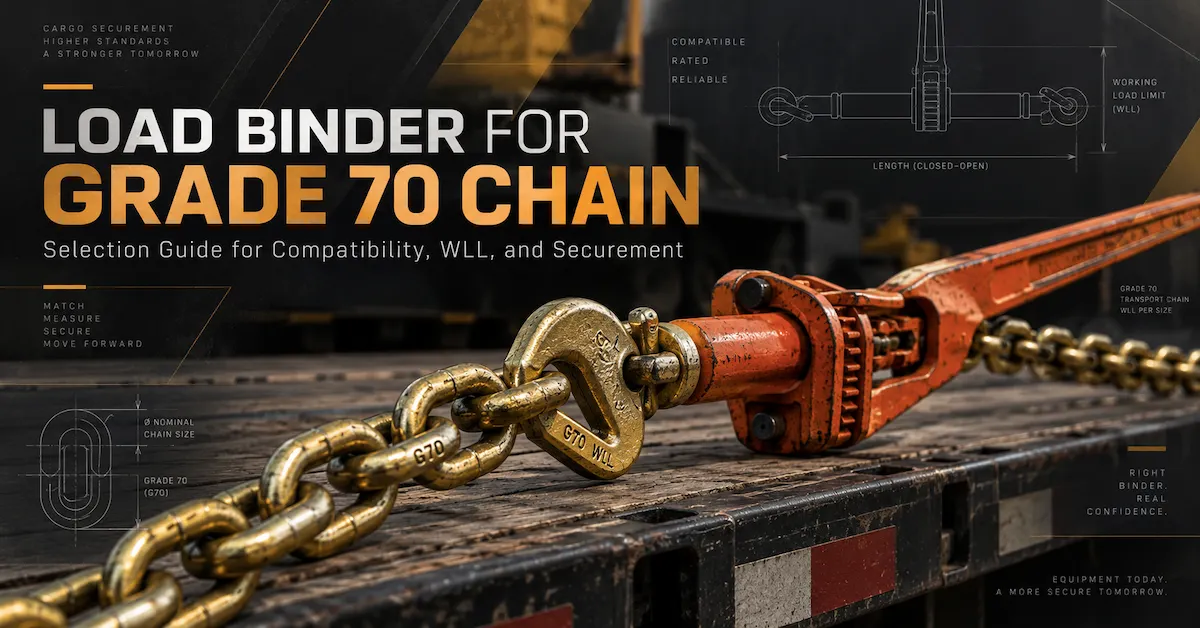
Either type may be available for Grade 70 transport chain. The buyer must match the exact chain size, binder WLL, hook geometry and product marking. Binder type alone does not determine compatibility.
Does a Ratchet Binder Apply More Tension?
Not automatically. Applied tension depends on design, friction, threads, geometry, condition and operator input. Do not infer system tension from mechanism type unless the product and procedure are specifically designed for measured tension.
Can a Pipe Be Used on a Lever Binder Handle?
Do not use an improvised extension unless the manufacturer specifically designs and authorizes the product for that method. Additional leverage can create uncontrolled forces and release behavior.
Can a Ratchet Binder Loosen in Transit?
Any securement device can create a problem if damaged, incorrectly engaged, improperly installed or used in a system that settles. Inspection, correct operation and route-specific rechecking procedures remain necessary.
Which Type Needs More Maintenance?
Ratchet binders generally contain more mechanism-related parts and threads that require inspection and appropriate maintenance. Lever binders are often mechanically simpler, but pivots, pins, hooks, handles and geometry still require inspection. Actual maintenance requirements depend on the exact model and environment.
Which Binder Is Better in Mud, Snow or Dust?
Environmental contamination can affect both designs. Ratchet gears, pawls and threads require attention, while lever pivots and connecting parts also need inspection. A field trial under the intended conditions is more reliable than a general assumption.
Should a Distributor Carry Both Types?
Many distributors benefit from offering both because customer applications, preferences and operating conditions differ. The product information should clearly explain chain compatibility, WLL, take-up, operating clearance and mechanism differences.
What Should an OEM Buyer Approve Before Mass Production?
Approve the drawing, material, critical dimensions, chain range, WLL, take-up, hooks, mechanism, finish, marking, testing, packaging, traceability and change-control process. A sample alone is not a complete production specification.
Conclusion
The ratchet vs lever load binder decision should be based on the complete operating system rather than habit or unit price. Ratchet binders generally offer incremental adjustment, controlled handle movement and better adaptability to limited clearance, while lever binders can provide fast operation and mechanical simplicity where the handle path is open and trained operators follow a consistent release procedure.
Before standardizing either type, confirm chain compatibility, WLL, hook geometry, take-up, operating clearance, operator workflow, quality controls and destination-market requirements. A controlled field trial and model-specific RFQ will usually reveal more than a catalogue comparison.
Review the ZTL load binder product range, learn more about ZTL’s manufacturing background, or contact ZTL Rigging with your chain size, grade, required WLL, application, binder preference, quantity, finish, marking and packaging requirements for a project-specific evaluation.