English


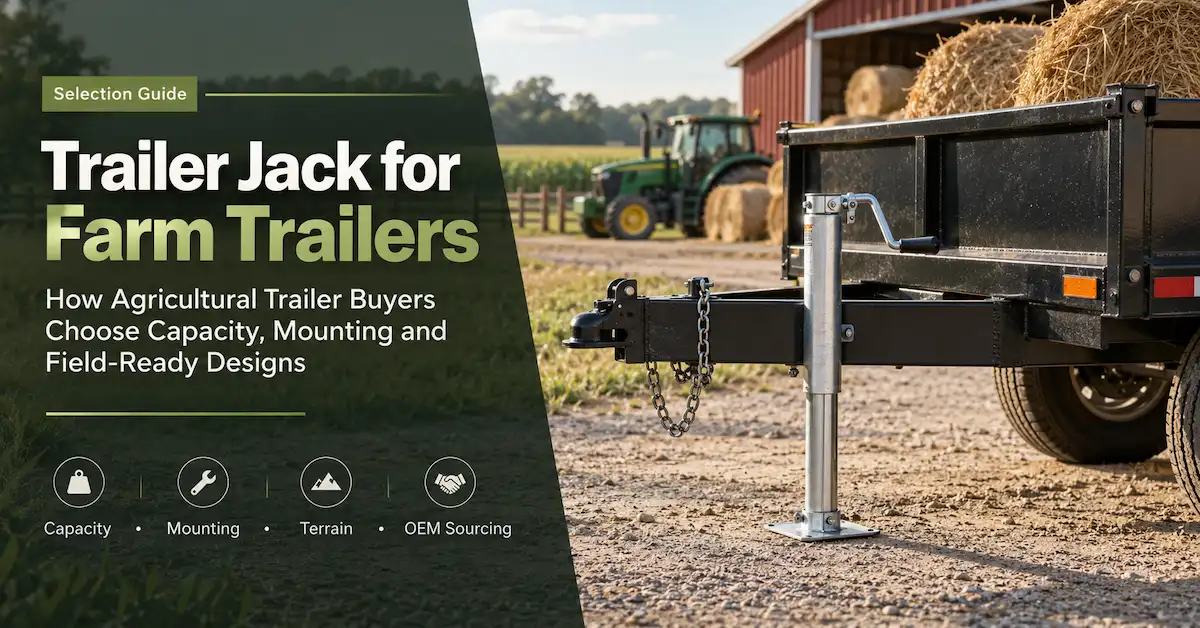
Trailer Jack for Farm Trailers: How Agricultural Trailer Buyers Choose Capacity, Mounting and Field-Ready Designs
A trailer jack for farm trailers works in a much less controlled environment than a jack used only on paved yards or occasional recreational trailers.
Agricultural trailers may be parked on compacted soil, gravel, grass, mud or uneven field entrances. They can spend long periods outdoors, operate around dust and moisture, and may be hitched and unhitched repeatedly during seasonal work. At the same time, the trailer itself may range from a relatively light utility platform to a livestock trailer, equipment hauler or heavier agricultural transport platform.
That means choosing a farm trailer jack cannot be reduced to one question:
“How many pounds is the jack rated for?”
For trailer manufacturers, agricultural equipment OEMs, distributors and replacement-parts buyers, a better purchasing process considers the complete application: the load carried at the jack position, mounting geometry, required travel, crank access, ground conditions, environmental exposure, operator frequency and repeat-order consistency.
Buyers comparing available configurations can begin with the current ZTL trailer jack range, but product approval should always be based on the actual farm trailer design rather than the catalogue capacity alone.
Why Farm Trailers Create Different Demands for a Trailer Jack
A farm trailer often moves between road use and field use.
That transition changes the conditions surrounding the jack. A hard, level loading yard may provide a stable surface in the morning, while the same trailer could be disconnected on soft soil or an uneven field edge later in the day.
Typical agricultural applications may include:
- livestock trailers;
- hay and bale trailers;
- utility farm trailers;
- agricultural equipment carriers;
- implement trailers;
- maintenance trailers;
- grain or material transport platforms;
- machinery and compact-equipment trailers.
The jack therefore has to fit both the trailer structure and the way the trailer is actually used.
For an OEM buyer, the real question is not simply whether a jack can lift a certain nominal load. It is whether the selected jack configuration can repeatedly support the intended trailer tongue or drawbar under realistic operating conditions without creating mounting, clearance or usability problems.
1. Start With Jack-Point Load, Not Total Trailer Weight
One of the most important distinctions when selecting a trailer jack for farm trailers is the difference between total trailer weight and the load acting at the jack.
A trailer may carry a substantial gross load, but the jack normally supports the front portion of the trailer when the trailer is disconnected. The load at that point depends on factors such as:
- axle position;
- trailer geometry;
- cargo distribution;
- drawbar configuration;
- equipment placement;
- whether the trailer is loaded or unloaded during unhitching;
- how the trailer is intended to be parked or serviced.
Because of this, buyers should not automatically select a jack by copying the trailer's total rated weight.
A better RFQ starts with:
What is the maximum expected vertical load at the jack mounting position under the intended operating condition?
That value should come from the trailer designer or engineering assessment.
The jack's published capacity designation can then be used as one part of the selection process.
ZTL currently lists trailer jack capacity classes including 2,000 lb, 5,000 lb, 7,000 lb and 12,000 lb across top-wind and side-wind configurations. Ningbo Zhongteli Rigging Co., Ltd. These classes help narrow the candidate family, but buyers should request the current drawing and model-specific rating definition before approving a product.
For a broader explanation of this process, see ZTL's trailer jack OEM buyer's guide.
2. Match the Jack to the Farm Trailer, Not the Other Way Around
Agricultural trailer fleets are rarely uniform.
A parts distributor may serve customers using compact utility trailers and much larger equipment trailers at the same time. An OEM may also manufacture several chassis families with different tongue dimensions, mounting locations and operating environments.
For that reason, one universal farm trailer jack is rarely the correct purchasing strategy.
A practical first-stage selection matrix looks like this:
| Farm trailer condition | Buyer should evaluate | Why it matters |
|---|---|---|
| Light utility or service trailer | Jack-point load, compact mounting, travel | Avoid unnecessary weight and oversized hardware |
| Livestock trailer | Repeated hitching, outdoor exposure, operator access | Frequent use makes crank position and durability important |
| Hay or flatbed farm trailer | Tongue geometry, parked load distribution, ground clearance | Long frames and changing loads can affect front support requirements |
| Equipment trailer | Higher jack-point load, frame strength, mounting method | Machinery position can substantially change tongue load |
| Agricultural implement trailer | Clearance around drawbar and nearby components | The crank must remain usable around equipment and connections |
| Heavy farm transport trailer | Capacity class, drop-leg requirement, mounting and documentation | Higher loads require a more controlled engineering review |
This approach prevents a common sourcing mistake: selecting a jack first and modifying the trailer later simply because the purchased component does not fit the real application.
3. Evaluate Soft and Uneven Ground Conditions
Ground conditions are especially important when selecting a farm trailer jack.
A foot that performs adequately on concrete may behave differently on loose soil, gravel or softened ground. The issue is not only the jack itself; it is the interaction between the jack foot and the surface beneath it.
Agricultural buyers should therefore evaluate:
- footplate dimensions;
- expected ground pressure;
- whether additional support pads are used in field operations;
- minimum and maximum working height;
- trailer angle when disconnected;
- stability on the intended parking surface;
- whether mud or debris can interfere with the lower section.
A larger foot contact area can be useful in some farm environments, but buyers should not assume that footplate size alone guarantees safe support on soft ground.
The complete trailer setup, operating procedure and ground condition still matter.
For OEM programs, foot geometry should be included in the approved drawing rather than treated as an incidental component that suppliers can change between batches.
4. Check Travel Before Selecting Capacity
A jack can have sufficient nominal capacity and still be unsuitable because it does not provide the required height range.
For agricultural trailers, buyers should define at least three dimensions:
Retracted position
The jack must retract enough to maintain appropriate clearance while the trailer is moving.
Required working height
The jack must position the coupler or drawbar correctly for connection with the towing vehicle.
Extension requirement
The available stroke and any drop-leg adjustment must cover the expected difference between parked and coupling positions.
This becomes particularly important when a trailer operates with different towing vehicles or works on surfaces where trailer height varies.
A trailer jack that requires excessive cranking every time the operator connects a farm trailer may technically fit the application but still create poor day-to-day usability.
For higher-capacity applications, buyers can review configurations such as ZTL's 7000 lb top-wind trailer jack and compare the published configuration with the actual trailer drawing before deciding whether it is suitable.
5. Top Wind or Side Wind for a Farm Trailer?
This is one of the most practical decisions in agricultural trailer jack selection.
Neither configuration is automatically better.
Top-Wind Trailer Jack
A top-wind handle rotates above the jack.
It can be useful where there is adequate overhead crank space but limited room beside the trailer tongue.
Before approving a top-wind design, check for interference with:
- toolboxes;
- drawbar structures;
- hydraulic components;
- covers;
- equipment frames;
- storage systems;
- other accessories positioned above the tongue.
ZTL's current trailer jack catalogue includes top-wind options in the 2,000 lb and 7,000 lb classes. Ningbo Zhongteli Rigging Co., Ltd.
Side-Wind Trailer Jack
A side-wind handle operates beside the jack body.
For many farm trailer layouts, this can provide convenient operator access, but only if the full crank path remains clear.
Potential interference points include:
- trailer frame rails;
- hydraulic hoses;
- safety chains;
- electrical connections;
- drawbar braces;
- spare wheels;
- storage boxes;
- nearby implements.
The current ZTL range includes 2,000 lb, 5,000 lb and 12,000 lb side-wind configurations. Ningbo Zhongteli Rigging Co., Ltd.
Buyers evaluating an intermediate side-wind option can review the 5000 lb side-wind trailer jack.
For applications requiring a higher published capacity class, ZTL also lists a 12000 lb side-wind trailer jack.
The correct decision should come from actual clearance and operating conditions—not from assuming that side wind or top wind is universally better for agricultural equipment.
6. Draw the Full Crank Envelope Before Approving the Jack
One useful practice for agricultural trailer OEMs is to add the crank movement to the trailer drawing.
Do not check only the jack body dimensions.
Model the complete handle path.
A handle that appears clear in a static CAD view may hit another component halfway through its rotation.
This is particularly relevant to farm equipment because trailer tongues often carry multiple systems within a limited area.
A pre-production check should answer:
- Can the operator complete the full crank rotation?
- Does the handle remain clear throughout the jack's height range?
- Is operation possible when the towing vehicle is connected?
- Can hydraulic lines, wiring or chains move into the crank path?
- Is the handle accessible while wearing work gloves?
- Will any future optional equipment create interference?
Resolving these questions before production is much cheaper than discovering the interference after a batch reaches an assembly line.
7. Consider Mounting as Part of the Trailer Structure
A farm trailer jack is not an isolated accessory.
Its mounting arrangement transfers force into the trailer frame.
Buyers should therefore specify:
- mounting type;
- bracket or tube geometry;
- weld or fastener requirements according to the trailer design;
- installation position;
- required mounting dimensions;
- structural clearance;
- orientation;
- drawing tolerances;
- whether the jack needs to move or stow for transport.
Do not assume that two jacks with the same capacity designation are interchangeable.
Differences in tube size, bracket location, travel, crank geometry or lower-leg arrangement can make a nominally similar product unsuitable for the existing trailer design.
For repeat OEM orders, the approved mounting interface should be controlled by drawing revision.
8. Agricultural Exposure Changes the Surface-Finish Question
Farm trailers regularly operate around moisture, dust, fertilizer residue, soil, road contamination and seasonal outdoor storage.
The relevant purchasing question is therefore not simply:
“Is the jack corrosion resistant?”
That statement is too vague for a technical RFQ.
Instead, define:
- operating environment;
- storage environment;
- required finish;
- appearance requirements;
- coating areas;
- protected and unprotected interfaces;
- verification or test requirements where applicable;
- acceptable surface defects.
ZTL describes surface treatment as part of its manufacturing capability and states that its production process includes forging, heat treatment and surface treatment, together with material, process and finished-product inspection. Ningbo Zhongteli Rigging Co., Ltd.
For a buyer, however, company-level capability should not replace product-level confirmation.
The finish and inspection requirements for the specific agricultural trailer jack should still appear in the quotation, drawing or agreed specification.
9. Think About Mud, Dust and Maintenance Access
Agricultural applications are maintenance-sensitive because debris can collect around moving components.
During product approval, consider how easily an operator can:
- visually inspect the jack;
- clean exposed surfaces;
- identify damage or deformation;
- access service points specified by the manufacturer;
- inspect the foot and lower tube;
- check mounting areas;
- detect unusual operating resistance.
Maintenance requirements should come from the approved jack specification and manufacturer's instructions rather than assumptions based on another model.
This is especially important for distributors selling replacement trailer jacks. Two visually similar products may have different internal construction or service requirements.
10. Capacity Is Only One Line in the Farm Trailer Jack Specification
A useful agricultural trailer jack RFQ should contain considerably more than a requested capacity.
| RFQ item | Information the buyer should provide |
|---|---|
| Application | Farm trailer, livestock trailer, equipment trailer, implement trailer, etc. |
| Jack-point load | Maximum expected load at the installed jack position |
| Trailer geometry | Relevant tongue or drawbar drawing |
| Handle type | Top wind or side wind |
| Crank clearance | Available operating envelope |
| Mounting | Required mounting configuration and dimensions |
| Travel | Required powered travel and working height range |
| Lower-leg requirement | Fixed or adjustable configuration as required |
| Ground conditions | Concrete, gravel, soil, field use or mixed conditions |
| Environment | Moisture, dust, outdoor storage and other exposure |
| Finish | Project-specific surface-treatment requirement |
| Quantity | Prototype, pilot or production volume |
| Destination market | Market where the trailer will be sold or operated |
| Documentation | Drawing, inspection, testing or traceability requirements |
| OEM requirements | Marking, packaging, labeling or other project-specific details |
Providing this information allows the supplier to evaluate the application instead of simply quoting the closest catalogue number.
11. Selecting a Trailer Jack for Different Farm Trailer Scenarios
Livestock Trailers
For livestock-trailer applications, frequent connection and disconnection may make operating access particularly important.
Buyers should focus on:
- crank clearance;
- reliable mounting;
- suitable working height;
- environmental exposure;
- operator access;
- batch consistency for replacement parts.
Farm Equipment Trailers
Equipment trailers can experience significant changes in load distribution depending on where machinery is positioned.
The jack-point load should therefore be evaluated for the intended loading condition rather than guessed from empty trailer weight.
Higher-capacity classes may become candidates, but capacity should still be verified against the trailer design.
Hay and Utility Trailers
For utility-oriented agricultural trailers, packaging a jack into a compact tongue arrangement may be more important than selecting the largest available product.
Check the relationship between:
- frame dimensions;
- handle path;
- coupler position;
- ground clearance;
- required travel;
- accessory locations.
Heavy Agricultural Transport Platforms
For heavier trailers, the sourcing process becomes more engineering-driven.
Besides capacity, buyers should define:
- mounting interface;
- travel;
- drop-leg arrangement where applicable;
- structural integration;
- surface treatment;
- inspection requirements;
- test requirements;
- batch traceability;
- change-control rules.
12. Do Not Oversize the Jack Without an Engineering Reason
Selecting the largest available trailer jack may appear conservative, but unnecessary oversizing can create new problems.
A larger jack may involve:
- greater product weight;
- different mounting dimensions;
- more packaging volume;
- altered crank geometry;
- additional frame requirements;
- higher purchasing cost;
- unnecessary complexity.
The objective should be to select an appropriately rated and correctly configured jack for the worst expected operating condition—not simply the largest unit in the catalogue.
This is why capacity, geometry and usage should be reviewed together.
13. Prototype Approval Is Not Enough for OEM Farm Trailer Programs
A good sample proves that one product can be produced correctly.
It does not automatically prove that every later batch will remain identical.
For agricultural trailer manufacturers and private-label buyers, repeatability matters because a seemingly minor change can affect assembly or field performance.
Important controlled characteristics may include:
- mounting dimensions;
- overall geometry;
- crank position;
- travel;
- foot design;
- surface finish;
- component configuration;
- markings;
- packaging;
- supplied accessories.
The approved drawing should become the reference point for production.
If the supplier changes a dimension, component, finish or other controlled characteristic, the buyer should know whether reapproval is required.
Buyers developing a formal supplier qualification program can also use ZTL's Trailer Jack Factory Audit Checklist for OEM Buyers as an additional internal evaluation reference.
14. What Agricultural Trailer Buyers Should Check During Supplier Evaluation
The best farm trailer jack manufacturer is not simply the company offering the lowest unit price.
For long-term OEM or wholesale supply, evaluate the complete manufacturing and quality system.
Engineering Support
Can the supplier review your application information and drawings before recommending a configuration?
Manufacturing Control
Can important dimensions, assembly characteristics and finishes be controlled consistently from batch to batch?
Inspection
Are incoming materials, production processes and finished products inspected according to defined requirements?
Documentation
Can the supplier work with approved drawings, specifications and project revisions?
Traceability
Can a shipment or production lot be connected to inspection and production information when required?
Change Control
Will the buyer be informed when a controlled component, dimension, process or finish changes?
OEM Support
Can marking, packaging and other private-label requirements be defined before production?
ZTL states that its quality system includes material inspection, process inspection and finished-product inspection, and its current company profile describes customized product solutions and global export service. Ningbo Zhongteli Rigging Co., Ltd.
OEM buyers can review more background on the ZTL manufacturing profile before preparing an RFQ.
15. Cost Should Be Evaluated at the Program Level
For agricultural trailer manufacturers, the cheapest quoted jack may not produce the lowest total cost.
Consider costs related to:
- assembly interference;
- rework;
- incorrect mounting dimensions;
- field replacement;
- inconsistent batches;
- packaging damage;
- specification changes;
- inventory duplication;
- warranty handling;
- engineering time spent solving preventable fit problems.
A slightly lower purchase price has limited value if the product creates repeated assembly or field-service problems.
For an OEM buyer, the more useful comparison is:
unit price + manufacturing consistency + documentation + supply reliability + application fit.
That is a stronger procurement metric than unit price alone.
16. A Practical Farm Trailer Jack Selection Checklist
Before approving a trailer jack for farm trailers, confirm the following:
- Maximum expected jack-point load is defined.
- Capacity terminology is understood and confirmed for the exact model.
- Mounting position and interface are defined by drawing.
- Required retracted and extended heights are known.
- Powered travel is suitable for the application.
- Top-wind or side-wind crank clearance has been checked.
- The full handle movement does not interfere with nearby components.
- The foot arrangement is suitable for the intended operating procedure.
- Field and storage environments have been considered.
- Surface-finish requirements are documented.
- Ground clearance during transport has been reviewed.
- Inspection requirements are agreed.
- Packaging and marking requirements are documented.
- Sample approval criteria are measurable.
- Repeat-order change control is established.
If several of these answers are still unknown, the project is probably not ready for final quotation.
Frequently Asked Questions About Trailer Jacks for Farm Trailers
What type of trailer jack is best for a farm trailer?
There is no single best configuration for every farm trailer. Selection depends on jack-point load, trailer geometry, mounting arrangement, required travel, crank clearance, terrain and operating frequency.
How do I choose the capacity of a farm trailer jack?
Start with the maximum expected load acting at the jack's installed position rather than selecting directly from total trailer weight. Then compare that requirement with the exact manufacturer's capacity definition and the trailer designer's requirements.
Is a side-wind jack better for agricultural trailers?
A side-wind jack can be convenient when there is sufficient space beside the trailer tongue. It is not automatically better than a top-wind design. Crank clearance and operator access should determine the choice.
When should I use a top-wind trailer jack?
A top-wind configuration can work well when the trailer has adequate space above the jack and limited side clearance. Buyers should model the full handle rotation before approval.
Is a 5,000 lb trailer jack suitable for a farm trailer?
It may be a candidate for some applications, but the 5,000 lb designation alone is not enough to confirm suitability. Jack-point load, mounting, travel, geometry, rating definition and operating conditions must also be checked.
Do farm trailer jacks need a large footplate?
Ground conditions should be considered when specifying the foot arrangement. Soft or uneven surfaces can affect support conditions, but footplate area alone does not guarantee stability. The complete trailer setup and operating procedure must be evaluated.
What information should I send a trailer jack supplier?
Provide the trailer application, expected jack-point load, drawing or mounting dimensions, travel requirements, crank preference, ground conditions, environment, finish, order quantity, destination market and any OEM documentation or packaging requirements.
Can one trailer jack model be used across an entire agricultural trailer range?
Sometimes platforms can share components, but this should only be done after checking each trailer's load, geometry, travel and mounting requirements. Standardization should follow engineering validation rather than precede it.
What should an OEM buyer inspect before placing a production order?
Confirm an approved sample and drawing, critical dimensions, mounting, operation, finish, inspection method, packaging, marking and change-control requirements. These controls make repeat orders more predictable.
Can ZTL provide trailer jack options for agricultural trailer projects?
ZTL currently publishes top-wind and side-wind trailer jack options across several capacity classes and states that customization is available within its trailer jack range. Buyers should submit the actual application requirements so the appropriate product or customization path can be reviewed. Ningbo Zhongteli Rigging Co., Ltd.
Conclusion
Choosing the right trailer jack for farm trailers is an application-engineering decision rather than a simple capacity comparison.
Agricultural trailer buyers should first determine the actual load at the jack position, then evaluate mounting geometry, required travel, top-wind or side-wind clearance, ground conditions, environmental exposure and operator use. For OEM and wholesale programs, the decision must go further by controlling drawings, inspection criteria, surface finish, packaging, traceability and changes between production batches.
A well-specified agricultural trailer jack should fit the trailer correctly, operate within the available space and remain consistent across repeat orders. That is why agricultural trailer manufacturers and distributors should provide detailed application information before requesting a final quotation rather than selecting a product by nominal capacity alone.
Review the current ZTL trailer jack product range or contact ZTL Rigging with your farm trailer application, jack-point load, mounting dimensions, required travel, handle preference, finish, quantity and destination market for a project-specific evaluation.