English


Why Trailer Jacks for Boat Trailers Need a Different Selection Process
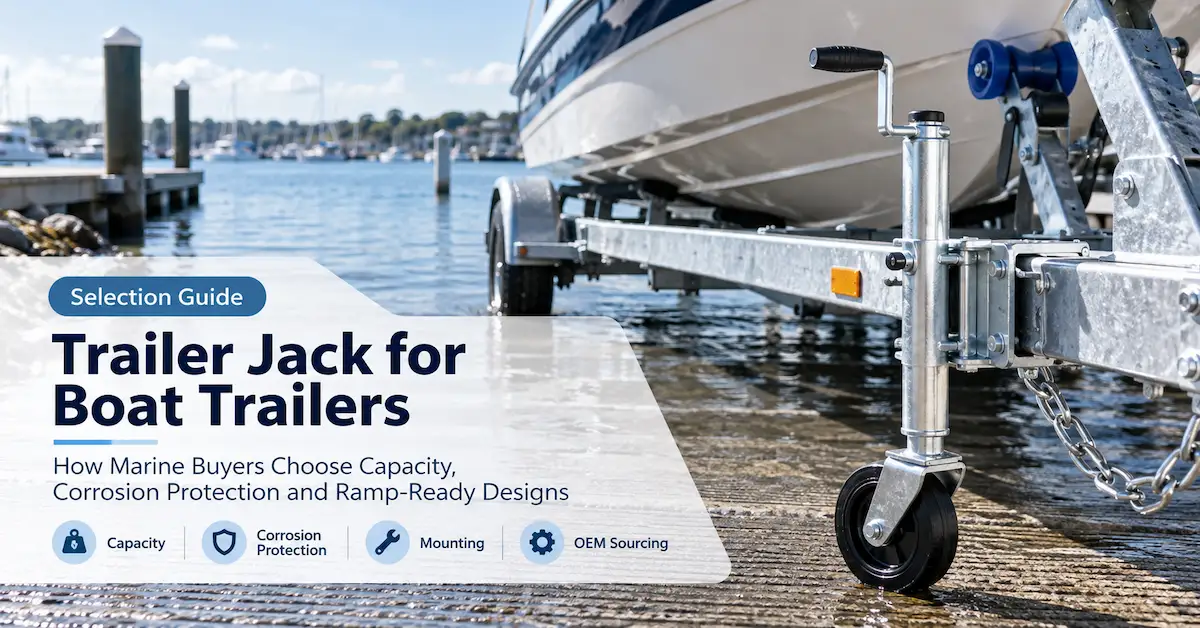
A trailer jack for boat trailers works in conditions that are very different from those experienced by many utility, farm or equipment trailers.
Boat trailers regularly move between highways, storage yards and launch ramps. Depending on the application, the jack may be exposed to rain, freshwater, saltwater spray, road salt, sand, mud and extended outdoor storage.
At the same time, the jack must fit into a relatively crowded area around the trailer tongue. A typical boat trailer may already contain the coupler, safety chains, brake actuator, winch post, bow stop, wiring and other accessories.
For boat trailer manufacturers, marine equipment distributors and OEM buyers, trailer-jack selection therefore requires more than checking a capacity number.
A better purchasing decision evaluates:
- actual load at the jack position;
- freshwater or saltwater exposure;
- mounting geometry;
- top-wind or side-wind handle clearance;
- required travel;
- retracted ground clearance;
- launch-ramp conditions;
- surface treatment;
- batch consistency;
- OEM documentation and change control.
Buyers evaluating potential configurations can begin with the current ZTL trailer jack product range, but the final selection should be based on the actual boat trailer design and intended operating environment.
Start With the Actual Jack-Point Load
One of the most important principles in selecting a boat trailer jack is understanding that total trailer weight and jack load are not the same thing.
When a trailer is disconnected, most of its total weight remains supported by the axle system.
The jack supports the vertical load acting at the tongue or jack mounting location.
That load can be influenced by:
- boat position;
- trailer axle location;
- outboard or inboard engine position;
- fuel load;
- batteries;
- water tanks;
- accessories;
- bow-stop adjustment;
- equipment stored in the boat.
This means two trailers with similar total weights may place very different loads on their tongue jacks.
What Should an OEM Buyer Calculate?
Before requesting a quotation, determine the maximum expected vertical load at the jack mounting position under the intended loading condition.
This should be based on the trailer design rather than estimated simply from total boat-and-trailer weight.
Once that value is defined, buyers can evaluate an appropriate jack capacity class.
For additional background on this process, buyers can review the trailer jack OEM buyer's guide.
Do Not Select the Largest Jack Automatically
Oversizing is not always the best answer.
A larger jack may also mean:
- greater component weight;
- different tube dimensions;
- larger mounting requirements;
- increased packaging volume;
- different handle clearance;
- higher purchasing cost.
The objective is to choose a jack that correctly fits the real application rather than automatically choosing the largest capacity available.
Freshwater and Saltwater Boat Trailers Should Not Be Treated as the Same Application
Marine environments vary significantly.
A recreational fishing trailer used primarily at freshwater lakes has different exposure from a trailer launched every day in coastal saltwater.
For purchasing purposes, the term marine trailer jack is therefore too broad on its own.
Define the Actual Environment
An RFQ should identify whether the trailer will be used in:
- freshwater;
- occasional coastal environments;
- regular saltwater launching;
- coastal storage;
- high-humidity marina conditions;
- mixed freshwater and saltwater applications.
This information directly affects the discussion around surface protection and maintenance.
Replace Vague Corrosion Claims With Specifications
A statement such as:
“The jack must be corrosion resistant.”
is not precise enough for an OEM purchasing specification.
Instead, buyers should define the required:
- surface treatment;
- coating or plating requirements;
- appearance requirements;
- protected areas;
- test requirements where applicable;
- acceptance criteria;
- inspection frequency;
- packaging protection.
The important purchasing principle is:
Corrosion resistance should be defined as a measurable requirement rather than a marketing adjective.
Do Not Assume a Corrosion-Resistant Jack Is Designed for Submersion
Water exposure can mean very different things.
A trailer jack may encounter rain and splash without ever being intentionally submerged.
Depending on the trailer geometry and launch-ramp depth, another installation may approach or enter the water during launching.
These are not automatically equivalent design conditions.
Buyers Should Define Water Exposure Clearly
Tell the supplier whether the expected environment involves:
- rain only;
- occasional freshwater splash;
- frequent saltwater spray;
- launch-ramp splash;
- possible temporary partial immersion;
- another specific exposure condition.
If the jack may be submerged, confirm whether the exact model is intended for that operating condition.
Do not assume immersion capability from:
- appearance;
- galvanized color;
- plating;
- coating;
- a general “marine” description.
This clarification is particularly important for reducing warranty and replacement disputes.
Top Wind vs Side Wind for Boat Trailers
Both top-wind and side-wind configurations can work on boat trailers.
The choice should be based primarily on trailer geometry and crank clearance.
Top-Wind Trailer Jack
A top-wind jack places the crank above the jack body.
This may work well where there is sufficient vertical operating space but limited clearance beside the tongue.
Potential interference points include:
- winch posts;
- bow stops;
- winch handles;
- spare wheels;
- storage boxes;
- brake actuators;
- wiring;
- trailer frames.
A buyer considering this configuration can use a top-wind trailer jack as a product reference while verifying actual dimensions for the target trailer.
Side-Wind Trailer Jack
A side-wind handle operates beside the jack body.
This configuration may provide convenient operator access when the trailer has sufficient side clearance.
However, buyers should check the entire crank rotation against:
- drawbar rails;
- couplers;
- brake components;
- safety chains;
- electrical connectors;
- winch structures.
A product such as the 2000 lb side-wind trailer jack can be used as a starting point when discussing this type of configuration.
The Better Question to Ask
Instead of asking:
“Is side wind or top wind better?”
ask:
“Which handle configuration can complete its full operating movement without interference on this specific trailer?”
That question produces a much more useful engineering answer.
Check the Full Crank Envelope Before Production
Many fit problems happen because engineers check only the jack body.
The handle movement is ignored.
This can result in a jack that technically mounts to the trailer but cannot be operated comfortably after the winch, coupler or brake actuator is installed.
A Crank-Clearance Review Should Confirm
- Full handle rotation is possible.
- The handle does not contact the winch post.
- The handle does not interfere with the bow-stop assembly.
- Safety chains cannot enter the crank path.
- Wiring and brake lines remain clear.
- The operator can access the handle while the boat is loaded.
- Optional trailer accessories do not create interference.
For OEM projects, crank movement should ideally be checked in CAD or on a prototype trailer before production approval.
Retracted Height Matters on Launch Ramps
Maximum extension receives a lot of attention during trailer-jack selection.
For a boat trailer, minimum retracted height can be equally important.
Launch ramps create changing angles between the trailer and the ground.
If the jack hangs too low, it may reduce clearance when:
- entering a steep ramp;
- exiting a ramp;
- crossing uneven pavement;
- moving through marina entrances;
- transitioning between roadway and ramp.
Dimensions Buyers Should Confirm
| Dimension | Purchasing reason |
|---|---|
| Retracted height | Affects transport and ramp clearance |
| Powered travel | Determines usable adjustment |
| Extended height | Determines maximum support position |
| Mounting height | Changes the effective working range |
| Lower-leg geometry | Affects ground clearance and support |
A jack can have adequate capacity yet still be unsuitable because its working-height range does not match the trailer.
Evaluate the Trailer on a Ramp, Not Only on Level Ground
Boat trailers are often designed and assembled on level workshop floors.
Real-world launch conditions may be very different.
A ramp creates changes in:
- trailer angle;
- tongue height;
- jack clearance;
- operator position;
- coupler relationship to the towing vehicle.
For marine trailer development, the buyer should consider both the normal towing position and the launch-ramp position.
Important Launch-Ramp Questions
- Does the jack retract far enough?
- Can the operator reach the handle?
- Does the base or lower section approach the ground?
- Does the crank contact the trailer structure?
- Is the coupler positioned correctly for hitching?
- Does the trailer geometry change substantially on steep surfaces?
The goal is not to design around one universal ramp angle.
It is to make sure the application reflects realistic conditions.
Control the Mounting Interface With an Approved Drawing
A trailer jack should not be approved only from a catalogue photograph.
Two products can appear similar while having different:
- tube dimensions;
- mounting brackets;
- hole patterns;
- handle positions;
- travel;
- retracted height;
- overall geometry.
For production programs, these differences affect assembly.
An Approved Drawing Should Define
- mounting method;
- mounting location;
- bracket dimensions;
- orientation;
- critical dimensions;
- handle direction;
- retracted position;
- clearance requirements;
- relevant tolerances.
After approval, the drawing should become the manufacturing reference.
If an important dimension changes, the buyer should know whether reapproval is required.
Evaluate the Ground Interface
The lower part of the jack is another application decision.
Depending on the boat trailer, buyers may consider a fixed foot, wheel or another support arrangement.
The correct solution depends on:
- tongue load;
- parking surface;
- slope;
- maneuvering requirements;
- stability requirements;
- transport clearance.
Wheel vs Fixed Support
A wheel can make light repositioning easier on hard surfaces.
However, mobility and stability are not the same requirement.
A wheel may behave differently on:
- gravel;
- soft ground;
- sloped ramps;
- broken pavement.
For an OEM project, the lower support configuration should therefore be selected from the actual operating scenario rather than copied from another boat trailer.
Surface Protection Is a Major Marine Purchasing Decision
Boat trailers create a stronger corrosion-management challenge than many dry-land trailer applications.
Potential exposure includes:
- water;
- salt;
- humidity;
- road contamination;
- mud;
- outdoor storage.
The specification should therefore describe the required surface treatment for the project.
Questions Marine Buyers Should Ask
- What finish is applied?
- Which surfaces are treated?
- Are mounting interfaces affected by coating thickness?
- How is finish consistency inspected?
- Are cosmetic limits defined?
- Is corrosion testing required by the buyer?
- How is finished product protected during shipping?
ZTL describes surface treatment and quality inspection as parts of its broader manufacturing process. Buyers can review the ZTL manufacturing and company profile before discussing project-specific requirements.
However, company-level capability should not replace confirmation for the exact jack model being purchased.
Maintenance Access Matters in Marine Environments
Salt, sand and debris can accumulate around trailer hardware.
That makes inspection accessibility important.
An operator should be able to detect:
- visible corrosion;
- damage;
- deformation;
- loosened mounting hardware;
- unusual crank resistance;
- damaged surface treatment.
The maintenance method should follow the instructions for the specific jack design.
A distributor should not assume that maintenance requirements for one model automatically apply to another.
Match the Jack to the Boat Trailer Application
Different boat trailer categories create different priorities.
| Boat trailer application | Main purchasing focus | Typical concern |
|---|---|---|
| Small fishing boat | Compact design, practical travel | Avoid unnecessary weight or complexity |
| Recreational boat | Crank access, ramp clearance | Frequent user operation |
| Pontoon trailer | Load, mounting, working height | Larger trailer geometry |
| Sailboat trailer | Height range, clearance | Unusual frame and boat geometry |
| Dealer/service trailer | Repeated operation | Durability and replacement consistency |
| OEM production trailer | QC, drawings, finish, traceability | Batch consistency |
This table is a screening tool.
Final approval should still use the actual trailer design.
Why OEM Buyers Need More Than a Good Sample
A prototype proves that one unit can meet expectations.
It does not prove that future production batches will remain identical.
For an OEM boat trailer program, characteristics that may need control include:
- mounting dimensions;
- crank geometry;
- travel;
- retracted height;
- surface finish;
- lower support design;
- markings;
- packaging.
Sample Approval Should Include Measurable Criteria
Instead of approving a sample because it “looks good,” record measurable requirements.
For example:
- drawing revision;
- critical dimensions;
- functional operation;
- surface appearance;
- mounting fit;
- handle clearance;
- packaging method.
These records provide a clearer reference for later production.
Batch Consistency Can Matter More Than the Lowest Price
A boat trailer OEM may install hundreds or thousands of jacks.
Small variations can therefore become manufacturing problems at scale.
Possible issues include:
- mounting holes shifting;
- crank position changing;
- coating thickness affecting assembly;
- different hardware being substituted;
- dimensions drifting;
- packaging damaging the finish.
This is why supplier qualification should evaluate the production system, not just the sample.
Procurement teams can use the trailer jack factory audit checklist when reviewing a potential long-term supplier.
How to Evaluate a Boat Trailer Jack Supplier
Engineering Support
Can the supplier review the actual application instead of immediately quoting a catalogue model?
A professional supplier discussion should include:
- tongue load;
- mounting;
- working height;
- crank clearance;
- water exposure;
- finish.
Manufacturing Control
Can important dimensions remain consistent between orders?
Quality Inspection
Does the supplier have defined checks for incoming material, production and finished components?
Drawing Control
Can both parties work from an approved specification and drawing revision?
Traceability
Can a production lot be connected with relevant manufacturing or inspection records when required?
Change Control
Will important changes to materials, geometry, finish or components be communicated before production?
Packaging Control
Marine buyers should also consider whether the jack is protected during international transport.
Damage to plating or coatings before assembly can reduce the value of a corrosion-protection specification.
What to Include in a Boat Trailer Jack RFQ
A complete RFQ helps suppliers recommend the correct product and reduces quotation differences.
| RFQ Item | Information Buyer Should Provide |
|---|---|
| Application | Fishing boat, recreational boat, pontoon, sailboat, etc. |
| Jack-point load | Maximum expected vertical jack load |
| Environment | Freshwater, saltwater, coastal or mixed |
| Water exposure | Spray, splash or other expected condition |
| Handle | Top wind or side wind |
| Mounting | Required interface and drawing |
| Retracted height | Required transport clearance |
| Travel | Required adjustment range |
| Extended height | Required support position |
| Ground interface | Foot, wheel or other requirement |
| Finish | Project-specific surface requirement |
| Quantity | Sample, pilot and production volume |
| Target market | Destination country or region |
| Testing | Required inspection or test requirements |
| Documentation | Drawings, reports or traceability |
| OEM requirements | Marking, labels and packaging |
A buyer who provides this information is much more likely to receive technically comparable quotations.
Common Trailer Jack for Boat Trailers Sourcing Mistakes
Choosing Capacity From Total Trailer Weight
Start with the vertical load at the jack position.
Using “Marine Grade” as the Entire Specification
Define the actual environment, material or surface-treatment requirements and acceptance criteria.
Ignoring Retracted Height
Ramp clearance can become a problem even when capacity is correct.
Checking the Jack Body but Not the Handle
The entire crank path must be verified.
Assuming Corrosion Resistance Means Submersible
Water exposure and immersion are different conditions.
Approving From Photographs
Use controlled drawings for OEM production.
Focusing Only on Unit Price
A lower price does not compensate for dimensional variation, rework or field replacements.
When Should a Boat Trailer Buyer Consider OEM Customization?
A standard product may be sufficient if it already meets the application's:
- load requirement;
- mounting;
- travel;
- crank clearance;
- environmental needs.
Customization becomes more relevant when a project requires a specific:
- mounting bracket;
- crank orientation;
- working height;
- finish;
- foot or lower support;
- branding;
- packaging.
Cosmetic and Functional Customization Are Different
Changing:
- carton printing;
- labels;
- markings;
is different from modifying:
- brackets;
- tubes;
- handles;
- structural geometry.
Functional changes should receive engineering review and controlled sample approval.
Frequently Asked Questions About Trailer Jacks for Boat Trailers
What Size Trailer Jack Do I Need for a Boat Trailer?
Begin with the maximum expected load at the jack position. Do not select the jack solely from total boat-and-trailer weight. Then check the candidate model's capacity, mounting and working conditions.
Is a Side-Wind Jack Better for a Boat Trailer?
It can be suitable where side clearance is available. The full crank movement must remain clear of the winch post, frame, brake components and coupler.
Is a Top-Wind Jack Suitable for Boat Trailers?
Yes, when enough clearance is available above the jack and the operator can complete the full crank movement without interference.
What Should I Consider for a Saltwater Boat Trailer?
Define the actual saltwater exposure and required surface protection. Avoid relying only on general terms such as “marine grade” or “corrosion resistant.”
Can a Boat Trailer Jack Be Submerged?
Do not assume so. If immersion is expected, confirm the requirement for the exact model with the supplier.
Is a Wheeled Trailer Jack Better for Boat Trailers?
A wheel can help reposition some trailers on suitable surfaces, but load, stability, terrain and slope should be evaluated before choosing it.
Why Is Retracted Height Important?
A low-hanging jack may reduce clearance when towing or moving across steep launch-ramp transitions.
What Information Should I Send a Boat Trailer Jack Manufacturer?
Provide application, jack load, mounting drawing, travel, retracted height, handle type, marine environment, finish, quantity, destination market and OEM requirements.
How Should Distributors Compare Trailer Jack Suppliers?
Compare application fit, drawing control, surface treatment, inspection, traceability, packaging and batch consistency in addition to price.
Can Trailer Jacks Be Customized for Private-Label Boat Trailer Brands?
Potentially, depending on the project. Buyers should distinguish between branding/packaging customization and structural product modifications.
Conclusion
Choosing the right trailer jack for boat trailers requires more than matching a catalogue capacity. Marine buyers should evaluate actual jack-point load, freshwater or saltwater exposure, mounting geometry, travel, retracted clearance and full crank movement as one complete application.
For OEMs and distributors, the stronger sourcing process is to define measurable specifications, approve the product against a controlled drawing and verify that the supplier can reproduce the same requirements across production batches.
If you are preparing a boat trailer project, you can review the ZTL trailer jack range or contact ZTL Rigging with your application, jack-point load, mounting dimensions, required travel, marine environment, finish, quantity and destination market for project-specific evaluation.